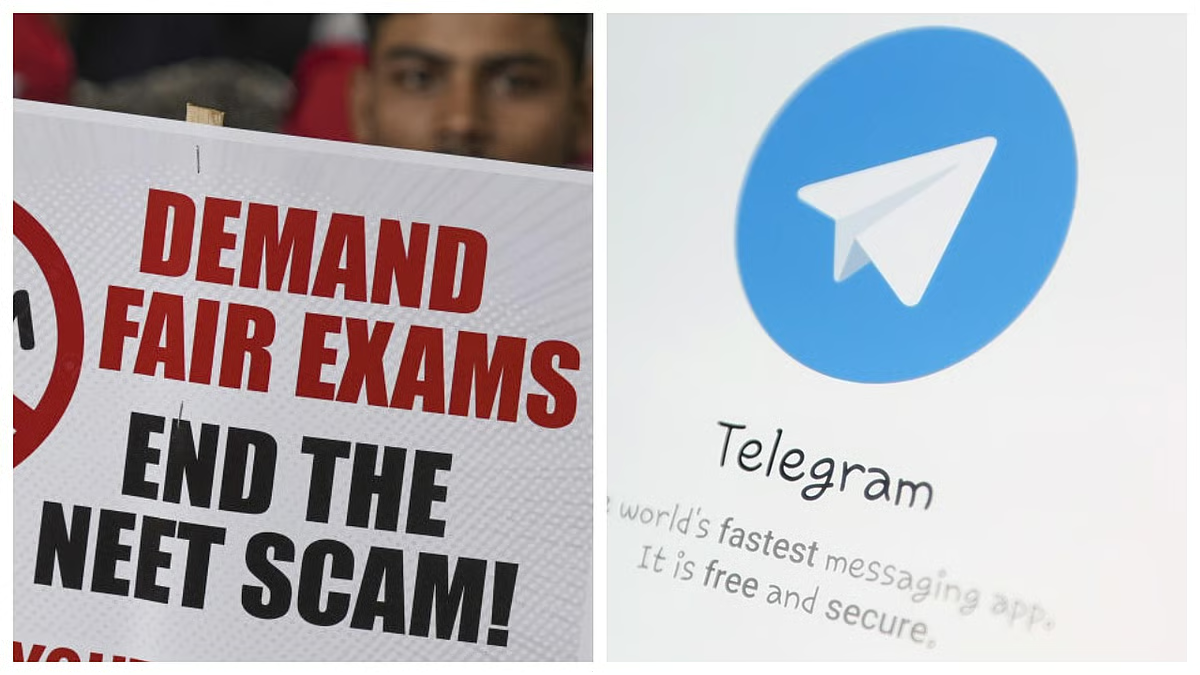
panic can make government bodies do peculiar things. When the National Testing Agency found itself drowning under the weight of its paper leaks, the pressure on authorities to demonstrate action was huge. Millions of students were outraged, medical entrance system integrity was shot. As re-exam was scheduled on 21st June, the govt required a concrete ‘win’. Their target was the messaging app, Telegram.
Using its sweeping powers under Section 69A of the Information Technology Act, the Ministry of electronics and Information Technology blocked access to Telegram, affecting around 150 million Indians up until June 22. The platform was also ordered to disable its message-editing feature throughout the country, up until the end of the month. The justification that was offered by the state authorities was perfectly solid as far as the papers and print-outs on the desk were concerned. Open channels named “Private Mafia” or “PAPER LEAKED NEET” were run by cyber fraudsters demanding huge sums of money in exchange for bogus access to the exam papers.
However, to bring the whole network down just to catch a few scamsters is a legal red flag in itself. Telegram immediately went to the Delhi High Court, not just for the lost business, but for a more fundamental constitutional issue, namely, a doctrine which curbs arbitrary actions by the state – the Doctrine of Proportionality.
Sledgehammer for a Sledgehammer Problem
to understand why the ban is so legally treacherous, we must turn to how courts analyze government limitations imposed on fundamental rights. The Supreme Court clearly elucidated this in the landmark Puttaswamy privacy judgment and also in the Anuradha Bhasin case with regard to internet shutdowns.
The doctrine of proportionality can be explained as the constitutionality stress-test: four things must be satisfied if a state imposes limits on a fundamental right. Firstly, a state must show that the state’s goal was legitimate, secondly, it must prove that the method used was adequate to achieve the end, thirdly, it must be necessary in that there were no less intrusive alternatives and fourthly, the good resulting from the action must outweigh the evil inflicted on the citizenry.
The Telegram ban begins to look terribly fragile on exactly this third point.
No one is contesting the legitimacy of the state’s goal to ensure a secure national exam, and it is here that things gets sticky. The state had played ‘whack-a-mole’ with numerous groups and channels trying to spread fake question papers across hundreds of groups and channels with the Indian Cyber Crime Coordination Centre taking them down. When they discovered their efforts were futile, they declared the blanket ban as the last resort. As the state would put it, to protect the public order, there was no less invasive alternative other than taking the platform offline altogether.
Telegram disagrees completely. In their legal brief, they claim that complete blackouts of massive online platforms without giving the platform a hearing at the very least constitute “disproportionate”. As they had developed and deployed AI technology that deleted over 900 illegal links associated with exam materials and Pavel Durov, CEO of Telegram highlighted in his tweet: The syndicate doesn’t cease to exist just because the state shuts down Telegram, the hackers simply find their way to WhatsApp, signal, or underground forums, leaving millions of students who may or may not use Telegram, but who are studying the same thing for the same exam, to pay for the system’s inherent structural problems.
The Illusion of a time-stamp
The one point the state is perhaps relying most heavily on is the specific software functionality which, when exploited, creates an optical illusion in the mind of the average internet user. Scammers used the Telegram’s editing function as a perfect vehicle for fabricated evidence and disinformation.
The mechanism of fraud works thus: the administration of a channel posts a mundane welcome message days before the exam is set to begin. On the completion of the test and after the genuine question paper has leaked, this previous message is amended by swapping out the text with a scanned PDF of the leaked exam paper. The original time stamp remains, and with this edited message, an immediate look of undeniable proof emerges – that the question paper was indeed leaked days earlier and for a steep price. This artificially inflates the cost for future tests and breeds further outrage.
The order that they imposed for freezing the edit function is a surgical, and more importantly, system-wide intervention that directly combats this one specific mechanic of fraud, however a total platform blackout combined with this targeted strike does begin to severely damage the proportionality claim. If the edit button does its job to prevent fabricated evidence on Telegram, then a complete server shutdown for everyone who uses the platform for regular, honest communication does not seem to be the most proportional step.
A symptom of much deeper Administrative decay
The politics of this ban lie not in securing future tests, but in moving away attention from the very real issues and the system’s failings and security flaws which facilitated the paper leaks in the first place. Paper leaks do not emerge from server room files; they do not miraculously come from the cloud or cyber-space. Paper leaks do not appear from the depths of the digital world. They originate in a printing press, during transportation and crucially, within physically secure locations where people in positions of power have the authority to bypass security. A Telegram channel merely serves as a postbox after the main leak has already occurred. This legal debate boils down to a case of the executive overreaching with administrative convenience and circumventing fundamental rights on the back of a genuine problem. Singling out Telegram, when equally capable platforms have not been taken offline to face a similar fate only goes against Article 14 which guards citizens from arbitrary and irrational treatment at the hand of the state. It is up to the Delhi High Court to discern whether state overreach should be tolerated given genuine problems that have crippled state administered examinations.