In November 2022, the Delhi High Court was approached by Amitabh Bachan for protection of his personality rights which included protecting his voice, image and name including variations like ‘Big B’, ‘AB’ and even ‘Bachchan’ along with his unique style of addressing his computer in KBC as ‘Computer ji’ along with ‘Lock kiya jaaye’ and the court granted him an ad-interim ex-parte injunction. A year later in September 2023, Anil Kapoor approached the same court for protection of his personality rights which included his distinct delivery of the word ‘Jhakkas’ along with obviously his name, persona, voice and image against various AI generated deepfakes and morphed merchandise which he argued appears to be endorsed by him and court was agreeable with this argument. And in May 2025, Sadguru Jaggi Vasudev and Ankur Warikoo got an all-encompassing dynamic injunction against AI fabrication and deepfakes. The question is no longer whether personality rights exist in India or not because one thig is clear they surely do but they came into existence by sacrificing doctrinal clarity and free speech which is guaranteed by the constitution.
The Roots of the Confusion
The personality rights river in India has an awkward beginning. In Phoolan Devi v. Shekhar Kapoor (1995), the Delhi High Court held that the depiction of rape of Phoolan Devi’s rape in a film violated and went way beyond the consent she had given for the film and that it clearly violates her right to privacy under Article 21. The decision aimed to protect the dignity of the applicant but the language it used stretched the use case of this judgment way beyond the intend and included control over how one’s identity is represented which subtly transformed into representational control. In ICC Development v. Arvee Enterprises (2003) then declared that the right of publicity had “evolved from the right of privacy” and could inhere only in an individual. Later on in 2010’s case of D.M. Entertainment v. Baby Gift House molded dignity into market control, locating the right in an individual’s autonomy “to permit or not permit the commercial exploitation of his likeness”. While in Shivaji Rao Gaikwad v. Varsha Productions (2015) the court restrained unauthorized use of Rajinikanth’s name even without consumer confusion. Then, in a direct contradiction, Gautam Gambhir v. D.A.P. & Co. (2017) refused relief for unauthorized use of the cricketer’s name in a restaurant, demanding evidence of consumer confusion the exact opposite stance.
The landmark judgment of KS Puttaswamy delivered by the Supreme Court furthered this divide the concurring opinion given by Justice Sanjay Kishan Kaul whose sum and substance is that publicity rights fall within the ambit of privacy, citing US’s judgment of Haelan Laboratories v. Topps Chewing Gum. Post this, High court’s have repeatedly invoked this consent-based logic of privacy and transplanted it into confusion-based logic of Intellectual Property Law. The result is quite in front of us that the mere identifiability of a celebrity is equated with breach of intellectual property law and the central test which is consumer confusion is conveniently ignored or is diluted.
The Anil Kapoor Order: A Broad Canvas Without a Frame
The Anil Kapoor v. Simply Life India & Ors. order (September 2023) is arguably the most ambitious of the recent batch. Justice Prathiba M. Singh’s order traversed the entire spectrum of a celebrity’s persona name, voice, image, likeness, manner of speaking, gestures, and even a slang catchphrase. The court observed:
“Fame can come with its own disadvantages. This case shows that reputation and fame can transcend into damaging various rights of a person including his right to livelihood, right to privacy, right to live with dignity within a social structure, etc. There can be no doubt that free speech in respect of a well-known person is protected in the form of right to information, news, satire, parody that is authentic, and also genuine criticism. However, when the same crosses a line, and results in tarnishment, blackening or jeopardises the individual’s personality, or attributes associated with the said individual, it would be illegal.”
The language is expansive and generously worded, but it raises as many questions as it purports to answer. Where, in the first instance, did the Court get the idea that there is such a “line” that satire or parody cannot cross, and who is to say where that line is drawn? The Court provided no metric whatsoever by which genuinely critical speech was to be distinguished from outright defamation. It simply asserted that because the offending use was “offensive,” the entire gamut of personality rights protection should be mustered in response. In addition, the Court failed to distinguish among privacy, trademark dilution, tarnishment, passing off, and constitutional personality rights conflating them all into a potpourri of vaguely worded injunctions, none of which actually find explicit grounding in any specific law. Most worryingly of all, the injunction misleads by suggesting that all sixteen of the named defendants are being permanently restrained from using Kapoor’s name, image, likeness, and voice in any manner, medium, or technological platform using “technological means such as Artificial Intelligence, Machine Learning, deep fakes, face morphing, GIFs either for monetary gains or otherwise.” The phrase “or otherwise” is doing a lot of work in this sentence and not in the best interests of free speech, criticism, and parody, either.
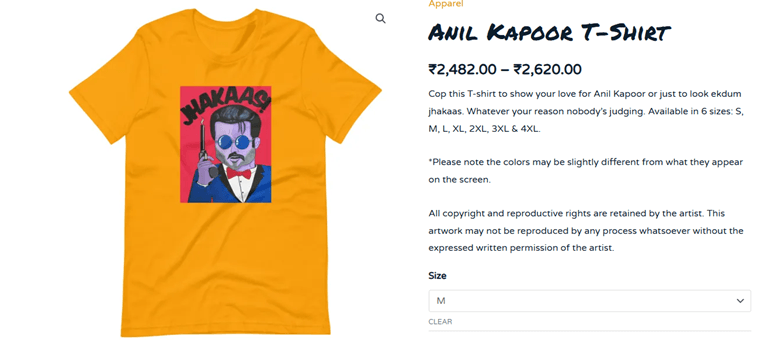
Other then the highlighted problems one more issue which the court is not addressing in these sweeping injunctions is that how these orders will work out in the real world. For example – the T-shirt which the court prohibited from being circulated is still available at the manufacturer’s website.
The Rajat Sharma Injunction: When Satire Meets Ex-Parte Speed
If the Anil Kapoor order was overbroad, the Delhi High Court’s May 2024 order in Independent News Service Pvt. Ltd. v. Ravindra Kumar Choudhary was arguably worse, as it targeted satirical expression directly. Rajat Sharma, editor-in-chief of India TV, had sued a self-professed political satirist over his use of the marks “Jhandiya TV” and “Baap ki Adalat” as parodic variations of “India TV” and “Aap ki Adalat.” The Court issued an ex-parte ad interim injunction restraining the defendant from “using [Sharma’s] photograph, video and name … either as trademark/logo/trading style, domain name, social media posts, audio video content, or in relation to any services” on grounds of passing off, finding a prima facie case, balance of convenience in favour of the plaintiff, and irreparable harm – the standard three-factor test but without any consideration for the possibility that the defendant’s use could be parody, which the Court had recently held to be protected in similar contexts with Jackie Shroff and Amitabh Bachchan.
The irony is indeed bitter. In the Jackie Shroff case itself the court had noted that, “parody is part of a developing comedic genre that uses the personality of the celebrities to create some humorous content” and that “such content is a livelihood for the young”. Further, in the Amitabh Bachchan case the court ruled that the mimicry artists were protected by the Right to Freedom of Expression and not prevented from doing so by the trademark laws. It is surprising then that the Rajat Sharma issue did not trigger similar considerations in the court. The Court did not explore the possibility of invoking the principle of nominative fair use which is embodied in Section 30 of the Trademarks Act, 1999. This provides that a registered trademark “may be used by any person to describe his goods or services, if such use is necessary to indicate the plaintiff’s goods or services.. or where the use of the trademark by the plaintiff himself is not feasible”.
“Baap Ki Adalat” is not a trademark infringement as it does not seek to mislead or confuse the public into believing that it comes from the plaintiff when in fact it does not but merely uses the celebrity persona for satire as a means to reach out to the audience in a humorous way. By equating a spoof with counterfeiting the Court committed an error.
Sadhguru and Ankur Warikoo: Dynamic Injunctions, Static Reasoning
The May 2025 orders in Sadhguru Jaggi Vasudev v. Igor Isakov and Ankur Warikoo v. John Doe, represent the cutting edge of artificial intelligence (AI) generated “deepfakes” in impersonation context. In both cases, the deepfakes did actual harm – the fraudulently generated videos purportedly from Ankur Warikoo were promoting fraudulent investment schemes, while AI-altered videos/images of Sadhguru were being used to market products and services and facilitate financial frauds. The Courts also went further in both cases, by granting dynamic injunctions, which allow the plaintiff to notify the court whenever new infringing material appears online, and get it taken down within thirty-six hours, without having to return to Court every single time. In particular, the Court in Sadhguru case held that “the said content, if not removed, would soon start circulating like a pandemic on internet/social media with wide ranging unpredictable deleterious consequences, and it would be neither practical nor feasible to expect the plaintiffs to run/chase after each one of the “unknown” defendants “rogue websites”.
The dynamic injunction is a pragmatic solution that covers up a more substantial problem. Both orders fail to distinguish between commercial misappropriation of a mark (where the celebrity’s personality is exploited for the sale of a commodity) and use for expressive or transformative purpose (where a celebrity’s persona is parodied or commented on). Both the orders do not grapple with the technology at hand, beyond the superficial. In Sadhguru’s case, the complaint was about his image being used and sold as NFTs across various digital platforms. This exploitation of a personality through a new technology was not taken up by the court, which missed an opportunity to comment on the law’s response to decentralised technologies. In the case of Warikoo, while the court took up the issue of dilution of brand value and reputation, it chose to overlook a more pertinent issue of misleading the consumer – the public at large was being deceived by these deepfakes.
The Cost of Conflation
The common thread running through all of these petitions is a fundamental, often unspoken, assumption: that finding a person recognizable in the challenged material is sufficient to find infringement. By conflating recognition with unconsented usage, the reviewing courts have essentially excised a vital element of passing off/passing: the consumer’s confusion. They have blurred the lines between injuries to dignity (privacy law) and injuries to goodwill (trademark law), replaced questions of consent with questions of consumer confusion, and applied privacy logic about permission to a regime where the central issue is whether the consumer was misled. We are left with an outcome that protects celebrities at the expense of free speech and fandom, if not outright censure of fandom. And this is a problem. This is not a doctrinal or theoretical endpoint but a practical concern: that by conflating injuries to privacy with injuries to goodwill, the courts are failing to provide clear legal guidance. Lower courts (faced with similar questions) across multiple jurisdictions and dealing with similar facts have varied their answers, and the next bench to hear one of these petitions can be excused for being unsure what to do. By failing to articulate a coherent legal rationale, the Supreme Court has hampered its ability to provide consistent, clear guidance to the legal profession. Moreover, by not clearly articulating the difference between the injury to a personality right (privacy) and the injury to a property right (trademark), the Court has created a doctrinal vacuum.
I want to be clear that I am not arguing against the outcome. I believe that the outcome is correct: the petitions were improperly filed, the ex-parte orders wrongly issued, the practice of allowing celebrities to file such orders without notice and hearing is inappropriate in a democracy. I am arguing against the lack of a rationale. The Court needs to be more transparent in its decision-making around privacy/publicity law and its relationship with trademark/passing off. I am arguing that the Court needs to develop a legal rationale for choosing one framework over the other, based on either a common law or statutory basis (India does not have a general Privacy Law). I am suggesting that it articulate a coherent legal theory that provides guidance to the lower courts. Judges in India have repeatedly observed that their decisions should reflect why they reached a particular conclusion that the ratio decidendi should be clear so that future courts can follow them. There is no better time to adopt such a view in privacy/publicity law than now. With the rise of artificial intelligence, voices can be cloned, and deep-fake videos made, with minimal effort, reaching millions of views in a matter of hours. The law cannot afford to be unclear.
An unexamined life is not worth living.” – Socrates
In November 2022, the Delhi High Court was approached by Amitabh Bachan for protection of his personality rights which included protecting his voice, image and name including variations like ‘Big B’, ‘AB’ and even ‘Bachchan’ along with his unique style of addressing his computer in KBC as ‘Computer ji’ along with ‘Lock kiya jaaye’ and the court granted him an ad-interim ex-parte injunction. A year later in September 2023, Anil Kapoor approached the same court for protection of his personality rights which included his distinct delivery of the word ‘Jhakkas’ along with obviously his name, persona, voice and image against various AI generated deepfakes and morphed merchandise which he argued appears to be endorsed by him and court was agreeable with this argument. And in May 2025, Sadguru Jaggi Vasudev and Ankur Warikoo got an all-encompassing dynamic injunction against AI fabrication and deepfakes. The question is no longer whether personality rights exist in India or not because one thig is clear they surely do but they came into existence by sacrificing doctrinal clarity and free speech which is guaranteed by the constitution.
The Roots of the Confusion
The personality rights river in India has an awkward beginning. In Phoolan Devi v. Shekhar Kapoor (1995), the Delhi High Court held that the depiction of rape of Phoolan Devi’s rape in a film violated and went way beyond the consent she had given for the film and that it clearly violates her right to privacy under Article 21. The decision aimed to protect the dignity of the applicant but the language it used stretched the use case of this judgment way beyond the intend and included control over how one’s identity is represented which subtly transformed into representational control. In ICC Development v. Arvee Enterprises (2003) then declared that the right of publicity had “evolved from the right of privacy” and could inhere only in an individual. Later on in 2010’s case of D.M. Entertainment v. Baby Gift House molded dignity into market control, locating the right in an individual’s autonomy “to permit or not permit the commercial exploitation of his likeness”. While in Shivaji Rao Gaikwad v. Varsha Productions (2015) the court restrained unauthorized use of Rajinikanth’s name even without consumer confusion. Then, in a direct contradiction, Gautam Gambhir v. D.A.P. & Co. (2017) refused relief for unauthorized use of the cricketer’s name in a restaurant, demanding evidence of consumer confusion the exact opposite stance.
The landmark judgment of KS Puttaswamy delivered by the Supreme Court furthered this divide the concurring opinion given by Justice Sanjay Kishan Kaul whose sum and substance is that publicity rights fall within the ambit of privacy, citing US’s judgment of Haelan Laboratories v. Topps Chewing Gum. Post this, High court’s have repeatedly invoked this consent-based logic of privacy and transplanted it into confusion-based logic of Intellectual Property Law. The result is quite in front of us that the mere identifiability of a celebrity is equated with breach of intellectual property law and the central test which is consumer confusion is conveniently ignored or is diluted.
The Anil Kapoor Order: A Broad Canvas Without a Frame
The Anil Kapoor v. Simply Life India & Ors. order (September 2023) is arguably the most ambitious of the recent batch. Justice Prathiba M. Singh’s order traversed the entire spectrum of a celebrity’s persona name, voice, image, likeness, manner of speaking, gestures, and even a slang catchphrase. The court observed:
“Fame can come with its own disadvantages. This case shows that reputation and fame can transcend into damaging various rights of a person including his right to livelihood, right to privacy, right to live with dignity within a social structure, etc. There can be no doubt that free speech in respect of a well-known person is protected in the form of right to information, news, satire, parody that is authentic, and also genuine criticism. However, when the same crosses a line, and results in tarnishment, blackening or jeopardises the individual’s personality, or attributes associated with the said individual, it would be illegal.”
The language is expansive and generously worded, but it raises as many questions as it purports to answer. Where, in the first instance, did the Court get the idea that there is such a “line” that satire or parody cannot cross, and who is to say where that line is drawn? The Court provided no metric whatsoever by which genuinely critical speech was to be distinguished from outright defamation. It simply asserted that because the offending use was “offensive,” the entire gamut of personality rights protection should be mustered in response. In addition, the Court failed to distinguish among privacy, trademark dilution, tarnishment, passing off, and constitutional personality rights conflating them all into a potpourri of vaguely worded injunctions, none of which actually find explicit grounding in any specific law. Most worryingly of all, the injunction misleads by suggesting that all sixteen of the named defendants are being permanently restrained from using Kapoor’s name, image, likeness, and voice in any manner, medium, or technological platform using “technological means such as Artificial Intelligence, Machine Learning, deep fakes, face morphing, GIFs either for monetary gains or otherwise.” The phrase “or otherwise” is doing a lot of work in this sentence and not in the best interests of free speech, criticism, and parody, either.
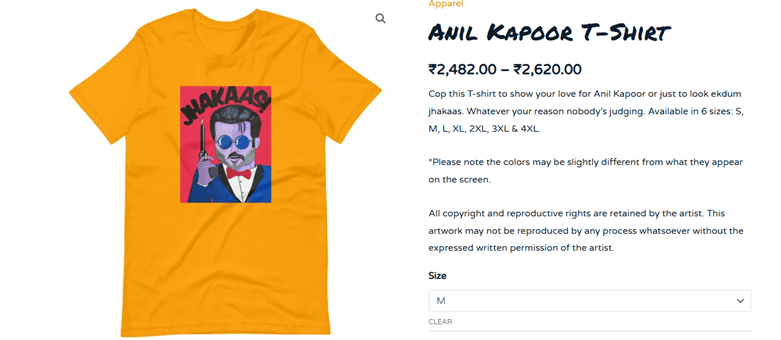
Other then the highlighted problems one more issue which the court is not addressing in these sweeping injunctions is that how these orders will work out in the real world. For example – the T-shirt which the court prohibited from being circulated is still available at the manufacturer’s website.
The Rajat Sharma Injunction: When Satire Meets Ex-Parte Speed
If the Anil Kapoor order was overbroad, the Delhi High Court’s May 2024 order in Independent News Service Pvt. Ltd. v. Ravindra Kumar Choudhary was arguably worse, as it targeted satirical expression directly. Rajat Sharma, editor-in-chief of India TV, had sued a self-professed political satirist over his use of the marks “Jhandiya TV” and “Baap ki Adalat” as parodic variations of “India TV” and “Aap ki Adalat.” The Court issued an ex-parte ad interim injunction restraining the defendant from “using [Sharma’s] photograph, video and name … either as trademark/logo/trading style, domain name, social media posts, audio video content, or in relation to any services” on grounds of passing off, finding a prima facie case, balance of convenience in favour of the plaintiff, and irreparable harm – the standard three-factor test but without any consideration for the possibility that the defendant’s use could be parody, which the Court had recently held to be protected in similar contexts with Jackie Shroff and Amitabh Bachchan.
The irony is indeed bitter. In the Jackie Shroff case itself the court had noted that, “parody is part of a developing comedic genre that uses the personality of the celebrities to create some humorous content” and that “such content is a livelihood for the young”. Further, in the Amitabh Bachchan case the court ruled that the mimicry artists were protected by the Right to Freedom of Expression and not prevented from doing so by the trademark laws. It is surprising then that the Rajat Sharma issue did not trigger similar considerations in the court. The Court did not explore the possibility of invoking the principle of nominative fair use which is embodied in Section 30 of the Trademarks Act, 1999. This provides that a registered trademark “may be used by any person to describe his goods or services, if such use is necessary to indicate the plaintiff’s goods or services.. or where the use of the trademark by the plaintiff himself is not feasible”.
“Baap Ki Adalat” is not a trademark infringement as it does not seek to mislead or confuse the public into believing that it comes from the plaintiff when in fact it does not but merely uses the celebrity persona for satire as a means to reach out to the audience in a humorous way. By equating a spoof with counterfeiting the Court committed an error.
Sadhguru and Ankur Warikoo: Dynamic Injunctions, Static Reasoning
The May 2025 orders in Sadhguru Jaggi Vasudev v. Igor Isakov and Ankur Warikoo v. John Doe, represent the cutting edge of artificial intelligence (AI) generated “deepfakes” in impersonation context. In both cases, the deepfakes did actual harm – the fraudulently generated videos purportedly from Ankur Warikoo were promoting fraudulent investment schemes, while AI-altered videos/images of Sadhguru were being used to market products and services and facilitate financial frauds. The Courts also went further in both cases, by granting dynamic injunctions, which allow the plaintiff to notify the court whenever new infringing material appears online, and get it taken down within thirty-six hours, without having to return to Court every single time. In particular, the Court in Sadhguru case held that “the said content, if not removed, would soon start circulating like a pandemic on internet/social media with wide ranging unpredictable deleterious consequences, and it would be neither practical nor feasible to expect the plaintiffs to run/chase after each one of the “unknown” defendants “rogue websites”.
The dynamic injunction is a pragmatic solution that covers up a more substantial problem. Both orders fail to distinguish between commercial misappropriation of a mark (where the celebrity’s personality is exploited for the sale of a commodity) and use for expressive or transformative purpose (where a celebrity’s persona is parodied or commented on). Both the orders do not grapple with the technology at hand, beyond the superficial. In Sadhguru’s case, the complaint was about his image being used and sold as NFTs across various digital platforms. This exploitation of a personality through a new technology was not taken up by the court, which missed an opportunity to comment on the law’s response to decentralised technologies. In the case of Warikoo, while the court took up the issue of dilution of brand value and reputation, it chose to overlook a more pertinent issue of misleading the consumer – the public at large was being deceived by these deepfakes.
The Cost of Conflation
The common thread running through all of these petitions is a fundamental, often unspoken, assumption: that finding a person recognizable in the challenged material is sufficient to find infringement. By conflating recognition with unconsented usage, the reviewing courts have essentially excised a vital element of passing off/passing: the consumer’s confusion. They have blurred the lines between injuries to dignity (privacy law) and injuries to goodwill (trademark law), replaced questions of consent with questions of consumer confusion, and applied privacy logic about permission to a regime where the central issue is whether the consumer was misled. We are left with an outcome that protects celebrities at the expense of free speech and fandom, if not outright censure of fandom. And this is a problem. This is not a doctrinal or theoretical endpoint but a practical concern: that by conflating injuries to privacy with injuries to goodwill, the courts are failing to provide clear legal guidance. Lower courts (faced with similar questions) across multiple jurisdictions and dealing with similar facts have varied their answers, and the next bench to hear one of these petitions can be excused for being unsure what to do. By failing to articulate a coherent legal rationale, the Supreme Court has hampered its ability to provide consistent, clear guidance to the legal profession. Moreover, by not clearly articulating the difference between the injury to a personality right (privacy) and the injury to a property right (trademark), the Court has created a doctrinal vacuum.
I want to be clear that I am not arguing against the outcome. I believe that the outcome is correct: the petitions were improperly filed, the ex-parte orders wrongly issued, the practice of allowing celebrities to file such orders without notice and hearing is inappropriate in a democracy. I am arguing against the lack of a rationale. The Court needs to be more transparent in its decision-making around privacy/publicity law and its relationship with trademark/passing off. I am arguing that the Court needs to develop a legal rationale for choosing one framework over the other, based on either a common law or statutory basis (India does not have a general Privacy Law). I am suggesting that it articulate a coherent legal theory that provides guidance to the lower courts. Judges in India have repeatedly observed that their decisions should reflect why they reached a particular conclusion that the ratio decidendi should be clear so that future courts can follow them. There is no better time to adopt such a view in privacy/publicity law than now. With the rise of artificial intelligence, voices can be cloned, and deep-fake videos made, with minimal effort, reaching millions of views in a matter of hours. The law cannot afford to be unclear.