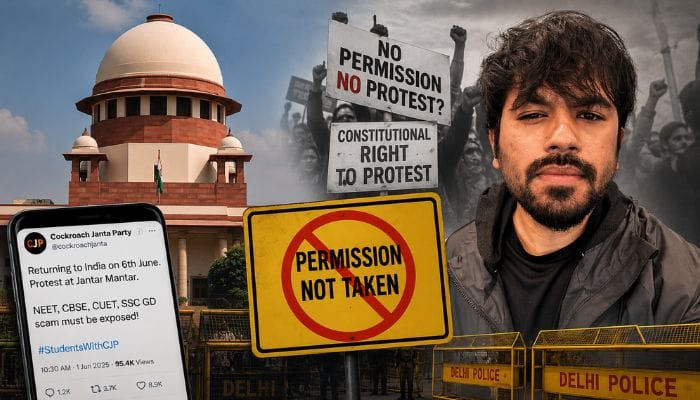
Abhijeet Dipke arrived at the Indira Gandhi International Airport early on Saturday. In his hands he had the auto-biography of B.R. Ambedkar. On a hot June 6 morning, he arrived in the city, arriving straight from Boston. Just before the plane landed on the tarmac, Dipke felt he was experiencing his last moments of freedom,” he told the press. He was sure to be arrested where he was. He instead went for a stroll and walked directly towards Jantar Mantar
His newly formed group, the Cockroach Janta Party (CJP) called for a huge assembly on one sole purpose. They were demanding the resignation of Union Education Minister Dharmendra Pradhan. This anger is due to the recent NEET paper leakage controversy and the improper functioning of CBSE on-screen marking system. Dipke is young. He is a former political communications strategist. In some way, he was able to extract a full-fledged satirical movement from the internet and bring it to the streets of the capital. And the state definitely took notice.
Delhi Police and paramilitary forces set up heavy barricades around the protest site hours before it started. Khaki uniforms could be seen all around. Security was not only tight in Delhi. In Maharashtra, police encircled Dipke’s family home in Waluj, MIDC, Chhatrapati Sambhajinagar. His parents weren’t even there. Local officers claimed the deployment was just to prevent unnecessary crowding and said they were ready to deploy more manpower if needed. With the police response so massive, there was an immediate question of how local authorities do deal with digital-first protests
Masks, flowers and sunscreen.
It was a strange but well-done event at Jantar Mantar. There were hundreds of students and young professionals who attended. Large cockroach masks were worn by many. They brought flowers. The team that had been led by Dipke had published a day-by-day manual online. It was not a political document, but a festival guide. They encouraged people to have a good breakfast; after all, for revolution, breakfast is important. They urged all to come to the park wearing sun block to work with the sun.
Most importantly, the organizers set out a set of rules to limit the police’s desire to crackdown. They were asked to bring the National Flag. They were told to not throw flowers, but to give flowers to police and thank them. They were instructed not to interact with online trolls and physical provocateurs. They were instructed to take notes on their cell phones.
Everyone came to see them stand there. Fifty year old, father of three, Radheshyam Kaithal, told reporters how rampant frauds have become in digital education. A 42-year-old Gayathri Singh spoke about her cousin, whose four-year tenure in a small room at Kota for preparing for NEET ended with the exam being spoiled due to a leak. The audience consisted of a wide variety of people ranging from tired students to concerned parents to young corporate staff members.
The Friction Point
It wasn’t silent. Delhi Police had arrested six people by mid-day. Two parties were going to meet each other and the officials intervened. The detentions were described as purely precautionary, to ensure peace. However, when people are quickly detained at what is supposed to be a peaceful gathering comes the question of legal safeguards again.
The protesters have a right to meet as outlined in the Constitution. The police are called upon to ensure peace and order. It’s a very fine divide between those two jobs at Jantar Mantar. The state had already blocked the CJP’s official X Twitter account before the protest even started, which Dipke discussed in his address to the crowd. The government spent a month hacking accounts, deleting posts, but didn’t even try to fix the broken education system, he said. You can take these posts down, you can’t take us down, he yelled into the mic.
Everything is legally dubious. Permission for protests in the capital is subject to several hurdles to clear. It is the responsibility of the organizer to ensure that there are no public disruption and crowd limitations. The CJP initially requested people to “swarm” the airport. This was altered a day later to prevent the risk of causing a public nuisance and everyone was sent to the Parliament Street Police Station. This switching may have helped them avoid charges of unlawful assembly.
The Core Demands
The movement isn’t just about the resignation of a minister. There is a press meet of the Constitution Club of India where the speakers have laid out their policy concerns. An investigative journalist and chief spokesperson of the group Saurav Das made it clear that they are asking for basic accountability.
They are outraged over the implementation of digitalization of education without proper teacher training. They are disheartened about the huge mental health crisis in the student population. Sugandha, 38, psychologist at the protest, noted that lakhs of students are living under ‘crushing’ pressure without any institutional support.
There’s also a very strong sense of frustration with the larger system problems. The current unrest in Manipur was linked to the education crisis. A 32-year-old social entrepreneur at the event, Winson described how his home state has not been working in a normal fashion for three years. Schools are closed. Colleges are paralyzed. Students are trapped. This protest grew into a general reaction to all of the young people’s complaints about the treatment of their futures. Even the education reformer Sonam Wangchuk threatened to join the protest if the education minister didn’t resign.
It’s a Test of Crowd Control!
The large number of soldiers and members of the paramilitary forces suggests the Home Ministry’s concern over this issue. Satire and true grievance is always a worry to authorities. It’s a challenge to foresee the future of a band called cockroaches.
Dipke’s tactic puts the police in a bind. But when protesters give officers flowers and carry copies of the Constitution to go with it, it looks bad in videos. And they are all recording. The CJP instructed all individuals to responsibly document the protest. This forms a huge, decentralized surveillance system that acts as a deterrent to police brutality.