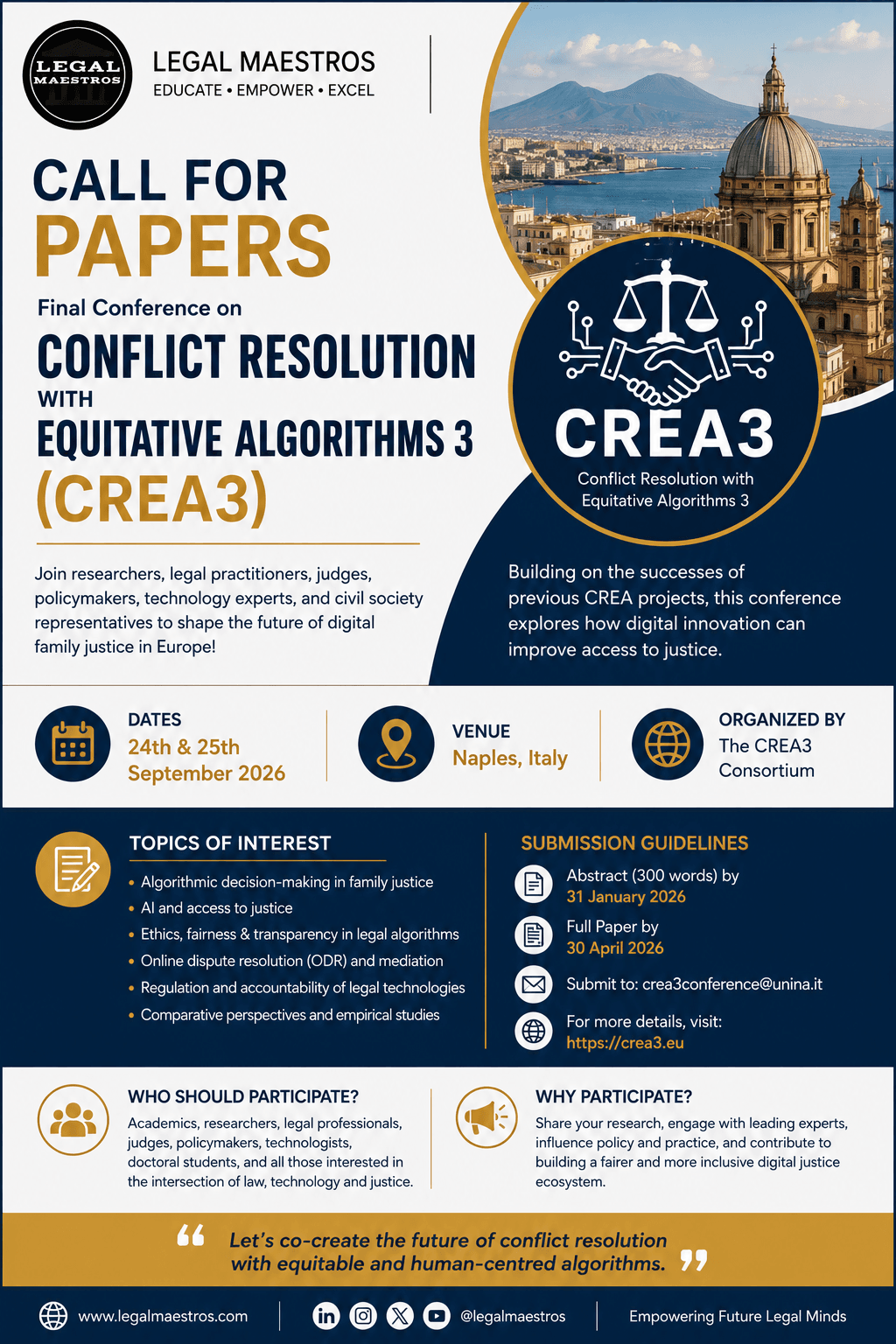
Researchers, legal professionals, judges, policymakers and technology experts working in the areas of law, technology and digital justice have an opportunity to present their research at the Final Conference on Conflict Resolution with Equitative Algorithms 3, also known as CREA3.
The conference will focus on the growing role of digital technologies in the justice system, with particular attention to family justice in Europe. The event will bring together experts from different fields to discuss how new technologies can improve access to justice while protecting fairness, fundamental rights and the interests of vulnerable people.
CREA3 Conference 2026
The CREA3 Final Conference is scheduled to take place on 24 and 25 September 2026 in Naples, Italy. The conference will provide a platform for researchers, practitioners, judges, policymakers, technology specialists and representatives of civil society to exchange ideas about the future of digital justice.
The conference builds on earlier CREA projects and aims to examine how digital innovation can support more effective and accessible systems of justice. At the same time, it will consider the legal and ethical challenges that may arise when technologies such as artificial intelligence and blockchain are introduced into judicial processes.
Areas of Research and Discussion
The organisers are inviting contributions on a wide range of topics connected with digital justice and conflict resolution.
One important area is predictive justice and AI assisted decision making. Researchers may explore how artificial intelligence can be used to support judicial decision making, predict possible outcomes and improve dispute resolution. Contributions may also examine game theoretical algorithms and the risks associated with relying on automated systems in legal processes.
The conference will also examine blockchain technology, electronic signatures and secure trust services. These technologies are increasingly relevant to digital transactions and judicial systems, particularly in relation to security, authentication and the protection of digital information.
Another area of interest is the interoperability of digital justice systems. Contributions may examine how different judicial systems can communicate with one another and how European Union rules on digital judicial cooperation can be effectively implemented.
Human centred artificial intelligence will also be an important theme. The use of AI in justice raises questions about procedural fairness, transparency, accountability and fundamental rights. Researchers are therefore encouraged to examine how technological systems can be designed and used without compromising important legal protections.
Digital inclusion and accessibility will also form part of the discussion. The conference particularly welcomes work concerning vulnerable users and the challenges they may face when accessing digital justice services. Such discussions are important because technological development should not create new barriers for people who already experience difficulties in accessing the justice system.
Opportunity for Early Career Researchers
The CREA3 conference particularly encourages early career researchers to submit their work. The Scientific Committee will provide dedicated feedback to early career participants, making the conference an opportunity not only to present research but also to receive academic guidance.
Participation in an international conference can also provide researchers with an opportunity to meet academics and professionals working in related fields. It may help participants develop research networks and receive new perspectives on their work.
Publication Opportunity
There is also a potential publication opportunity for accepted contributions. Papers presented at the conference will be considered for a special issue of the European Journal of Privacy Law & Technologies.
This makes the conference particularly relevant for researchers who are working on emerging questions involving artificial intelligence, digital technologies, privacy, fundamental rights and the future of justice.
How to Submit an Abstract
Interested researchers are required to submit an abstract of up to 500 words.
The abstract should present the main idea of the proposed contribution and clearly explain its connection with the themes of the CREA3 conference. Researchers should focus on a specific research question, argument or area of inquiry that can contribute to the wider discussion on digital family justice and technology.
The abstract should be sent by email to gioia.arnone@vub.be.
Important Deadline
The suggested deadline for submission of abstracts is 31 August 2026. The organisers have clarified that this deadline is not binding, but applicants are requested to follow it as far as possible.
The conference itself will take place on 24 and 25 September 2026 in Naples, Italy.
Who Should Apply?
The call is relevant to researchers, academics, legal practitioners, judges, policymakers, technology experts and civil society representatives interested in digital justice and conflict resolution.
It may be particularly useful for researchers working in areas such as artificial intelligence and law, family law, digital justice, legal technology, privacy, fundamental rights, blockchain, European Union law and judicial cooperation.
Why This Conference Matters
The increasing use of technology in legal systems is changing the way people interact with courts and access justice. Artificial intelligence, digital platforms, blockchain and other technologies may make legal services faster and more accessible, but they also raise important questions about fairness, accountability and human rights.
The CREA3 Final Conference provides a forum for examining these developments from different perspectives. By bringing together people from law, technology, government and civil society, the conference aims to encourage discussion about how digital justice can be developed in a way that remains fair, inclusive and centred on people.
For early career researchers in particular, the opportunity to present research, receive feedback and potentially contribute to a special journal issue makes this an important academic opportunity in 2026.