Bhopal asks pertinent question A weekend talk at a law campus in Madhya Pradesh turned into an open sermon addressing police stations and courtroom corridors in the entire nation. Speaking as the fourth Justice G P Singh Memorial Lecture at National Law Institute University in Bhopal, Supreme Court Justice Ujjal Bhuyan was not regurgitating text from legal books. He was bringing to light real-life, unnerving instances of how innocuous daily activities are morphing into criminal episodes.
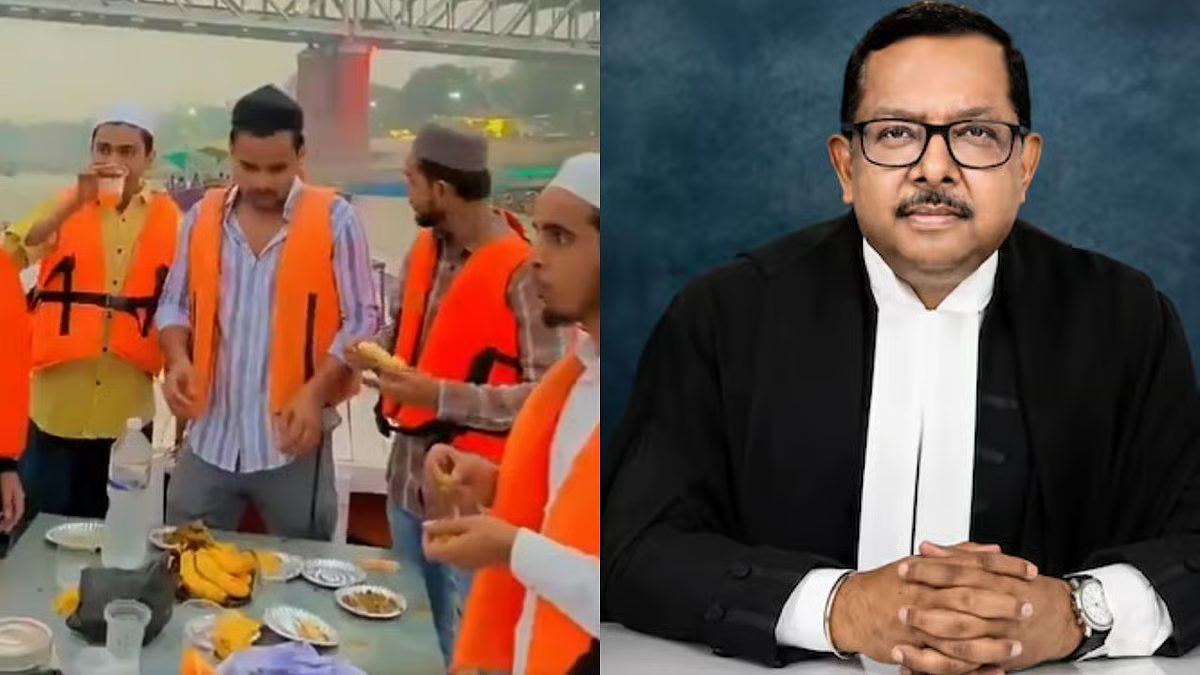
Most discussed was an account where a bunch of young lads spent close to three months in jail, incarcerated for something completely innocuous. They shared a meal on a boat. For the judge to hear of people, ordinary citizens lose their liberty for reasons wholly divorced from crimes is not something this country can gloss over. He was unequivocal in telling the law students and professors gathered that those not in courts, but on the street, and observing how our justice system reacts when an overzealous law enforcement machinery overreaches its bounds.
The Ganga Incident in March A perusal of the actual incident for which the Supreme Court judge was agitated brings one to Varanasi in March of this year. A gaggle of fourteen young Muslims had hired a boat on the sacred river Ganga and, it being the month of Ramzan and daylight fasts for these youths, sat down for their evening meal. A chicken biryani they enjoyed while floating on the waters of the Mother Ganga ended up landing them in the police chowky. Complaints had been lodged against them about consuming meat and casually throwing pieces of chicken on the waters of Ganga; to its religious followers the river represents so much more than a body of water.
The police were prompted to intervene and all fourteen youths were taken into custody. A comprehensive case document was filed, charging them under Sections 298 and 299 of the Bharatiya Nyaya Sanhita for wilfully hurting religious sentiments and promoting enmity among different groups respectively. Additionally, they were booked for creating a public nuisance, and for violating provisions of the Water Pollution Control Act. It took around three months, Ninety days, for these unfortunate youth to be granted bail, so protracted were the bail proceedings.
No Law against Eating chicken at all Justice Bhuyan dismantled the legal reasoning of these arrests. “I dare state,” the judge boomed on the stage in Bhopal, “that there is no law in the land that prevents anyone from consuming chicken while standing or travelling on the river Ganga. The question for me is, what was this investigation process like?
How on earth could any investigative agency justify lodging an offence and how on earth, in the wise of our learned judges of trial courts, could all these unfortunate young fellows be made to languish in jail for three months on the very basic premise that they ate Chicken Biryani and threw chicken bones in the river Ganges?”
Need Help With Your PhD or LLM Thesis?
Explore our thesis and dissertation writing support services for PhD and LLM students. Get subject-specific academic assistance for your research project.
Explore Our Services →He expressed surprise about how, in cases where absolutely no law has been violated and none is sought to be framed, they were being thrown into jail with the assistance of our higher courts and lower courts. It appears not too late in coming as per the Supreme Court judge, with this, the present situation that is prevailing country wide not just by a single police outpost in Varanasi. He did not see the matter as an aberration in an isolated police station’s functioning rather this a clear trend where people is being put into a category where any and any activity by the populace would be booked in some criminal section by taking advantage of a wide array of laws and restrictions. In India, he mentioned, where even innocent everyday actions seem to have become legal offences – to quote the Supreme Court – for individuals losing freedoms to the State the space for individual liberty in our country is surely contracting’.
Protesters, students thrown to jail Justice Bhuyan’s lecture also shed light on how the State tends to clamp down on protest movements. According to him, space available to dissent and disagreement is diminishing in India. University students agitating against policies and actions by universities or the government were frequently apprehended from demonstration grounds by police teams only to take days and weeks to secure bail.
“Such apprehended students,” Justice Bhuyan added, “are often treated in a manner as if they committed crimes of grave nature, such as treason, on being granted any form of liberty, many times, while they are waiting to be produced in the court, at time many University councils slap disciplinary proceedings with suspension order thereby disrupting their entire educational term for long months… Many students, while sitting in custody or while out on bail, do lose many months to the university, at time more then some months is lost…” In this context, he stated he had had occasion to express displeasure over treatment being meted to several well-meaning activists protesting environmental destruction by the State to some government enterprises such as mining or mega-corporations from the country.
They were hunted like ordinary criminals, as though their plea against environmental degradation in our country was in opposition to national interests. Many a environmental activist from various parts of country, he said, have met same faith of similar harsh treatment like college students from various parts of India’.
Problem of restrictive bail Justice Bhuyan lamented the way bail was often granted with severe restrictions, tying the release of protesters to debilitating conditions like no right to attend political meetings and no ability to air opinions on social media or express views through the print media. He wondered aloud if such conditions were sent a message by courts to those on the ground that they should remain silent on all matters related to public opinion and dissent.
Bulldozer Raj and Palestine ruling Lastly he dwelled upon two significant recent judgments. Referring to theSupreme Court in 2024, setting strict guidelines for demolitions of buildings of accused persons; it was appreciated, though JusticeBhuyan clarified the matter had been delayed by several months since a landmark was rendered two years earlier than this judgement, however, its implications in protecting the citizenry has been acknowledged. He also brought up the issue wherein Bombay High Court declined to permit organisers of a pro-Palestine rally; Justice Bhuyan stated there has been instances where even a request for a rally by pro-Palestine youth at the height of tensions between Hamas and Israel prompted the judges to ask activists from Mumbai why, exactly, are they interested in that matter? This inquiry, he argued, raised concerns about the narrowing of space for genuine concern by the populace.