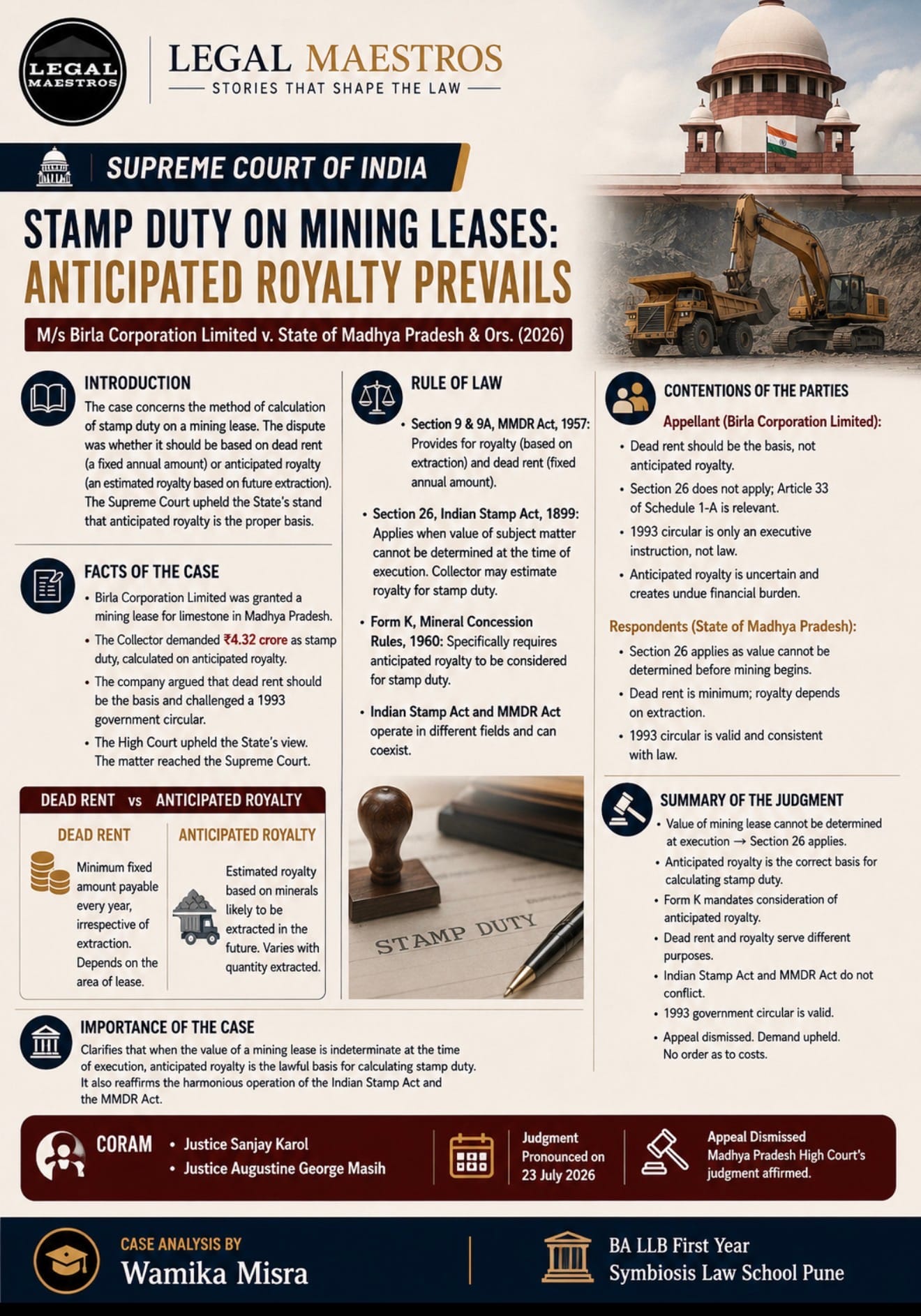
Wamika Misra
Introduction
This case deals with the calculation of stamp duty on a mining lease. A dispute arose between
M/s Birla Corporation Limited and the State of Madhya Pradesh over the method used to
calculate the stamp duty. The company believed that the calculation should be based on dead
rent, while the State Government calculated it on the basis of anticipated royalty. This
disagreement eventually reached the Supreme Court. While deciding the case, the Court
explained the difference between dead rent and royalty and interpreted the relevant provisions
of the Indian Stamp Act, the MMDR Act and the Mineral Concession Rules.
The case is important because it explains how stamp duty should be calculated when the
value of a mining lease cannot be determined at the time of execution. It also clarifies the
relationship between the Indian Stamp Act and the MMDR Act.
Facts of the Case
Birla Corporation Limited applied for a mining lease to extract limestone from an area of
56.27 hectares in Satna district, Madhya Pradesh. The State Government accepted the
application and a lease agreement was executed between the parties. Before the lease could
be registered, the District Collector directed the company to pay stamp duty of ₹4.32 crore.
The amount was calculated on the basis of anticipated royalty.
The company did not agree with this calculation. It argued that stamp duty should have been
calculated on the basis of dead rent, which is a fixed amount payable under the Mines and
Minerals (Development and Regulation) Act, 1957. According to the company, anticipated
royalty is only an estimate since mining has not started at the time the lease is executed. The
company also challenged a government circular issued in 1993 which stated that stamp duty
for fresh mining leases should be calculated on anticipated royalty.
The company first challenged the demand before the Madhya Pradesh High Court. The High
Court dismissed the petition and agreed with the stand taken by the State Government. The
company then filed an appeal before the Supreme Court. It argued that the stamp duty
demanded was much higher than what would have been payable if dead rent had been used.
The main issue before the Supreme Court was whether stamp duty should be calculated on
the basis of dead rent or anticipated royalty and whether the 1993 circular was legally valid.
Need Help With Your PhD or LLM Thesis?
Explore our thesis and dissertation writing support services for PhD and LLM students. Get subject-specific academic assistance for your research project.
Explore Our Services →Rule of Law
To decide the dispute, the Supreme Court examined the Indian Stamp Act, 1899, the Mines
and Minerals (Development and Regulation) Act, 1957 and the Mineral Concession Rules,
1960.
Section 9 of the MMDR Act provides that the holder of a mining lease has to pay royalty on
the minerals actually extracted from the leased area. Section 9A deals with dead rent. It
requires the lessee to pay a fixed amount every year. If both royalty and dead rent become
payable, the higher of the two amounts has to be paid.
The judges also referred to Section 26 of the Indian Stamp Act. This provision applies when
the value of the subject matter cannot be determined at the time the document is executed. In
mining leases, it is impossible to know in advance how much mineral will actually be
extracted. For this reason, the law permits the Collector to estimate the royalty for calculating
stamp duty.
The Court also referred to Form K under the Mineral Concession Rules. This is the standard
lease form used in mining leases. It clearly states that anticipated royalty is to be taken into
account while calculating stamp duty. Since both parties had signed the lease in this statutory
form, the Court held that they were bound by its terms.
The Supreme Court also clarified that the Indian Stamp Act and the MMDR Act deal with
different subjects. Since both laws have different purposes, they can operate together without
any inconsistency.
Meaning of Dead Rent and Anticipated Royalty
Dead rent is the minimum fixed amount that a mining company has to pay to the government
every year, even if no minerals are extracted. It depends on the area covered by the lease.
Anticipated royalty is the estimated royalty that the government expects to receive from the
minerals likely to be extracted in the future. Since mining has not started when the lease is
signed, the exact royalty cannot be known. An estimate is therefore made for calculating
stamp duty. Royalty increases with the quantity of minerals extracted.
Contentions of the Parties
Birla Corporation Limited argued that the State Government had calculated the stamp duty
incorrectly. According to the company, dead rent should have been taken as the basis because
it is a fixed amount prescribed under the MMDR Act. It also argued that Section 26 of the
Indian Stamp Act did not apply to this case and that Article 33 of Schedule 1-A of the Stamp
Act was the relevant provision for calculating stamp duty on mining leases.
The company further submitted that the 1993 government circular was only an executive
instruction and did not have the force of law. It claimed that such a circular could not override
the provisions of the Stamp Act. Another argument raised by the company was that
anticipated royalty was only an estimate based on future mining activity. Since the quantity of
minerals to be extracted was uncertain, using anticipated royalty for calculating stamp duty
would place an unnecessary financial burden on the lessee. It also argued that the proviso to
Section 26 was inconsistent with the main provision. The company therefore requested the
Court to set aside the demand.
The State Government opposed these arguments. It submitted that Section 26 of the Indian
Stamp Act specifically applies where the value of the subject matter cannot be determined at
the time a document is executed. Since mining had not started, the actual royalty could not be
calculated. The State therefore argued that anticipated royalty was the correct basis for
calculating stamp duty.
The State also explained that dead rent is only the minimum amount payable under the lease,
whereas royalty depends on the quantity of minerals extracted. It also defended the validity of
the 1993 government circular.
Summary of the Judgment
After considering the arguments of both sides, the Supreme Court dismissed the appeal and
agreed with the State Government. It held that the value of a mining lease cannot be
determined at the time the lease is executed because mining has not yet started. Since the
actual royalty is unknown at that stage, Section 26 of the Indian Stamp Act becomes
applicable. The Court also rejected the company’s argument that the proviso to Section 26
was inconsistent with the main provision.
The judgment explained that dead rent and royalty serve different purposes. Dead rent is a
fixed amount that has to be paid every year, whereas royalty depends on the quantity of
minerals actually extracted. Since the exact royalty cannot be known in advance, anticipated
royalty can be used to estimate the stamp duty.
The Court also pointed out that Form K under the Mineral Concession Rules clearly provides
that anticipated royalty should be considered while calculating stamp duty. Since both parties
had signed the lease in the prescribed statutory form, they were bound by its terms.
The Court also held that the Indian Stamp Act and the MMDR Act operate in different fields
and therefore do not conflict with each other. It also upheld the validity of the 1993
government circular. The appeal was dismissed, the demand for stamp duty based on
anticipated royalty was upheld and no order as to costs was passed.
Coram
The judgment was delivered by a Division Bench of the Supreme Court consisting of Justice
Sanjay Karol and Justice Augustine George Masih. The opinion of the Court was written by
Justice Sanjay Karol. The judgment was pronounced on 23 July 2026. The appeal filed by
M/s Birla Corporation Limited was dismissed, and the judgment of the Madhya Pradesh High
Court was affirmed.
About Author
My name is Wamika Misra, and I am currently pursuing my B.A. LL.B. (Hons.) at Symbiosis Law School, Pune. I have always been curious about how law shapes society, which is why I enjoy researching and writing on contemporary legal issues. My areas of interest include Constitutional Law, Criminal Law, Human Rights, and Public Policy. I believe that legal research is not just about understanding the law but also about questioning, analysing, and contributing to meaningful discussions. Through my work, I hope to keep learning and make a positive contribution to the legal field