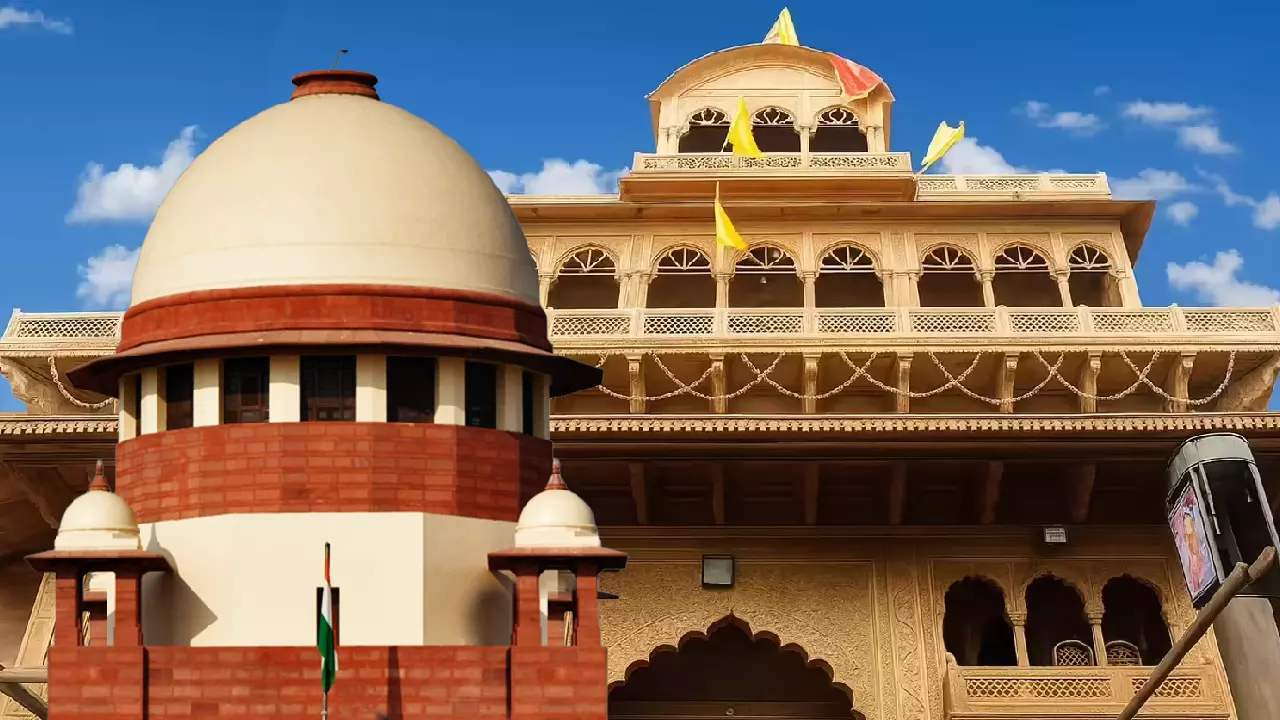
Supreme Court is attempting to unravel a very knotty situation in Vrindavan. The apex court on Tuesday got involved in the controversy surrounding the management of the well-known Banke Bihari Temple. A battle between old religion and a very contemporary issue—overwhelming crowds
The Chief Justice of India, Surya Kant and Justice Joymalya Bagchi, presided over the court. They felt that those who carry them out should be at the table. The court ordered the temple special committee which runs the temple to listen to the Goswami community.
All this chaos began last August. The Uttar Pradesh government in an attempt to assert its control over the management of the temple passed the Banke Bihari Temple Trust Ordinance, 2025. That law was suspended by the Supreme Court. Rather, they organized a strong committee headed by Justice Ashok Kumar, a retired high court judge. The issue was that the majority of the committee consisted of bureaucrats. The priests were angry. They were exiled from their own temple
Now, the Supreme Court is pushing for some compromise.
Wardens take the Priests to the Table.
For centuries, the Goswami has been serving at the temple. They are divided into various groups according to their respective responsibilities for rituals. The court instructed four members from these groups to have a say in the management committee.
The bench used a direct reference to the people. There will be 2 members representing the Shayan Bhog group. There are two who will represent the group of Raj Bhog. The names that were announced in the court were Gopesh Goswami, Himanshu Goswami, Rajat Goswami and Shailendra Goswami.
The judges were adamant that these four men need to collaborate with one another. They should put forward co-ordinated recommendations to the committee appointed by the court. The aim is to find ways of running the temple effectively, while preserving its traditions. On the record, the Chief Justice said that the committee can’t afford to ignore these suggestions. They are no longer to overlook the priests
However, a strict guideline was set. Traditions have to be carried on but there is no exploiting. The bench didn’t want anybody using these rituals to squeeze money out of the visitors or to provide special treatment to the rich devotees. VIP culture was mentioned by the Chief Justice. The status of the privileged class within the temple should not exist, he said.
The Argument Over the Clock
The main conflict between the government committee and the Goswamis was regarding the time.
Senior advocate Shyam Divan showed up in court to speak for the Goswami Samaj. He said the committee had been working to alter the daily routine of the temple to cater to the huge crowds of pilgrims in recent times. To a Bureaucrat, it makes perfect sense to extend hours. It makes the crowd a little thinner.
The priests however, it is a gigantic affront to their faith. Divan argued that the rituals done at Banke Bihari are extremely fixed. The deity is worshipped in the form of a child. The traditions include awakening the deity, feeding him and setting him to rest at very precise times. These practices are called as Rajbhog, Shayan Bhog and Vishram Kaal.
The judges were told by Divan that you cannot just alter a child’s normal sleeping routine because the line on the outside is too long. He felt that such would be practices that had been used for centuries. They should not be adjusted solely to ease the task of local police in crowd control.
A defence of the committee was made by Additional Solicitor General K M Nataraj. He said they changed the timings only due to the dangerously large crowd. But he finally came around to accepting that the panel would abide by the court’s decision on the rituals. The Supreme Court sided with the priests on this one. They commented that just leaving doors open for longer is not crowd control.
The Narrow Alleys are a reality.
The real problem is the geography of Vrindavan. The Supreme Court discussed a lot about physical space around the temple on Tuesday.
Justice Bagchi likened Banke Bihari to the gigantic Temple Complex in Tirupati. He remarked that Tirupati has an enviable location. Vrindavan does not. The Banke Bihari temple is a medium sized temple. Up to it are narrow winding streets.
The judge simply pointed out that if you would just stuff two hundred people into these alleys, the whole place would be clogged! The old fashioned technique of setting up barricades and getting people in line just doesn’t work there. The Chief Justice concurred. The congestion is permanent as long as there is no change in the physical infrastructure, he said.
The court also noted that there was a lack of basic civic sense. The judges discussed the practice of devotees in throwing garlands and garbage about the temple premises. They stated that no matter how much schedules change, it just can’t change the physical fact that there are too many in too little space.
A Massive Construction Plan is in progress.
The Supreme Court has instructed the Uttar Pradesh government to prepare the bulldozers as changing the time will not make the road safe.
The bench directed the state to come up with a comprehensive master plan for the entire area. They are interested in a wider development of the temple enclosure. This requires the purchase of land. It is to increase the width of the roads so as to prevent stampede.
The government attorney told the court a project is underway for a corridor. They’re packing a lot of ground. The State has already conducted 14 sale deeds to acquire land around the temple.
The Supreme Court was given a list of long objects to be constructed. They advised the government to make plans for hospitals, drinking water facilities and suitable restrooms. They need “waiting” rooms and “emergency” exits. They even requested state to arrange battery-operated vehicles for senior citizens to travel in the area. The state also needs to resolve how to expel the enterprising business activity and stores from the immediate gates of the temple.