.
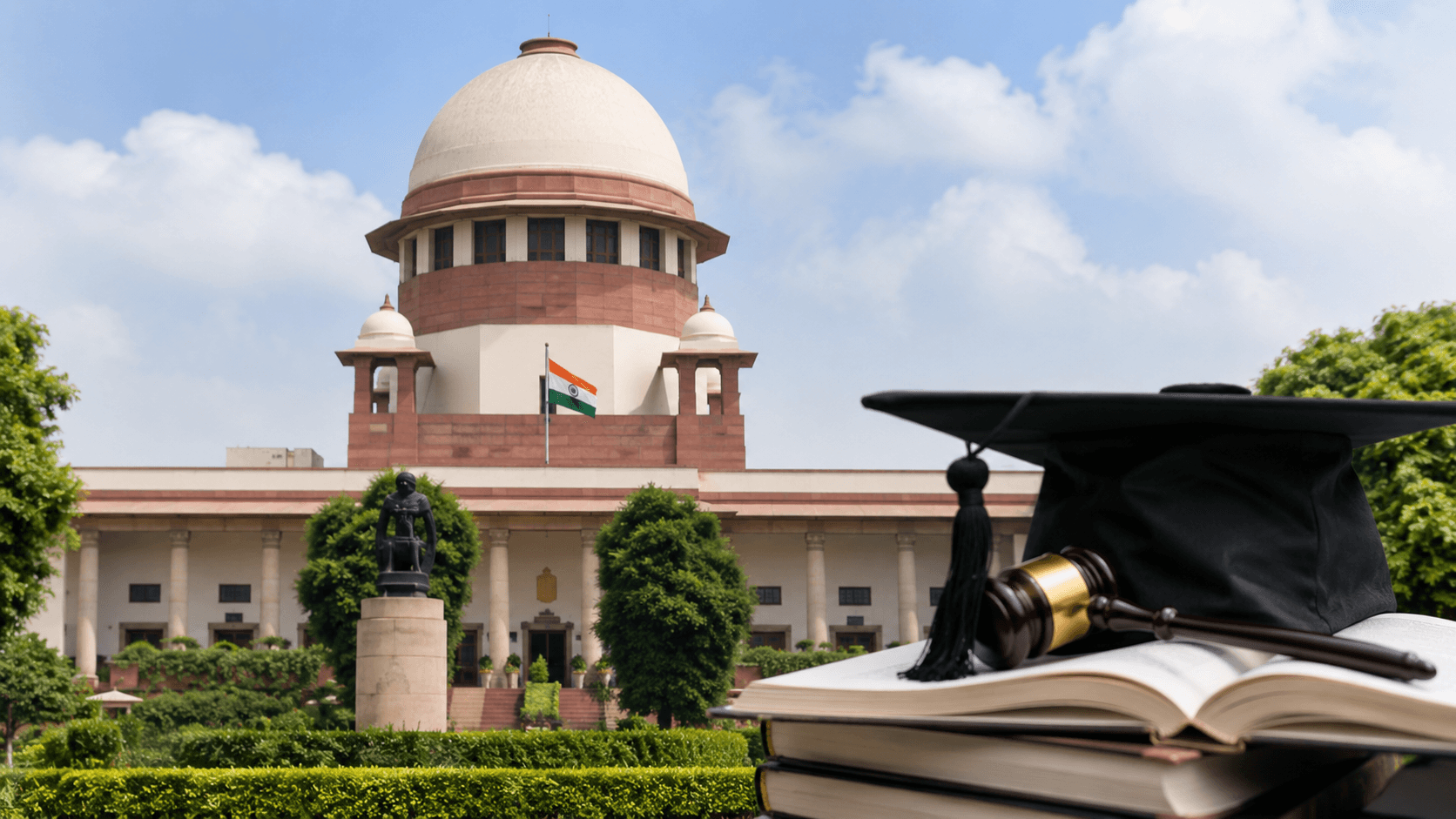
The top court on Tuesday temporarily halted an earlier controversial decision by the Delhi High Court in November which had upheld the validity of the ordinance.The top court on Tuesday put in abeyance a decision of the Delhi High Court last November which had struck down the ordinance. The lower-court decision effectively removed the ability of universities to ban students from exams because they missed too many classes. It was a great success for those who didn’t enjoy the morning lectures. It was awful, though, for college administrators. They appealed to the Supreme Court. But, now a bench of Justice Vikram Nath and Justice Sandeep Mehta has put a hold on it.
The judges were not at all happy with the condition of law colleges. Their focus was on the ramifications of the High Court’s ruling and their forecast of empty lecture halls. The bench pointed out that it seemed that institutions, namely the National Law Universities, were bleeding. They said that all of the students were now saying they don’t want to be mandated. They even mentioned that alumni who have already graduated are supporting the current students in their mission to skip class
The judges posed a very straightforward and pragmatic question. What shall the university teachers do if the students just do not come?
A Late Challenge
The Bar Council of India is the regulatory body which actually prescribes the rules for legal education. They filed a petition to set aside the High Court’s order. However, they were rather slow about it.
Need Help With Your PhD or LLM Thesis?
Explore our thesis and dissertation writing support services for PhD and LLM students. Get subject-specific academic assistance for your research project.
Explore Our Services →The Supreme Court bench was looking down on BCI chairman Manan Kumar Mishra during the hearing. He is a senior advocate of his country. The judges then pressed him for the answer directly: So why did the regulatory body take about six months to question a fundamental change in the way law schools work? It was up to Mishra to stand there and take the blame. He said that the delay amounted to a “regulatory lapse
Other big wigs lawyers were present too, representing various colleges hoping for a solution. Senior advocate Mukul Rohatgi showed up for one of the connected petitions. He was not hesitant to use words. He had informed the bench that the Delhi High Court was giving him a reward for indiscipline. He said students saw it as a license to ignore the rules and made college a hobby instead of an obligation of a learning program.
Justice Mehta appeared to concur with that. It is being perceived as a free pass to drop classes altogether, he said, as a result of the High Court’s verdict. The bench went one step further, suggesting that the lower court went beyond its jurisdiction. The justices noted that the High Court seemed to be setting aside the tenets of interpreting the law and was virtually passing a law on education from the bench.
The Ruling Wasn’t the End of the Tragedy.
In order to appreciate the November 2025 order by the Delhi High Court, it’s necessary to look at the backstory. It all began with a tragedy.
In 2017, a law student by the name Sushant Rohilla committed suicide. He was enrolled with Amity University. He was killed, and a big scandal ensued because of rumors that he was harshly bullied by the administration for his poor attendance. The university had been reporting that he was compelled to study an entire academic year in his BA LLB course as he was unable to complete the stipulated hours. His relatives and friends had said that the strict and absolute policy on school attendance had driven him to the brink
Those allegations were taken to heart by the Delhi High Court. Last year they emphasized the psychological impact of being heavily policed in the classroom. They commanded that the attendance rules be never strictly and painfully applied so as to cause great mental distress. They decided that the students of any recognized law college should not be pulled out of their exams or denied promotion on the basis of too low an attendance percentage. The High Court also instructed the Bar Council to return to the drawing board to revise its rules on mandatory attendance which would be compatible with newer, more flexible educational systems.
The Pushback from Campuses
The universities were totally stunned. Other institutions, such as Narsee Monjee Institute of Management Studies, also submitted their petitions. They had said that the High Court had opened the floodgates. Students were all but taking their colleges to court to sit for exams after barely attending classes during the semester.
The colleges relied on Rule 12 of BCI Rules on Legal Education 2008. The rules section of the book includes all of the math. Law Students must attend a minimum of 70% of the classes. A college administration may waive that requirement to 65 percent in very unusual cases. There is no lower limit.
The institutions said that studying a textbook the night before an exam is not a way to become a lawyer. They explained to the Supreme Court that the actual essence of legal education is live classroom interactions, moot court exercises and tutorials of practice. They said that if it becomes irrelevant to attend the law college in attendance, massive residential law college camp transforms itself into a very costly boarding and lodging institution.
The Immediate Future
The Supreme Court heard the terror and issued a particular interim order. They maintained the validity of paragraph 249 of the High Court decision.
But they inserted an important proviso, they said. The stay is only prospective. But it also implies that no student can be “double dipping” by getting a benefit under the court’s protection in the last several months and then be penalized by his or her college for that protection. However, the old rules will prevail in the future. The university now has the legal means to bar students from the exam hall if they miss too many classes now.