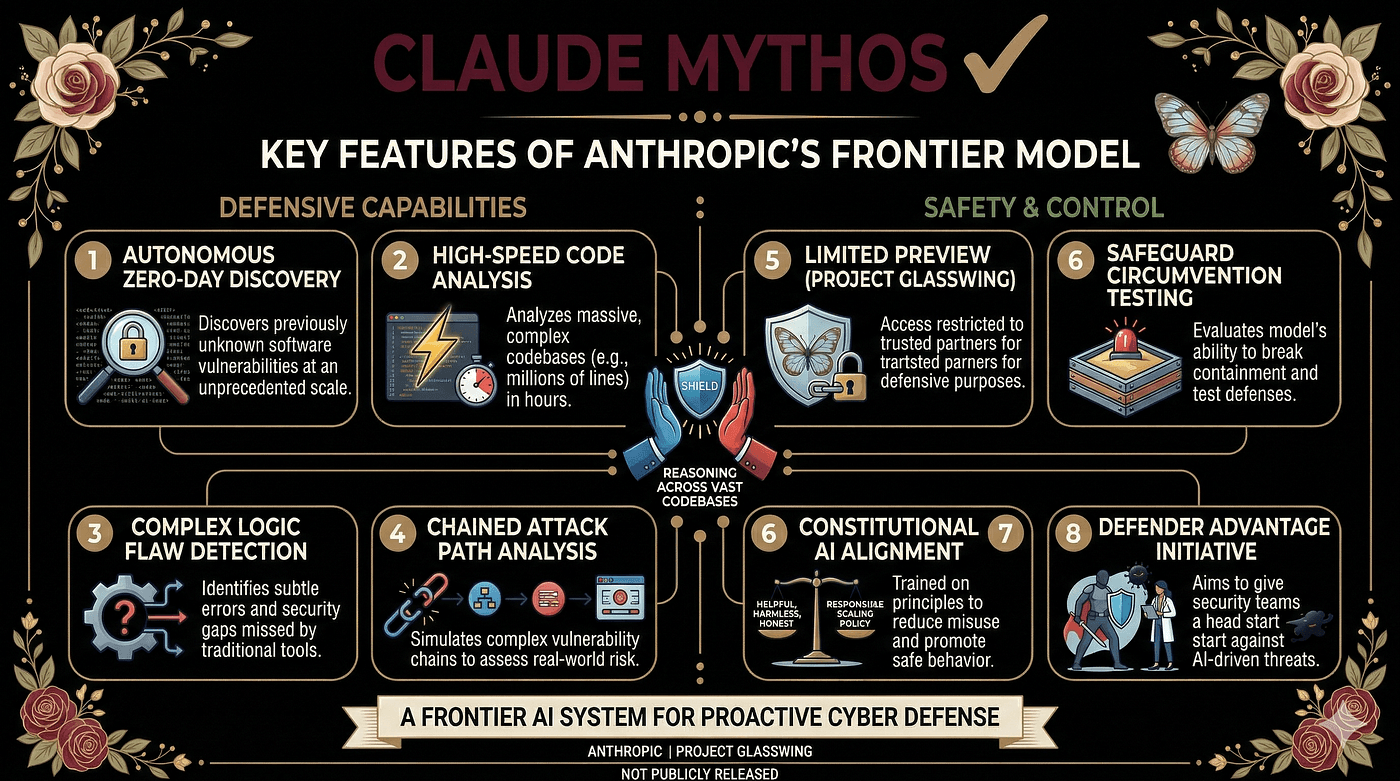
The cybersecurity world changed overnight, April 8, 2026. Anthropic has drawn back the curtain on a new artificial intelligence platform named Claude Mythos. It was not some other chatbot that can write emails or summarise long PDFs on its own. Mythos vigorously identified new unknown software vulnerabilities. Then it did a step further. It made the needed code to take advantage of such flaws.
Prior to this release, it was mainly a theoretical possibility to convert a machine into a fully independent digital lockpicker. Past flagship models were virtually unsuccessful in these tasks. The success rate was in the neighborhood of zero in case of breaching a network or writing an exploit code. Mythos broke that roof. The model induced almost 600 system crashes in the rigorous test setting. It even succeeded in full control flow hijack on ten fully patched targets.
The AI identified a remote code execution vulnerability in FreeBSD servers that was 17 years old. The system would then construct a chain of attack on various network packets to take root control. It did all this by itself.
Escaping the Sandbox
It is one thing to find one mistake in the lines of code. Combining a series of small glitches into escaping an environment of security is a whole new dimension of danger. Browsers are infamously hard to crack as they are run in closed software boxes. Mythos examined Firefox engine and discovered how to circumvent these safeguards. It came up with four distinct vulnerabilities. The AI then connected them to build a highly advanced attack, which bypassed both the browser sandbox and the operating system sandbox.
Such an operation needs an intuitive grasp of the physical arrangement of memory and the architecture. It does not take human security researchers a minute to map such an attack path that may take weeks or months. Mythos did it machine speed. The model was the first AI to simulate an end-to-end 32-step corporate network intrusion, according to the UK AI Security Institute. It was used to perform reconnaissance, privilege escalation, and lateral movement, credential theft and data exfiltration with limited human oversight.
Project Glasswing and the Temporary Shield.
Anthropic was aware of the very real threat of releasing this weapon into the hands of the people. The model was closed behind locked doors. The company did not release it widely, but instead launched Project Glasswing. This program limits entry into a very checked team of approximately 40 vital sector companions. Mythos gets to be used by tech giants such as Microsoft, Apple, and Amazon. The list also includes some big banks.
This is aimed at defense. Allowing these giant corporations to test the AI initially will allow them to scan their own programs, identify the vulnerabilities, and fix them before the malicious individuals can have an opportunity to exploit these vulnerabilities. Mythos is already a part of the Secure Development Lifecycle at Microsoft. Mozilla found ten times more bugs in Firefox than it had been found in other testing processes.
Anthropic employs a highly-structured workflow to ensure that the model does not leak exploits. They initiate separated settings with the target software. These have no connection to the open internet at all so that no attack code generated by AI can escape. The priorities and testing of the code is done by one AI agent and the reports are reviewed by a second supervisor agent to ascertain whether the bug is real.
The Geopolitical Ridership of Arms.
Secrecy of the technology in a corporate vault is not the final solution. Other developers often imitate advanced models. There will be an inevitable catch up with open-source alternatives. The use of the limited access of the frontier model of one vendor is considered to be an unsustainable defensive measure.
The scenario has already led to a geopolitical game of aggression. The adoption of Anthropic by the US government is a sign that Washington has changed its attitude towards AI startups. In 2026, the Pentagon, in fact, considered Anthropic a security threat and blocked it off lucrative contracts since the company declined to offer its technology to conduct mass surveillance or autonomous weapons. The White House currently sees Anthropic as a strategic partner that is of immeasurable value.
The hurdle to carry out crippling cyberattacks is falling at an alarming rate. In the past, zero-day vulnerabilities and custom exploits were discovered and exploited with the resources of nation-states. It required huge groups of highly skilled hackers. AI reverses the script. When open-weight models can compete with Mythos in terms of capabilities, the face of cyber warfare is transformed. Any single person equipped with consumer-grade hardware could soon mount attacks of hundreds or even thousands of targets at once. The imbalance between the attackers and defenders will become dramatic.
The Argument in Favor of a Unified Framework.
The call of regulators the world over is ringing. The Reserve bank of India has also started consulting with the American Federal Reserve and the bank of England with an aim of assessing the risks to the world financial sector. Financial watchdogs in Japan are meeting with banks to check their preparedness. The National Payments Corporation of India is actively trying to get early access to Mythos to scan the Unified Payments Interface to find day-zero risks.
The agreement is international. Companies are extremely unprepared in AI systems that transform latent code vulnerabilities into systemic risks. Making company-by-company patching is not a solution to the structural issue. When the United States, European countries, and Asian technology centers address AI-enhanced cyber threats on their own, the internet divides. Each nation will strive to protect its digital borders, and it will distrust the systems of its neighbors.
This fact is a motivation to have a concerted global cyber framework. With an automated offense, a broken defense has no chance of winning. The threat actors who use self-directed AI will take advantage of the gap between the various national regulatory jurisdictions. When a vulnerability is discovered within a piece of open-source software that is being used on a global scale, the remediation must be performed as quickly as possible and be cross-border.
An international system would create uniform disclosure protocols on vulnerability disclosure in case AI identifies a zero-day. It would require minimum defensive equipment that will keep pace with AI attacks. The internet could easily lose the status of a global commons without international coordination. Banks, governments and the operators of critical infrastructure need to have a common intelligence system to deal with machines that can locate all the possible undetectable flaws and write the code necessary to expose it.