Introduction
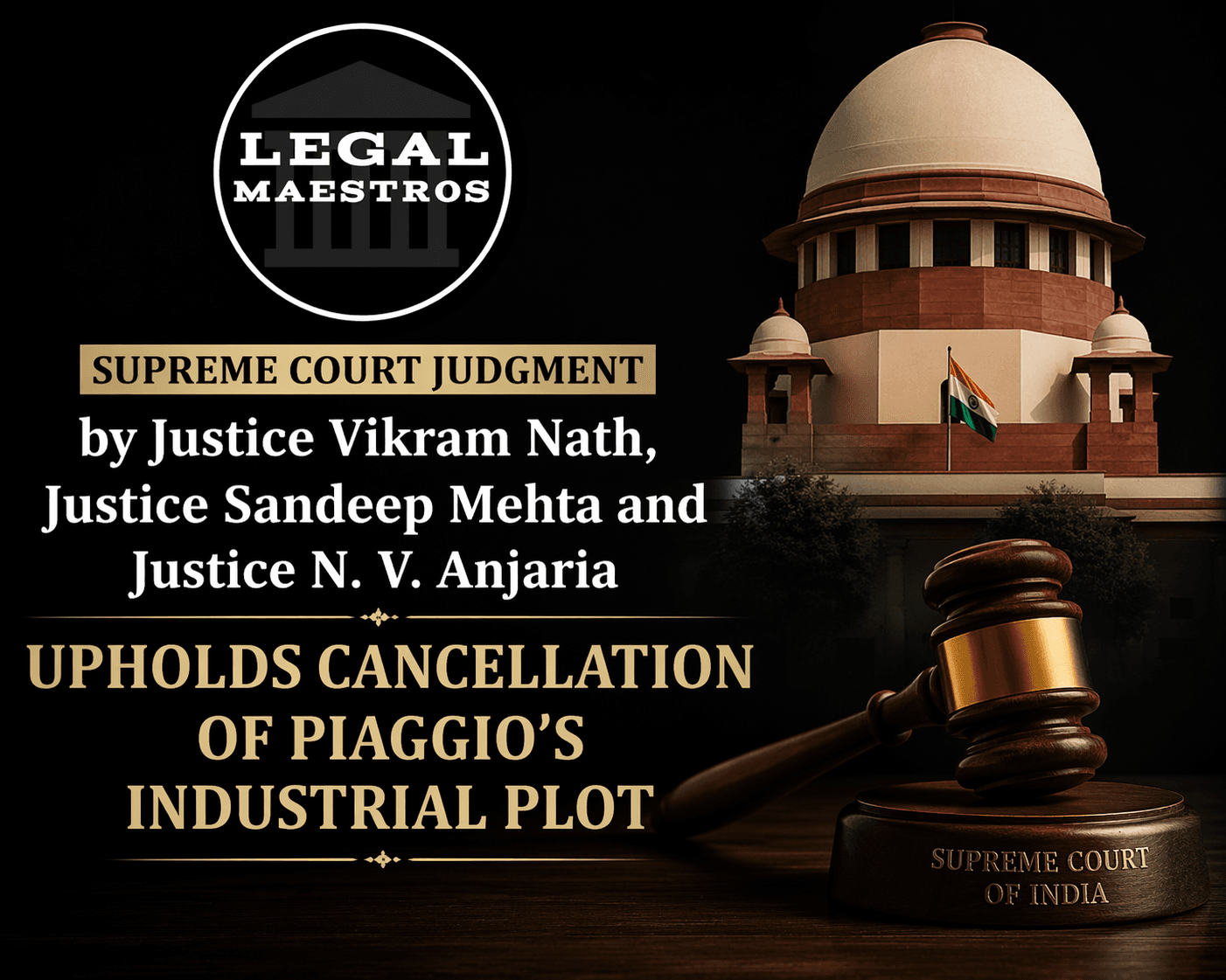
The M/s. case was a significant judgment by the Supreme Court of India. The case of Piaggio Vehicles Pvt. Ltd. vs State of U.P. and others where the cancellation of an industrial plot was made based on non-utilisation.
On 6 April 2026, a bench of Justice Vikram Nath, Justice Sandeep Mehta and Justice N. V. Anjaria passed the judgment.
The case highlights the importance of complying with conditions of industrial allotment and the limits of judicial relief.
Background of the Case
The conflict occurred when the appellant company was given an industrial plot in Surajpur, Uttar Pradesh.
The plot was leased with a provision that the company has to build its factory and begin production within a stipulated duration.
Need Help With Your PhD or LLM Thesis?
Explore our thesis and dissertation writing support services for PhD and LLM students. Get subject-specific academic assistance for your research project.
Explore Our Services →Nevertheless, the company was unable to complete the construction and even after several years, the industrial operations were not launched.
As a result, the Uttar Pradesh State Industrial Development Authority cancelled the lease and decided to take back the plot.
Events Leading to Cancellation
The company argued that it had invested funds and established a testing plant on the site.
It also claimed that it was unable to meet the deadline as it had business pressures in another plant in Maharashtra.
The company had begged several times to be given more time.
Authority accepted to entertain extension but subjected to conditions like payment of fees and affidavit.
The company was not able to provide these conditions in the necessary time.
Lastly, the authority cancelled the lease and chose to re-enter the land in August 2008.
Cases Before the High Court.
The company appealed to the High Court against the cancellation.
The High Court however declined the petition and affirmed the ruling of the authority.
Feeling aggrieved by this, the company came to the Supreme Court.
Key Case Before the Supreme Court.
The Court needed to find the answer to the following question: was the cancellation of the lease justified and did the company have a case to be made?
The Court was forced to consider whether the company had adhered to the conditions of the lease and whether the authority was fair.
Conditions of the Leases as analyzed by Court.
The Supreme Court looked at the lease contract attentively.
It observed that the lease was categorical that the company was obliged to commence construction within a limited time and commence industrial use within the required time.
The Court determined that:
The company did not implement any significant construction on the plot.
Very little of the pre-existing construction was utilized.
There was no development plan, which was submitted.
It took a long time before an attempt was made in earnest to form an industrial unit.
Failure to Comply with Extension Conditions
Another issue that the Court considered was the extension request of the company.
It found that:
The authority had given an opportunity to seek extension.
The company did not present the affidavit in the prescribed format.
The extension fee was not paid within time.
Even subsequent efforts were postponed and unsatisfactory.
The Court noted that such failures were indicative of non-seriousness of the company.
Rejection of the Arguments of the Company.
The company maintained that:
It had put money into it and provided jobs.
It was ready to establish an electric car unit.
Giving it another chance should be given.
The Court did not accept these arguments.
It held that:
They must not just intend but comply.
Long delay and failure to follow conditions cannot be ignored.
Commercial decisions by the State cannot be interfered by courts unless there are compelling reasons.
The Reason of Industrial Development.
The Court described that industrial plots are allocated in the interest of the people like economic development and job creation.
When one company fails to utilize the land appropriately, it will lock out other people.
Thus, it is required to adhere to the terms of the lease strictly.
The Court noted that the negligence on the part of allottees cannot lead to the waste of public resources.
Final Judgment
The appeal was dismissed by Supreme Court.
It upheld the cancellation of the lease and allowed the authority to take back the plot.
The Court instructed the company to deliver the possession within thirty days.
It also directed the refund of money that the company deposited in the Court with interest.
Significance of the Judgment
This verdict gives a powerful message that:
Industrial allotment conditions have to be strictly followed by companies.
Relief will not be offered by the courts in cases of apparent breach of terms.
The use of the land that is occupied by the population should be efficient and responsible.
The ruling enhances responsibility in policies of industrial development.
The Supreme Court clarified the fact that contract-related duties should not be violated.
The ruling makes it clear that the state resources are precious and cannot be possessed without any reasonable application.
This case shows the significance of discipline, responsibility, and timely action in industrial projects.
Keywords
Piaggio Vehicles, Supreme Court, case, Justice Vikram Nath, Justice Sandeep Mehta, Justice N V Anjaria, industrial plot cancellation, UPSIDA, lease violation, industrial law, public resources, contract law.