Introduction
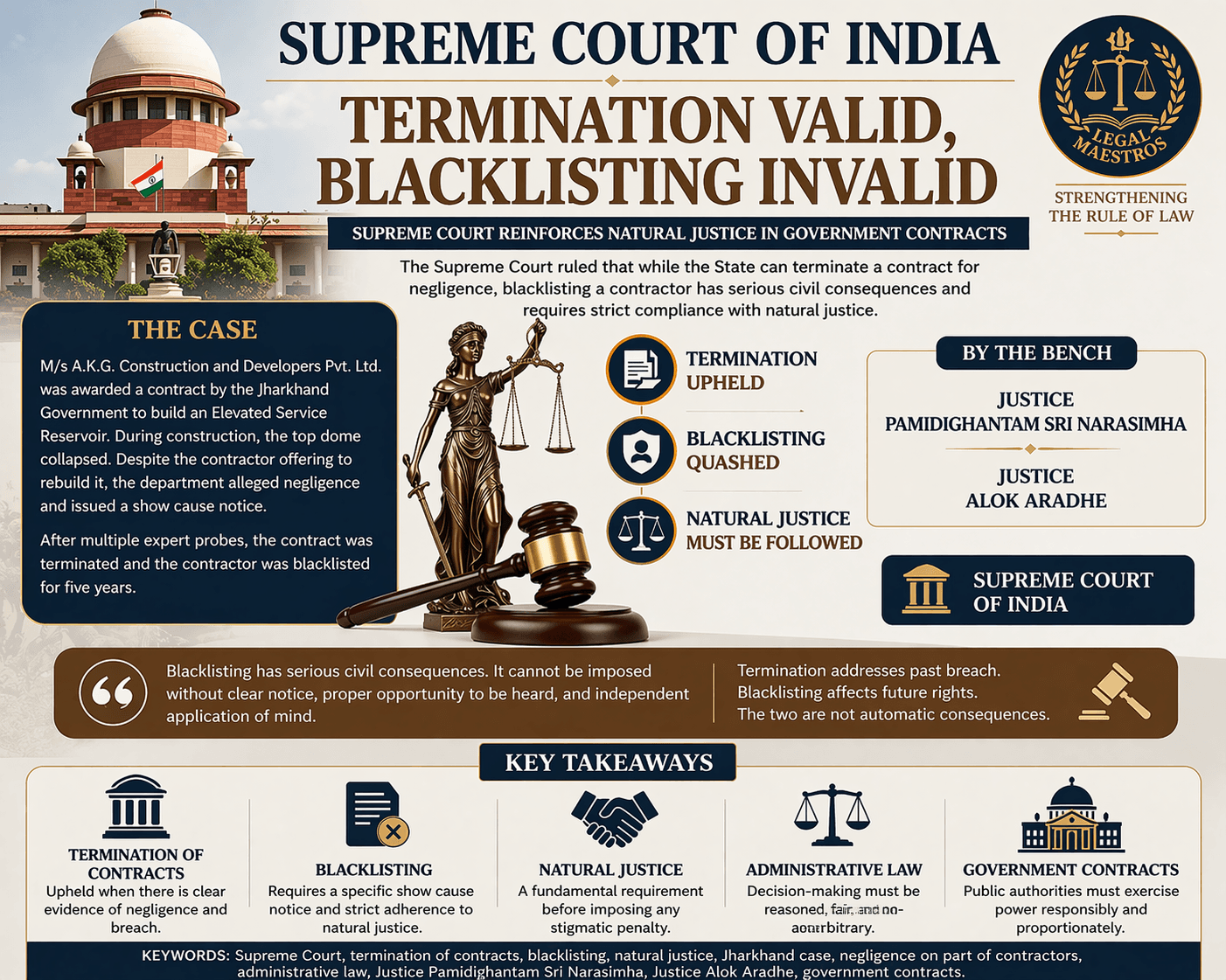
In a significant ruling, the Supreme Court of India made it clear that termination of a contract and blacklisting of a contractor are different. The case of M/s A.K.G. Construction and Developers Pvt. Ltd. vs State of Jharkhand and Ors. mentions how the government authorities should be cautious and in particular where their decisions can not only impact the current contracts but also the future of a business.
This ruling was passed by the two judges, the Justice Pamidighantam Sri Narasimha and Justice Alok Aradhe who considered whether the State was reasonable when canceling a contract and blacklisting a contractor.
The case has a history that dates back to the year 1995.
M/s A.K.G. Construction and Developers Pvt. Ltd. was an appellant who was granted a contract by the Jharkhand Government to build an Elevated Service Reservoir (water tower). The construction work commenced as planned, though something serious happened in the process.
On the 1 June 2024, the highest dome of the reservoir collapsed. The contractor insisted that this occurred as a result of a natural disaster, which is a cyclone. They even offered to reconstruct the structure at their own cost.
Nevertheless, the government was on the lookout of laxity and poor workmanship. A show cause notice was given to provide why action not to be taken against the contractor.
The departmental action and findings are described below.<|human|>The departmental action and findings are as follows.
Following the incident, several investigations were carried out. These were reports of a committee of three and institutional contributions of institutions such as IITs and Birsa Institute of Technology.
The only reports were of negligence and lack of adherence to the correct design and quality standards. Based on these findings, the department passed an order on 23 August 2024.
There were two significant effects of the order. To begin with, it ended the contract. Second, it banned the contractor a period of five years and this implied that the contractor would not be able to undertake any government work in the next five years.
The High Court proceeded to make a decision regarding the case.
The contractor appealed against this ruling in High Court. The High Court, however, rejected the petition and upheld the decision of the government. It even fined the contractor 2 lakh rupees.
The contractor approached Supreme Court thereafter.
The dispute the Supreme Court is to hear concerns the following key legal question.
The issue that the Supreme Court was looking at was whether the termination of the contract and the blacklisting of the contractor were both lawful.
The Court needed to look into the question whether due process and natural justice principles were adhered to, particularly the issue of blacklisting.
The analysis by Supreme Court on termination.
The Court closely considered the material and concluded that there was substantial evidence of the negligence of the contractor. The reports were very clear that the construction was not performed based on approved designs and quality standards.
The Court also pointed out that, the contractor was given several chances to put forward its case at various levels, some of them being before the appellate body and the High Court.
It is on this basis that the Supreme Court decided that the termination of the contract was reasonable and legally sound.
The Blacklisting Analysis by the Supreme Court.
But the Court held differing opinion in the aspect of blacklisting.
According to the judges, blacklisting is a very serious measure. It not only impacts on the current work, but also prevents a contractor to receive government contracts in future. It tarnishes reputation and business opportunities.
Due to these severe effects, the legislation mandates the adherence to principles of natural justice. This involves provision of a clear and specific show cause notice prior to blacklisting.
In this case, the Court established that the show cause notice given by the department was not appropriate to blacklist. It was not clear that it was thinking about blacklisting. It also failed to provide the contractor with a fair chance to defend itself particularly against being blacklisted.
The Court stated that termination and blacklisting are two distinct decisions. Blacklisting does not occur as an automatic consequence of termination. The authority should exercise its mind before making such a move.
Violation of Natural justice is a fact that the law has been breached.
The Court strongly noted that the natural justice principles were broken. No proper warning was given about the intention to blacklist, and the reasoning given in the final order was not clear either.
The Court cited previous cases and recited that blacklisting has civil ramifications and cannot be meted out without fairness and due process.
The Supreme Court issued its final decision.
Having looked at everything, the Supreme Court gave a fair judgment.
The Court affirmed the cancellation of the contract saying that it was founded on substantial evidence and due process.
Nonetheless, the Court enjoined the order of blacklisting. It believed the blacklisting to be capricious, illogical and unsustainable in law.
Taking into account the fact that much time had already elapsed, the Court also determined that the blacklisting was not going to be continued and would instantly terminate rather than refer the case to be re-heard.
The importance of the Judgment is as follows.
This ruling is significant since it establishes a clear division of two government powers.
Termination considers the current contract and they may be done on the grounds of breach or negligence. Blacklisting on the other hand impacts the future and should be approached with more caution.
The Court has created a powerful impact that blacklisting cannot be enforced by the authorities as a mechanical process. They should adhere to the due process, provide adequate notice and be equitable.
Conclusion
The ruling of the Supreme Court is a compromise between responsibility and justice. Although it makes the contractors accountable of low work, it also safeguards them against unjust and unreasonable punishment.
The Court has strengthened the role of natural justice in administrative decision making by maintaining termination and eliminating blacklisting. This ruling will also inform future proceedings of government contracts and hold power to exercise responsibly.
Keywords
Supreme Court, termination of contracts, blacklisting, natural justice, Jharkhand case, negligence on part of contractors, administrative law, Justice Pamidighantam Sri Narasimha, Justice Alok Aradhe, government contracts.