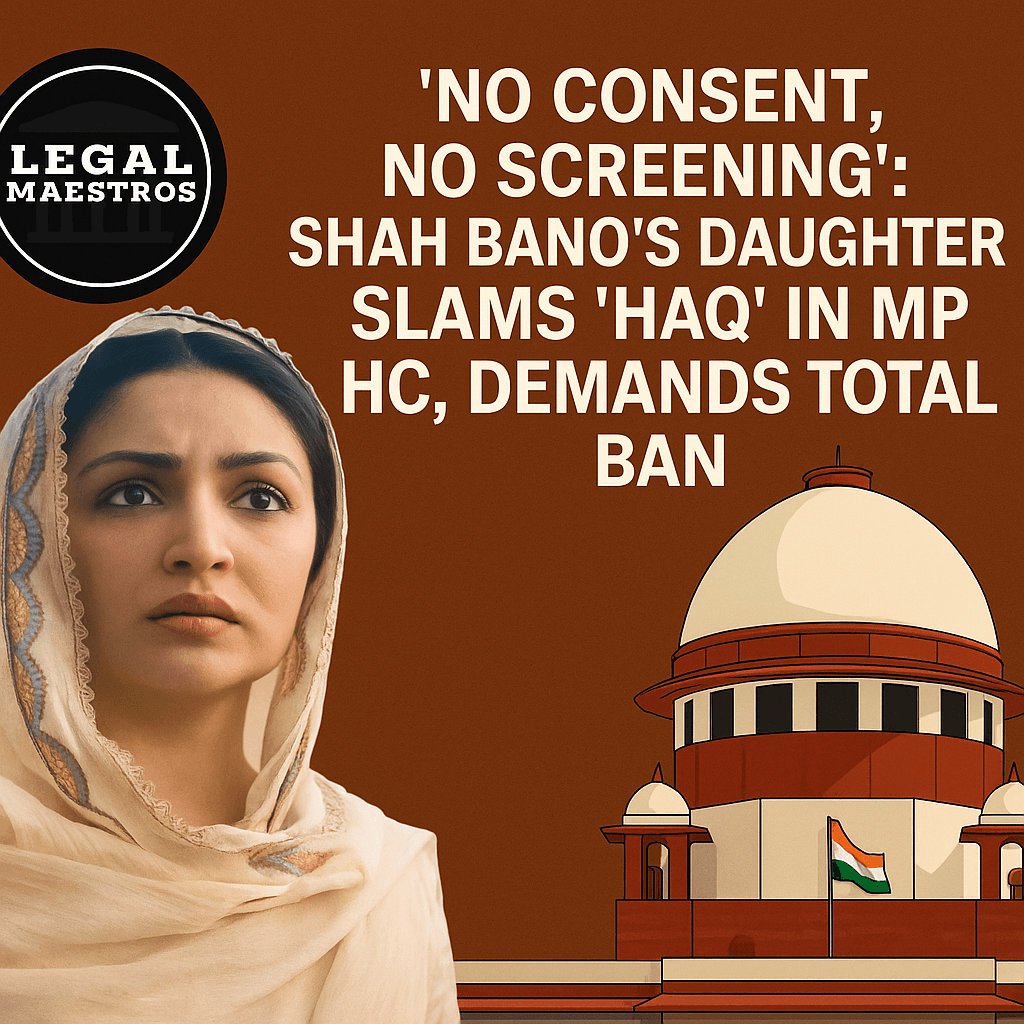
Daughter of Shah Bano Seeks an outright prohibition of a film Haq.
A new Bollywood courtroom film, ‘Haque’ has been embroiled into a severe legal tussle just days before its release. The daughter of the deceased Shah Bano, Siddiqua Begum Khan, has petitioned the Madhya Pradesh High Court to stop the film without any delay. It was petitioned in the Indore bench on the grounds that the movie is an unauthorized portrayal of the personal life of her mother and was created without her legal heirs consent.
The movie produced by Yami Gautam and Emraan Hashmi is said to be based on the famous historical case 1985 case on Supreme Court which was referred as Shah Bano case. This historic legal struggle was the turning point in the history of women rights and maintenance laws in India. The case of Siddiqua Begum presents an argument because she claims that the commercial use of her mother and her personal suffering is not only unlawful but also unethical, and extremely traumatizing to the family.
The court case is no simple controversy, but a complete criticism of the very existence of the film. The family is insisting on the total stoppage of the publication, screening, promotion, and release of the movie in all the formats. The petition cites the director of the film, Suparn S. Verma and the producers of the film, Junglee Pictures and Baweja Studios as the main parties culpable in this illegal representation.
This suit comes after a cease and desist letter had been sent to the filmmakers in October, purportedly without response on their part. The daughter of Shah Bano has stepped up the battle by petitioning the High Court to allow her to prevent the release of the film which is to be released in November 7. The case has now been left with Justice Pranay Verma who started hearing the arguments.
Prohibition: The Core Complaint: No Consent, No Screening.
The main idea behind the petition of Siddiqua Begum is the full deficiency of consent on the part of Shah Bano family. Her counsel Tousif Z. Warsi has told the media that the filmmakers did not approach the legal heirs and asked permission to tell the story of Shah Bano. The family is really very attached with the way her personal life, struggles and even personal family affairs would be depicted in a two-hour commercial film.
Plea claims that Siddiqua Begum who is the legal heir has inherited the rights of her moral and personality of her mother. They are the rights that the Indian law defends against the unauthorized commercial use of the life story, name, and even a likeness of a person. The argument of petition is that the film violates these rights and infringing on the right of the family to privacy which is a fundamental right.
Need Help With Your PhD or LLM Thesis?
Explore our thesis and dissertation writing support services for PhD and LLM students. Get subject-specific academic assistance for your research project.
Explore Our Services →Especially of concern to the family is the fictionalized aspects of the movie. They are insisting that the script and storyline of the film should be revealed to the legal heirs by the filmmakers. The fear is that during the making of a drama, the authors might have exaggerated factual happenings or characters in real life. This, the plea contends, may be defamatory and hurtful to the character and the reputation of Shah Bano and her family.
The petition is also more inclusive asserting that the film is offending the feelings of the Muslim community and may give a wrong impression of Sharia legislation. The family is saying that no editing can resolve the main issue that is the lack of permission by requesting a complete ban. They are quite categorical on the issue; no consent should mean that it should not be screened.
The Central Board of Film Certification (CBFC) was also warned by the legal notice that was sent earlier. The family has pressed the CBFC to stop or recall the censor certificate of the film. According to them, the Cinematograph Act provides that a film libeling a person or invading his privacy need not be certified to be shown in theatres, at least at a time when the family is also protesting against it.
The Filmmakers: The Filmmaker Defense Statement: Fiction.
The producers of Haq have come out and defended themselves in court in response to the legal challenge. The film-makers claim to the court through their legal representative that it is not a biopic of Shah Bano. Rather, they assert it is a fictional book that is only inspired by the historic Supreme Court ruling, which is an open document accessible to everybody.
The film makers argued that there is a definite disclaimer in the film. This, they believe, is a clear statement that the movie is fiction and not factual account of the life of any individual. They argue that this disclaimer leaves them legally free to avoid seeking permission of the heirs of Shah Bano since the characters and events are not supposed to be a literal representation.
Upon this argument the court has requested the filmmakers to come up with this disclaimer on record to be examined. Justice Pranay Verma made it clear that it is the duty of the court to guard the right of privacy of the family. The objection made by the lawyer of the family was that it is not the drawing of the Supreme Court judgment but the fictionalized version of the personal life and sufferings of Shah Bano that are being encased in that of the judge.
It is also a publicly declared fact of director Suparn S. Verma that the movie is not a direct adaptation of the Shah Bano case. He said that he was inspired by several cases and that he and the author took more than 2 years of research, which involved interviews with the Islamic experts and clerics. The film was also defended by one of its actors Emraan Hashmi who said the film was pro-women and he was a liberal Muslim, and there was no way he could do the movie to add to the stigmatization of any community.
The book The Legacy of the Shah Bano Case
In order to comprehend the violent response of the family one has to realize the significance of the Shah Bano case in itself. The court struggle commenced with the case of Shah Bano, a Muslim woman of 50 years of age (62 years old in 1978), who was divorced by her husband a well known lawyer Mohammed Ahmed Khan in the year 1978 in the state of Indore. The divorce resulted in him refusing to pay her maintenance and she petitioned the court.