High Court attacks Conversion by Inducement as Social Menace.
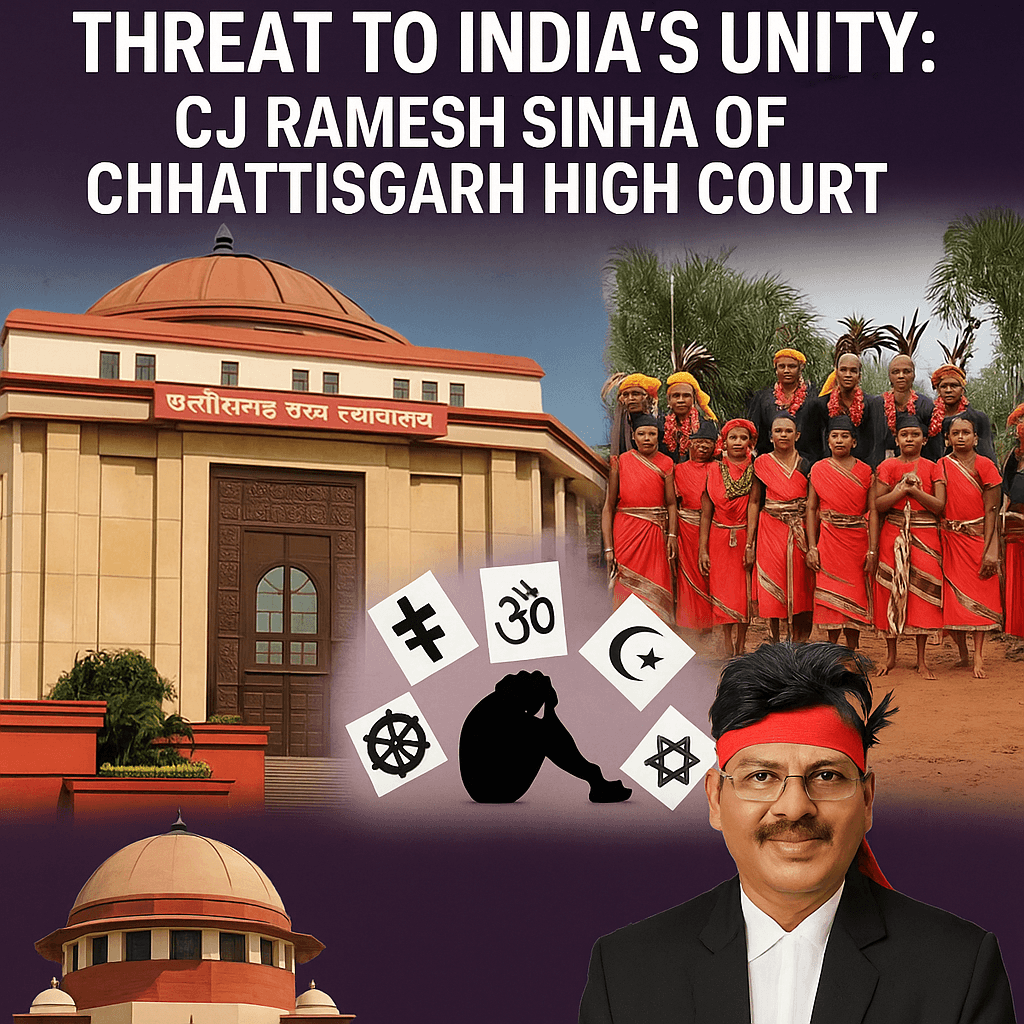
Chhattisgarh High Court has observed a lot of sensitive issues in this matter of religious conversions especially among distant tribes. Division bench, headed by Chief Justice Ramesh Sinha and Justice Bibhu Datta Guru termed conversion by inducement by some groups as social menace. According to the court, such practices are a danger to the unity and cultural continuity of the indigenous people of India. These strong lines were not uttered in an indiscriminate oratory, but in a judgment which was detailed.
This verdict was made on the occasion of disposing a series of public interest litigations. These banners specifically barred the coming of Christian pastors and those individuals who had converted to Christianity saying that the villages were under protection of the laws that aimed at protecting the tribal culture.
According to the petitioners, these hoardings were fear-inducing and went against the Christian community segregation. They alleged that the banners infringed on their basic constitutional rights such as the freedom of movement (Article 19) and the freedom of religion (Article 25). This case requested the court to declare such hoardings and Gram Sabha resolutions in their background unconstitutional and remove them.
The petitions were dismissed by the bench after listening to all the arguments. It determined that the hoardings, in themselves were not unconstitutional. In its place, the court considered them as a precaution on the part of the village councils in protecting their cultural heritage against what they considered illegal conversion efforts. The decision made by the court has gone deep into the act of balancing between freedom of religion and protection of vulnerable groups.
The Court Difference between Faith and Exploitation.
The High Court in its ruling, took a keen note to make a clear distinction between genuine faith and the practice of coercion. According to the bench, religious conversion in the case of voluntary and spiritual conversion is a lawful exercise of conscience. It established the fact that the Constitution secured the right of an individual to select his/her religion. The court stated the issue is the case at which this is not a voluntary process.
The court observed that some missionaries that started off with the aim of social upliftment and healthcare overtime turned these mediums into a source of proselytization. It is in this that the court determined the issue to start.
Need Help With Your PhD or LLM Thesis?
Explore our thesis and dissertation writing support services for PhD and LLM students. Get subject-specific academic assistance for your research project.
Explore Our Services →These allegations which are common in remote tribal belts were emphasized in the judgment of the court. It said that missionaries commonly get the charge of attacking families who are illiterate and poor. They are said to be offered such monetary aid, free education, medical care or job to convert to their religion. The bench admonished that this kind of practice was a misrepresentation of the spirit of voluntary faith that constituted cultural coercion.
This tactic was termed by the court as a calculated exploitation in the name of charity and this strategy destroys faith and freedom. With this framing of the matter, the bench was able to distinguish the act of sharing its religion as being protected by the law, and the act of using allurement to recruit converts as being unlawful. The hoardings, according to the court, were the reaction to the latter.
Cultural Identity: Right to Hold Gramm Sabha.
The ruling by the High Court to support the hoardings was supported by the law based on the special powers given to tribal village councils. The act grants tribal communities special powers of governance.
Through the PESA system, Gram Sabhas will have the authority to conserve and protect their cultures, practices and values. The court pointed out that the state government had sent out a circular urging Gram Sabhas to preserve their: Hamari Parampara Hamari Virasat (Our tradition, our heritage). The hoardings were regarded as being a direct move by the village councils to meet this statutory obligation.
The petitioners had alleged misuse of these resolutions and banners to encourage religious discrimination. The court however held that the hoardings was a limited and narrow step. The bench noted that the banners were not against the entrance of all the Christians. Instead, they targeted the prevention of only those Pastors who are entering the village with the intention of illegal conversion and who are part of other villages.
The court thus declared the hoardings to be a precautionary measure and not an out right act that was unconstitutional. It incorporated the activities of the Gram Sabha into the legal provisions of the PESA Act that is aimed at ensuring that the indigenous culture is not eroded. According to the court, the village councils have a valid right to safeguard their community against what they perceive as being culturally coerced.
Influence of Conversion on Social Cohesion and Tradition of a Tribe.
In its judgement, most of which was the judgment of Chief Justice Ramesh Sinha, the court looked at the social consequence of such conversions. The court noted that this process, has also resulted in serious divisions in the society of tribal communities. This is where lies the comment that these conversions pose a threat to unity and the continued existence of culture.
With the conversion of tribal members, the bench observed that the members tend to form new cultural practices, which make them forget their traditional rituals and shared festivals. Such alienation, the court said, results in the polarisation, social boycotts, and even violent confrontations in the villages. The court even referred to arguments that refer to 2023 riots in Narayanpur that broke out between converted and non-converted tribal groups.