kapil sibal tejashwi yadav
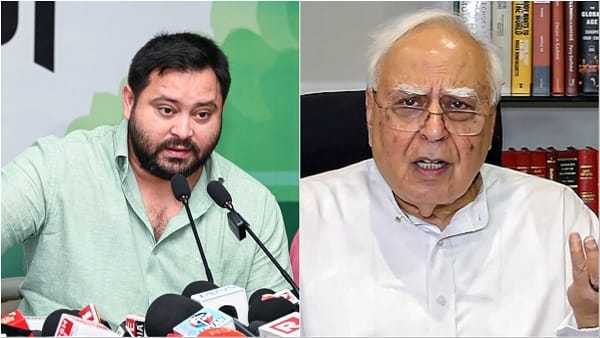
I saw my friend Kapil Sibal’s interview of Tejaswi Yadav on his show ‘Dil Se’ titled ‘NDA jeeta loktantra haara’
I agree with both Kapil and Tejaswi that the NDA’s securing 202 seats out of the 243 seats in the recent Bihar state assembly elections indicate that there was massive rigging in the elections, by misuse of the SIR, a biased Election Commission, tampering of the EVM machines, money distribution, etc.
However, I regret to say that the participants in the interview did not go into the deeper issue : is all this relevant for the common man in Bihar ? In my opinion it is wholly irrelevant. Let me explain.
For any queries or to publish an article or post or advertisement on our platform, do call at +91 6377460764 or email us at contact@legalmaestros.com.
(1)The test of every political activity and political system is one, and only one : does it raise the standard of living of the people ? Does it give them better lives ?
Now suppose the Bihar elections were totally fair, and there was no rigging. At most this might have resulted in the Mahagathbandhan winning the elections, and Tejaswi becoming the Chief Minister, replacing Nitish Kumar. In other words, there would only have been a change in the political leadership in Bihar.

But how would that have raised the standard of living of the common Biharis ? Massive poverty, massive unemployment, almost total lack of proper healthcare and good education for the masses, appalling level of child malnutrition, skyrocketing prices of food and other essential commodities, etc would have continued as before. It reminds one of a scene in the Ramcharitmanas where Manthara, the slave girl of Queen Kaikeyi tells her :
” Koi nrip hoye hamein ka haani
Chedi chhaand ka hoib rani ”
i.e.
” How does it matter to me who will be the next king ( i.e. Ram or Bharat ) ?
Will I cease to be a slave and become a queen ? ”
The plight of the people of Bihar will remain as miserable as of Manthara, whether Nitish Kumar or Tejaswi Yadav becomes the Chief Minister.
I have explained this in my interview by journalist Neelu Vyas
(2) The title of the interview said ‘Loktantra ( democracy ) haara’. This presumes that democracy is a good thing, and therefore rigging elections is a bad thing.
But as I have explained in the video link below, democracy as practised in India is a bad thing, as it runs largely on caste and communal vote banks. Casteism and communalism are feudal forces, which have to be destroyed if India is to progress, but democracy as practised in India further entrenches and fortifies casteism and communalism ( as our politics largely run on their basis ). How then can democracy ( as practised in India ) be a good thing ? And if it is not a good thing, how does it matter if it is destroyed ( by rigging or otherwise ) or not ?
In my opinion democracy is not suited to, and is not good for, India, as explained in the video below
Democracy is meant for people with rational minds, who vote on rational considerations. The most important consideration for rational voters should be whether the candidate, if elected, would serve their interests. But most Indian voters only see the caste or religion of the candidate, or the caste or religion his party claims to represent ( which should be irrelevant considerations ). This shows they are not mentally fit for being voters, and do not deserve the right to vote, as they mostly vote in droves, like sheep and cattle, on the basis of caste and religion.
In Plato’s book ‘The Republic’, the Greek philosopher Socrates gives an example. Suppose there is a choice between voting for a sweets shop owner or a doctor. The sweets shop owner will say to the voters “Vote for me, because I will give you a lot of sweets, which will delight you, whereas the doctor will give you bitter medicines, and perform painful operations on you.”
The voters, who are short-sighted and silly, will vote for the sweets shop owner, forgetting that politicians rarely keep their election promises. And even if the sweets shop owner does give them sweets, that may give momentary delight but may be bad for health in the long run. On the other hand, the doctor gives bitter medicines and operates on them to save their lives, which is for their own good.
Most Indians are like the people who will vote for the sweets shop owner i.e. the party or candidate who promises the moon, and distributes freebies just before the elections, and this proves they are not fit for democracy.
https://www.linkedin.com/pulse/why-i-dont-have-faith-parliamentary-democracy-markandey-katju
https://www.theweek.in/news/india/2024/11/02/opinion-why-democracy-is-unsuited-to-india.html
https://www.hastakshepnews.com/2025/07/democracy-is-not-holy-cow-justice-katju.html
(3) Tejaswi said in a press conference before the elections that if the Mahagathbandhan wins and he becomes the CM he will give a government job to one member of every family in Bihar.
But where would the money for this come from ? There are about 2.75 crore families in Bihar, and it is estimated that implementing this promise alone will entail an expenditure of Rs 6 lakh crores (some estimate it as 9 lakh crores) annually.
But Bihar’s budget for the year 2025-2026 showed expenditure of only Rs 3.17 lakh crore. So fulfilling this demand alone will mean that all the state government’s expenditure will be on meeting this demand alone, and still it will not be met (what to say of the other 24 promises in the Manifesto like giving Rs 30,000 per year to every woman in Bihar, pensions, insurance, etc ). From where then would come the money to pay salaries of government employees, and meet other government expenses ?
Tejasvi also said before the elections that he will get numerous factories set up in Bihar to give employment. But which businessman will invest in a state so disturbed by political and social strife ?
Moreover, jobs cannot be created artificially like this, otherwise the government may as well announce that it will give Rs 10,000 pm to every person who is willing to sweep the streets in cities, or rural paths, in Bihar.
Jobs are created when there is significant growth in the economy i.e. increased industrialization. But this increased industrialization can only take place if there is increased demand, which can only happen when the purchasing power of the people significantly rises. After all, the goods produced have to be sold. Tejaswi has not mentioned how he will increase the purchasing power of the people.
The interview was therefore irrelevant