Sanction Becomes Crucial: Justice Supreme Court lays out protections of police officers.
Introduction
In the case of Samarendra Nath Kundu and Anr. v. Sadhana Das and Anr., the Supreme Court of India made a significant decision. (2026 INSC 304). The case concerns a fundamental issue in the criminal law, when do sanctions by the government in the past have to be enforced in prosecuting police officers?
Justice Manoj Misra and Justice J.B. Pardiwala gave the judgment.
Background of the Case
The case was out of a complaint by a woman who claimed that her husband was killed by police authorities when there was a case of law and order when there was an election day.
The complaint charged the three police officers with the commission of offences involving grave provisions such as murder and criminal conspiracy, including the appellants.
The Magistrate received the complaint and ordered the accused to appear before him under the provisions of Indian penal code 1860 and code of criminal procedure 1973.
Previous Proceedings and Related Judgment.
A senior police officer who was one of the co-accused approached the Supreme Court earlier and contended that he could not be prosecuted without sanction by a previous section of 197 CrPC.
His argument was accepted by the Supreme Court who quashed proceedings against him, as he had no sanction. It however permitted new proceedings when the sanction was subsequently granted.
The present appellants also enjoyed this benefit later on by the Magistrate.
High Court’s Decision
This was a decision that the complainant appealed to the High Court.
The High Court also determined that the previous Supreme Court ruling was only applicable to the senior officer and not to the current appellants.
It ordered that the case against the appellants be proceeded with.
Important Cases Before the Supreme Court.
There were two key questions that the Supreme Court considered.
The former was whether the appellants had the privilege to enjoy the advantage of the prior adjudication made to their co-conspirators.
The second was whether a subsequent government declaration to extend protection to police officers would cut across their case.
Presumption of whether Sanction was necessary.
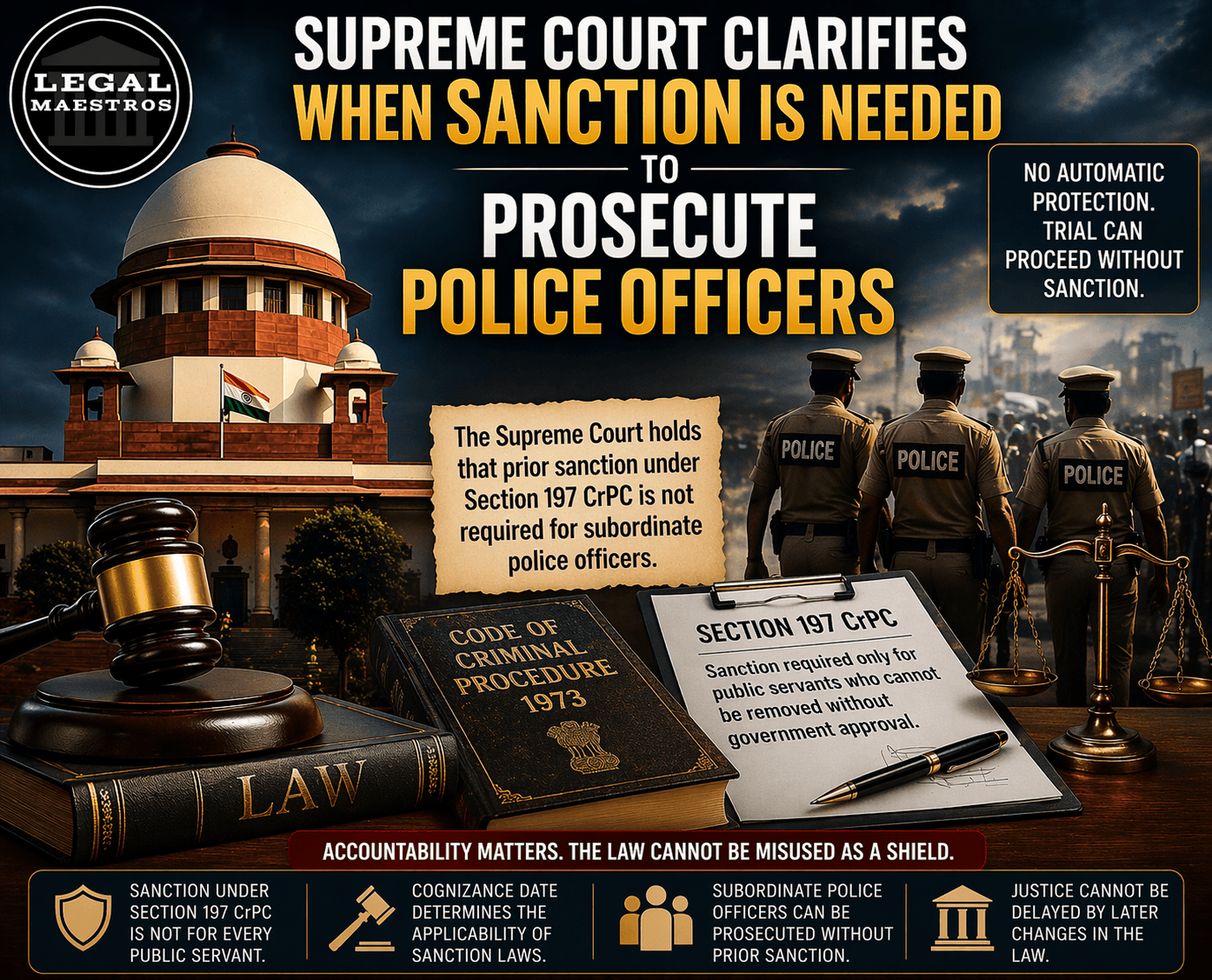
The Court clarified that only some of the categories of the public servants must be sanctioned beforehand according to Section 197 of CrPC.
This defense is primarily on the likes of individuals who cannot be ousted in office unless by government authority.
The Court established that the appellants were lower-ranking police officers who could be terminated without such a penalty.
Thus, they did not have the right to be covered by Section 197(1) of CrPC.
Effect of Government Notification
The appellants were relying on a notice that was issued in 2010, which gave protection to some police officers.
Nevertheless, the Court made a significant point clear.
The necessity of sanction takes effect at the point when the court takes cognizance of the offence.
Cognizance was taken in 2001 in this case, way back before the notification was issued.
Therefore, the notification could not be applied retrospectively to protect the appellants.
Profit of Previous Decision Refused.
The Court believed that the previous ruling that favored the senior officer could not necessarily be extended to the appellants.
Such protection rested on the special position of the senior officer and legal necessity of sanction in his instance.
The appellants could not have the same benefit since they did not belong to the same category.
Final Decision of Supreme Court.
The appeal was dismissed by the Supreme Court.
It believed that there was no preceding sanction to convict the appellants.
The Court did not stop the criminal proceedings against them.
Yet it made clear that it had not given any statement on the merits of the case.
Conclusion
This judgment clearly explains that protection under Section 197 CrPC is not available to all public servants.
It is based on the rank of the officer and the case stage.
The Supreme Court pointed out that subsequent alterations in law will not be able to reverse legitimate proceedings which have already commenced.
This ruling makes accountability more effective because lower-level officials cannot evade prosecution without a valid justification.