About the University of Edinburgh
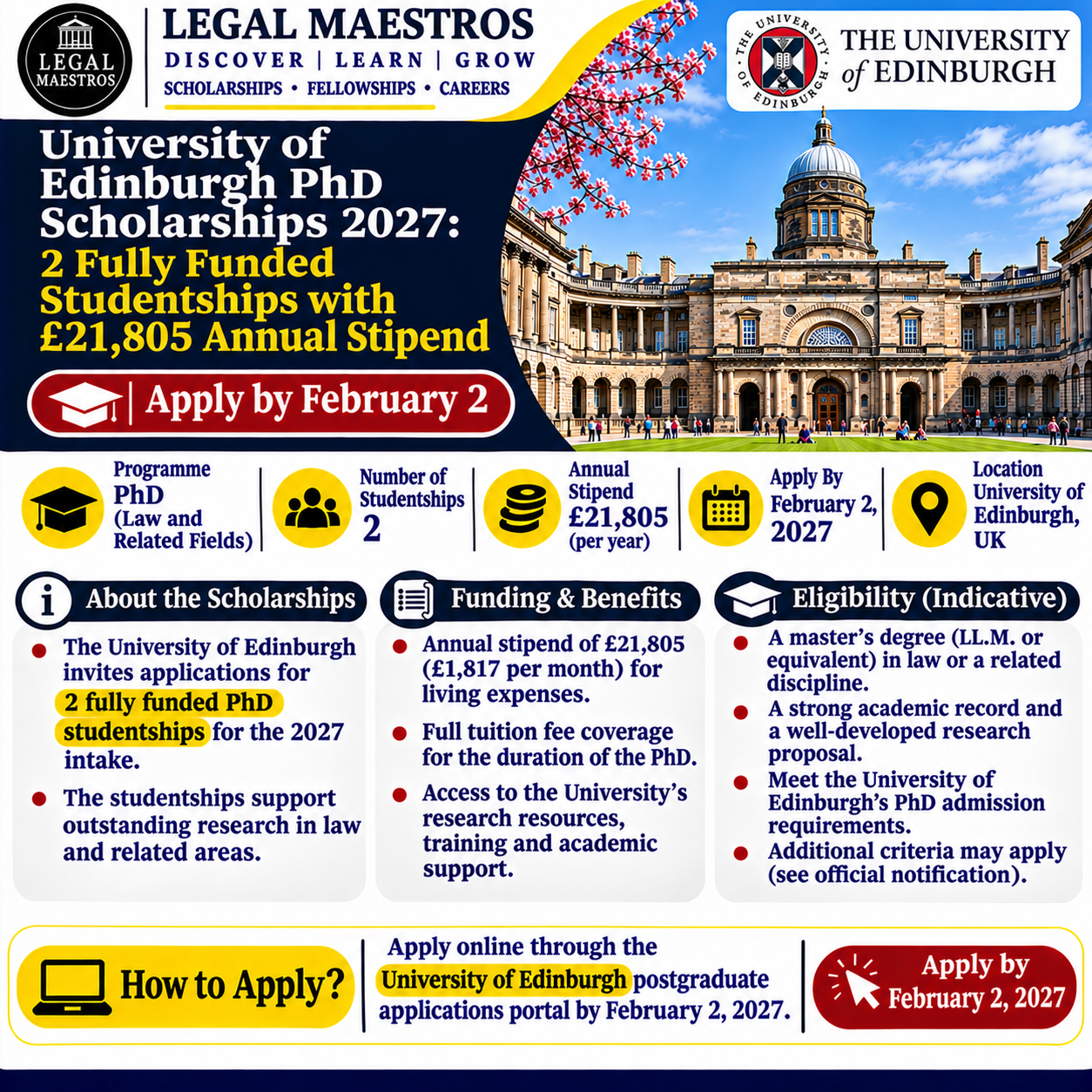
The University of Edinburgh, United Kingdom, has invited applications for the Edinburgh Law School and Ewen Cameron PhD Scholarships for the 2027–2028 academic year.
The university is offering two fully funded doctoral studentships for candidates interested in undertaking advanced research in law, socio-legal studies, criminology and other law-related subjects.
Selected scholars will receive financial assistance covering tuition fees and an annual stipend of approximately £21,805. The funding will continue for a maximum of three years, subject to satisfactory academic progress.
The scholarships are open to eligible applicants from different countries, including India.
The last date for submitting scholarship applications is 2 February 2027.
About the Edinburgh Law School and Ewen Cameron Scholarships
The Edinburgh Law School and Ewen Cameron Scholarships are postgraduate research awards offered by the University of Edinburgh.
Need Help With Your PhD or LLM Thesis?
Explore our thesis and dissertation writing support services for PhD and LLM students. Get subject-specific academic assistance for your research project.
Explore Our Services →The programme supports candidates with strong academic qualifications who wish to pursue original doctoral research.
One of the two studentships is funded through a bequest from Ewen Cameron, an alumnus of the University of Edinburgh.
The scholarships allow successful applicants to pursue independent research while participating in the university’s academic community.
Candidates can undertake research across different branches of law and related disciplines.
The university has not restricted the awards to a single legal specialisation.
Applicants working in traditional legal subjects, interdisciplinary legal studies and criminology may all be considered.
Number of Scholarships
Edinburgh Law School is offering two full PhD studentships for the 2027–2028 academic year.
One studentship is associated with the Ewen Cameron bequest, while the other is offered through Edinburgh Law School.
The university has not announced a separate number of places for Indian applicants.
Both domestic and international candidates can compete for the available awards.
Selection will depend on academic achievement, research potential and the suitability of the proposed research.
Scholarship Amount and Financial Benefits
Selected candidates will receive funding covering their tuition fees.
The scholarships also provide an annual stipend in line with the rates established by UK Research and Innovation, commonly known as UKRI.
Edinburgh currently estimates the annual stipend at approximately £21,805.
The final amount may vary according to the applicable UKRI rate.
The stipend will be paid in equal monthly instalments.
Financial support will continue for a maximum of three years, subject to satisfactory academic progress.
At the currently published approximate rate, the stipend would amount to £65,415 across three years, excluding tuition fee support.
This is an illustrative total rather than a guaranteed fixed payment for the complete period.
The scholarship announcement does not separately guarantee international travel, visa or relocation allowances.
Scholarship Duration
The scholarships provide funding for up to three years.
Successful applicants must begin the first year of their PhD during the 2027–2028 academic session.
The university has identified two possible entry periods: September 2027 and January 2028.
The regular full-time PhD programme lasts three years.
A part-time PhD normally takes six years.
While part-time scholarship awards may be paid on a proportional basis, international students who require visa sponsorship are not eligible for the part-time study arrangement under this scholarship.
Indian applicants who require a UK student visa should therefore plan to apply for full-time doctoral study.
Eligibility Criteria
Applicants must satisfy the University of Edinburgh’s admission requirements for its PhD in Law programme.
The minimum academic requirement is a UK upper second-class honours degree, commonly known as a 2:1, in law, arts or social sciences.
Candidates must also possess a UK master’s degree or an equivalent international qualification.
For the master’s qualification, Edinburgh requires at least 60% in the taught component and 65% or more in the dissertation, or the relevant international equivalent.
However, meeting these minimum qualifications does not guarantee admission or scholarship selection.
The university has clarified that successful scholarship applicants normally exceed the minimum academic requirements.
They generally possess the highest degree classification in at least one of their previous qualifications.
Applicants must also submit a strong research proposal closely connected with the university’s research expertise.
Can Indian Law Graduates Apply?
Yes. Indian applicants are eligible to compete for these scholarships.
The University of Edinburgh expressly states that candidates from the United Kingdom and other countries may apply.
An Indian candidate holding a recognised LL.B., BA LL.B. or BBA LL.B. qualification, along with a suitable master’s degree, may seek consideration.
The university will assess whether the applicant’s qualifications are equivalent to its prescribed UK academic requirements.
An LL.M. degree may provide a suitable postgraduate background for applicants undertaking legal research.
However, the university also considers candidates from relevant arts and social science disciplines.
Applicants working in socio-legal research, legal history, criminology or interdisciplinary legal studies may therefore qualify even if their academic background is not exclusively in law.
Research Areas
The Edinburgh Law School and Ewen Cameron Scholarships support research across a broad range of legal and law-related subjects.
These include constitutional law, criminal law, international law, commercial law, human rights and jurisprudence.
Applicants may also undertake research involving criminology, law and society, legal institutions and interdisciplinary questions.
For example, a researcher interested in criminal justice may propose a project examining sentencing practices, criminal law reform or institutional responses to crime.
A candidate interested in public law may examine constitutional accountability, judicial review or comparative governance.
Researchers working in international law may investigate questions involving state responsibility, human rights or international legal institutions.
These are examples of possible research directions, not a fixed list of projects advertised by Edinburgh.
The important requirement is that the proposed topic fits the expertise of academics available to supervise the research.
About the PhD in Law Programme
The PhD in Law at the University of Edinburgh is an advanced research degree.
Students undertake independent research under the supervision of academic specialists.
The programme culminates in a doctoral thesis of approximately 100,000 words, demonstrating an original contribution to knowledge.
Students receive research training covering legal and criminological methodologies.
The university also provides opportunities for advanced training relevant to individual research projects.
PhD candidates participate in seminars, research discussions and other academic activities.
The programme is intended to develop scholars capable of conducting original legal research and communicating their findings through academic publications and other forms of scholarship.
Research Proposal Requirements
Applicants must submit a detailed research proposal as part of their PhD admission application.
Edinburgh Law School specifies a proposal of no more than 2,000 words.
The proposal should include a working title and clearly identified research questions.
Candidates must explain the academic context of their proposed work and identify the relevant existing literature.
They should also discuss the theoretical framework and research methodology.
Depending on the topic, the methodology may involve doctrinal analysis, comparative legal research, empirical investigation or interdisciplinary methods.
Applicants should explain the resources necessary to complete their research.
A bibliography must also be provided.
The university considers the proposed project’s originality, academic significance and suitability for supervision.
A well-developed proposal is particularly important for scholarship selection.
Finding a Research Supervisor
The availability of suitable academic supervision forms an important part of the PhD admission process.
Edinburgh Law School assesses whether an applicant’s research interests correspond with the expertise of its academic staff.
Applicants are encouraged to review the university’s research areas and faculty profiles before preparing their proposals.
The School normally examines completed applications and identifies an academic who may be able to supervise the proposed project.
A potential supervisor may arrange an online discussion with the applicant.
This provides an opportunity to examine the research proposal and discuss the suitability of the project.
A strong proposal may still be unsuccessful if the university cannot provide appropriate supervision.
Selection Criteria
The scholarships are awarded through a competitive academic selection process.
Edinburgh Law School considers four principal areas when evaluating candidates.
These are the applicant’s previous academic achievements, the strength of their research proposal, the fit between the proposed research and the School’s expertise, and the support demonstrated by academic references.
The university has expressly stated that financial circumstances and nationality are not considered when selecting recipients.
The scholarships are therefore awarded on academic merit and research potential rather than financial need.
Applicants must demonstrate their ability to undertake independent doctoral research.
Strong references from academics familiar with the applicant’s research work may support the application.
English Language Requirements
The University of Edinburgh requires applicants to demonstrate English-language proficiency.
For IELTS Academic, the minimum overall score is 7.0.
Candidates must obtain at least 7.0 in writing and 6.5 in each of the remaining components.
For TOEFL iBT examinations taken before January 21, 2026, Edinburgh requires an overall score of 100, including at least 25 in writing and 23 in the other components.
For the revised TOEFL iBT introduced in January 2026, the university requires an overall score of 5.0, with at least 5.0 in writing and 4.5 in the other components.
Certain applicants may qualify for an exemption based on previous education taught and assessed in English.
However, applicants from India should verify whether their previous university and degree meet Edinburgh’s specific exemption rules.
An English-medium law degree does not automatically guarantee exemption.
Documents Required
Candidates must first submit their application for admission to the PhD in Law programme.
The application requires academic transcripts covering all previous degree programmes.
Applicants must also provide undergraduate and postgraduate degree certificates.
Two academic references are required.
Edinburgh specifies that these references should be signed, dated within the preceding two years and issued on official institutional letterhead.
The university does not accept references from personal email addresses under its published PhD admission guidance.
A research proposal of no more than 2,000 words must also be submitted.
Candidates must provide evidence of English-language proficiency where required.
After applying for admission, applicants must complete the separate online scholarship application through the university’s EUCLID system.
How to Apply?
Interested candidates must complete two stages of application.
The first stage involves applying for admission to the University of Edinburgh’s PhD in Law programme.
Applicants should visit the official university website and submit their academic documents, references and research proposal through the online admissions system.
After submitting the course application, candidates will receive university login credentials.
These credentials provide access to MyEd and the EUCLID application system.
Applicants must then complete the separate online application for the Edinburgh Law School and Ewen Cameron Scholarships.
The university has clarified that candidates cannot access the scholarship application form until they have submitted their PhD admission application.
Candidates should therefore not leave the admission application until the scholarship closing date.
Important Application Timing
The scholarship application deadline is 2 February 2027.
However, Edinburgh requires applicants to submit their PhD admission application at least five working days before that date.
This is necessary because the university may need several days to complete administrative checks and provide access to the scholarship system.
For the February 2027 deadline, applicants should aim to submit their PhD admission application no later than January 26, 2027.
Edinburgh also recommends applying for admission approximately two weeks before a scholarship deadline.
Submitting the admission application by mid-January would therefore provide additional time to resolve document or login issues.
The university’s ordinary PhD admission deadline for September 2027 entry is later, but candidates seeking these scholarships must follow the earlier funding timetable.
Scholarship Selection Results
The university will review applications after the scholarship closing date.
Candidates will be assessed according to their academic qualifications, research proposal, references and suitability for doctoral study.
The final decisions will be made through the university’s scholarship selection process.
Applicants are expected to receive the outcome of their scholarship applications by the end of April 2027.
Students who receive scholarship offers will need to satisfy the conditions of admission and funding.
The university has not announced a separate interview schedule specifically for these two scholarships.
Can Applicants Receive Other Scholarships?
The Edinburgh Law School and Ewen Cameron Scholarships cannot be held simultaneously with another fully funded scholarship.
This means that a candidate who receives another comprehensive award for the same doctoral studies cannot ordinarily retain both full scholarships.
However, the university permits recipients to hold these studentships alongside partially funded awards.
In such circumstances, the Edinburgh scholarship may be reduced proportionately to account for the additional funding.
Applicants should disclose their other funding arrangements to the university.
Official Application Links
Official Scholarship Announcement: https://www.law.ed.ac.uk/study/research-degrees/scholarships-funding
PhD in Law Admission and Application Process: https://www.law.ed.ac.uk/study/research-degrees/how-to-apply
Official PhD in Law Programme: https://study.ed.ac.uk/programmes/postgraduate-research/168-law
University MyEd and EUCLID Portal: https://www.myed.ed.ac.uk/
Edinburgh Law School Research Areas: https://www.law.ed.ac.uk/research/research-areas
Official Email for PhD and Scholarship Queries: phd.law@ed.ac.uk
Application Deadline
The last date to submit applications for the University of Edinburgh Law School and Ewen Cameron Scholarships is 2 February 2027.
Candidates must first complete their PhD admission application at least five working days before the scholarship deadline.
Two full PhD studentships are available for the 2027–2028 academic year.
Each award covers tuition fees and provides an annual stipend currently estimated at £21,805, payable for up to three years subject to satisfactory academic progress.
Indian law graduates and researchers with suitable postgraduate qualifications can apply for full-time doctoral study in law, socio-legal studies, criminology and other law-related disciplines.
The university expects to communicate scholarship decisions by the end