About the University of Cambridge
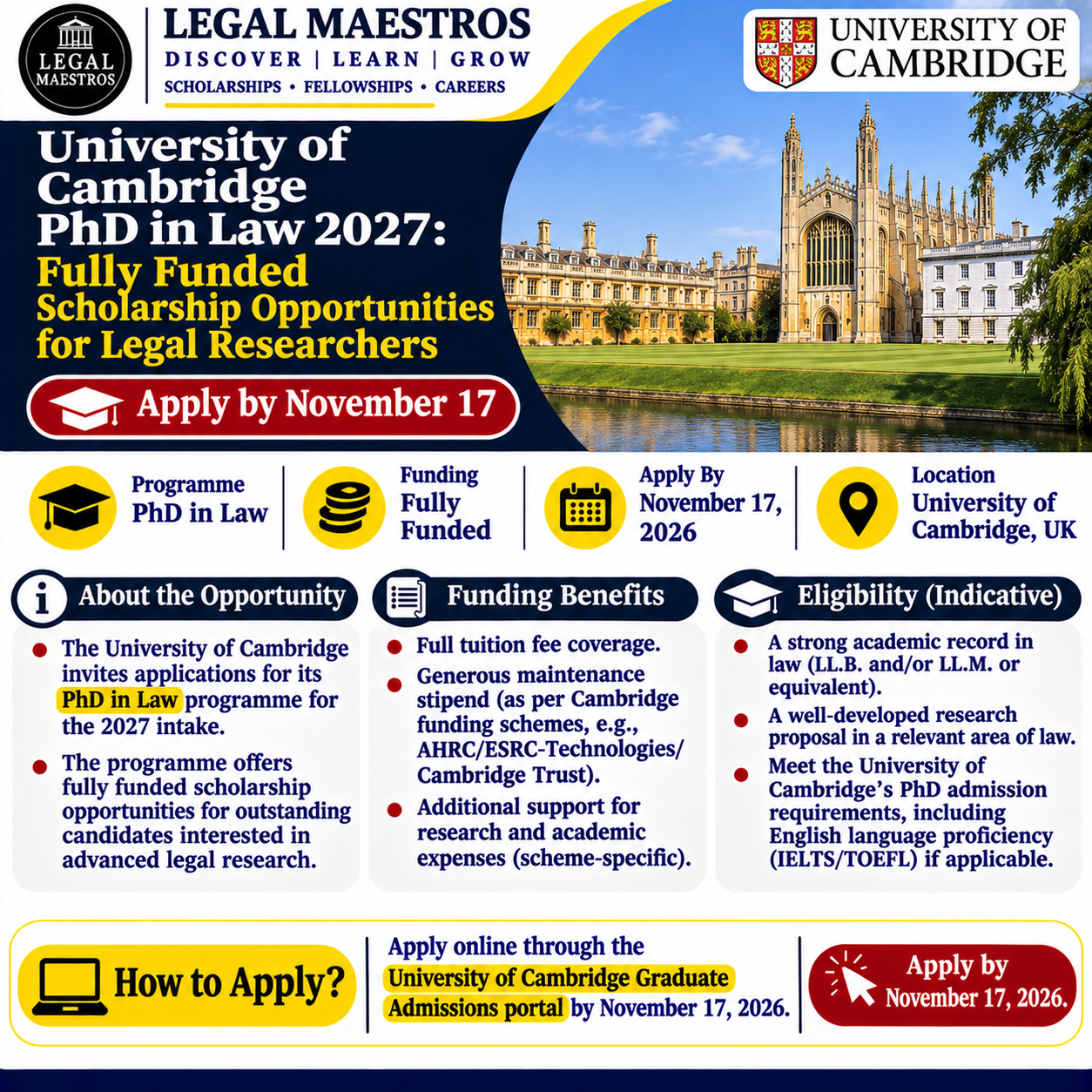
The University of Cambridge, United Kingdom, has invited applications for admission to its Doctor of Philosophy (PhD) in Law programme for the 2027–2028 academic year.
Indian law graduates, legal researchers and aspiring academics who meet the university’s admission requirements may apply for doctoral research in law and related disciplines.
The university offers several competitive funding opportunities through the Cambridge Trust, Gates Cambridge, individual colleges and other research funding programmes.
Some awards cover international tuition fees and living expenses, while others provide partial financial assistance.
The PhD programme will begin on October 1, 2027.
The final date for submitting applications is November 17, 2026.
Need Help With Your PhD or LLM Thesis?
Explore our thesis and dissertation writing support services for PhD and LLM students. Get subject-specific academic assistance for your research project.
Explore Our Services →About the PhD in Law Programme
The PhD in Law is an advanced research degree offered by the Faculty of Law at the University of Cambridge.
The programme is designed for candidates who wish to undertake original research and make a significant contribution to legal scholarship.
Unlike a taught postgraduate programme, the PhD focuses primarily on independent research conducted under academic supervision.
Students develop a research project, examine existing academic literature and produce a doctoral thesis.
The thesis must demonstrate original thinking, detailed knowledge of the research subject and the ability to undertake advanced academic work.
Cambridge expects doctoral research to be of a standard that could support academic publication.
Successful candidates are awarded the Doctor of Philosophy degree after completing the university’s academic and examination requirements.
Duration of the PhD Programme
The PhD in Law normally takes three to four years of full-time study.
Part-time study is also available, with the programme generally extending over four to seven years.
The doctoral thesis must not exceed 100,000 words, excluding the bibliography, table of contents and other specified preliminary material.
Students undertake supervised research throughout the programme.
Their academic progress is assessed at different stages.
The university also conducts a formal review during the early period of doctoral study to determine whether the candidate is making satisfactory progress.
The programme requires substantial independent research and sustained engagement with the chosen legal subject.
Eligibility Criteria
Applicants should ordinarily possess a first-class honours degree in law or a related discipline relevant to their proposed research.
The degree may have been awarded by a recognised university in the United Kingdom or an overseas institution.
Cambridge also considers certain applicants who hold a very good upper second-class honours degree.
Such candidates must additionally possess a master’s degree in law or a relevant discipline with an overall first-class result or distinction.
Applicants must demonstrate that they possess the academic ability necessary to undertake original doctoral research.
The university also assesses whether the proposed research can be supervised by an appropriate academic member of the Faculty of Law.
Meeting the minimum academic requirements does not automatically guarantee admission.
Can Indian Law Graduates Apply?
Yes. Indian applicants are eligible to apply for the Cambridge PhD in Law programme.
Candidates holding recognised degrees such as BA LL.B., BBA LL.B. or LL.B. may be considered if their qualifications meet Cambridge’s academic equivalency requirements.
Applicants who have completed an LL.M. may also apply.
However, Cambridge does not impose a universal requirement that every PhD applicant must possess an LL.M.
A candidate with an outstanding undergraduate law degree may be eligible under the university’s academic criteria.
Applicants whose undergraduate marks do not meet the equivalent first-class requirement may need to demonstrate the additional postgraduate qualifications specified by Cambridge.
Indian applicants should check the university’s official international qualifications guidance to determine how their degree and marks are assessed.
Research Areas
Cambridge’s Faculty of Law supports doctoral research across a wide range of legal disciplines.
These include public law, constitutional law, international law, criminal law, private law, commercial law, jurisprudence and legal history.
Researchers may also investigate intellectual property law, human rights, environmental law and other specialised fields.
Interdisciplinary research may be considered where the proposed project falls within the expertise of available supervisors.
Applicants are not required to select from a fixed list of advertised doctoral projects.
They may develop their own research proposals.
However, the proposed topic must be academically suitable and capable of being supervised by the Faculty.
Research Proposal Requirements
One of the most important documents required for admission is the PhD research proposal.
Cambridge requires applicants to submit a proposal of 2,000 to 3,000 words.
The word limit includes footnotes but excludes the bibliography.
The proposal should identify the proposed research question and explain why it is important.
Applicants should discuss the existing legal literature and identify how their research will make an original contribution.
The proposal should also demonstrate a realistic research approach.
A strong proposal will explain the methods the candidate intends to use and how the project can be completed within the normal doctoral period.
The Faculty’s Degree Committee considers the proposal during the application process.
Finding a Research Supervisor
Cambridge has clarified that PhD in Law applicants are not expected to contact potential supervisors before submitting their applications.
However, candidates are strongly encouraged to identify one or more academics whose research interests align with their proposed topic.
Applicants may mention these potential supervisors in the relevant section of their application.
The Faculty’s Degree Committee considers the suitability of the research proposal and the availability of academic supervision.
The committee may then identify an appropriate supervisor for a strong application.
Applicants should carefully review the Faculty of Law’s academic staff profiles before selecting potential supervisors.
A proposal may be unsuccessful if the university does not have a suitable and available academic willing to supervise the project.
Scholarships and Financial Assistance
The University of Cambridge offers several funding opportunities to prospective doctoral students.
These awards are administered by different organisations within and outside the university.
Funding may be provided through the Cambridge Trust, Gates Cambridge, individual colleges, Faculty of Law awards and research council programmes.
The benefits differ according to the scholarship.
Some awards provide comprehensive support covering tuition fees and living expenses.
Others cover only part of the student’s financial requirements.
Scholarship selection is competitive and is separate from admission.
An applicant may be offered admission to the PhD programme without receiving financial assistance.
Cambridge Trust International Scholarship
The Cambridge Trust International Scholarship is an important funding opportunity for international PhD applicants.
It is open to eligible candidates from countries outside the United Kingdom and Ireland who have overseas fee status.
Indian applicants may therefore be considered.
The scholarship is awarded primarily on academic merit and research potential.
Candidates are assessed using their academic qualifications, examination results, references and the strength of their research application.
The scholarship can cover international tuition fees and maintenance expenses.
The published funding arrangements also include support for certain immigration-related costs and additional benefits, subject to the award conditions.
For the 2027–2028 academic year, the Cambridge funding database lists approximately 60 Cambridge Trust International Scholarships across eligible subjects.
These are university-wide awards and are not reserved exclusively for law students.
Applicants are considered through the postgraduate admissions and university funding process.
Gates Cambridge Scholarship
The Gates Cambridge Scholarship is another major funding opportunity for international postgraduate students.
The programme supports academically outstanding applicants from countries outside the United Kingdom.
Indian legal researchers are eligible to apply if they meet the scholarship requirements.
Gates Cambridge provides comprehensive financial support, including eligible university fees, maintenance assistance and certain additional study-related expenses.
Selection considers academic excellence, suitability for the proposed programme, leadership potential and commitment to improving the lives of others.
Candidates seeking Gates Cambridge funding must complete the relevant scholarship section in the postgraduate application.
PhD applicants must also provide the additional Gates Cambridge reference and required research proposal.
The scholarship is extremely competitive.
Receiving admission to Cambridge does not guarantee selection for Gates Cambridge funding.
College Scholarships
Several Cambridge colleges provide scholarships and studentships for postgraduate researchers.
Some awards are restricted to students belonging to a particular college.
Others may be available to applicants who are willing to transfer to the college offering the funding.
The amount and duration of financial assistance differ between awards.
For example, the university’s 2027–2028 funding database includes Cambridge International PhD Studentships associated with Wolfson College.
These are intended to support eligible overseas-fee-status doctoral applicants.
Other college scholarships may provide partial assistance towards tuition fees or maintenance.
Applicants should consult Cambridge’s official postgraduate funding search to identify the awards relevant to their course, nationality and college preferences.
Faculty of Law and Research Council Funding
Cambridge’s Faculty of Law also identifies research funding opportunities for prospective doctoral candidates.
The Faculty may nominate suitable applicants for awards connected with the Arts and Humanities Research Council’s Doctoral Landscape Awards.
Certain candidates may also be considered for funding through the Economic and Social Research Council’s Doctoral Training Partnership.
These arrangements are subject to the eligibility rules of the relevant funding programme.
Research council scholarships may have restrictions concerning academic discipline, research methodology, fee status or the number of awards available to international students.
The Faculty also administers certain smaller scholarships.
For example, the Bill Cornish Scholarship supports eligible PhD research involving intellectual property law.
This award is separate from the main doctoral funding process and has its own application arrangements.
Scholarship Amount
There is no single fixed stipend for all Cambridge PhD in Law scholarship recipients.
The amount depends on the particular scholarship awarded.
Comprehensive awards may cover international tuition fees and provide financial support towards living expenses.
Some awards additionally cover approved visa costs, immigration health surcharge payments or other expenses.
Partial scholarships may support only a portion of the total financial requirement.
Students who receive partial funding will need to arrange the remaining amount independently.
Applicants should examine the individual scholarship conditions rather than assume that every Cambridge PhD admission offer includes full funding.
English Language Requirements
Cambridge has published English-language proficiency requirements for the PhD in Law.
For IELTS Academic, applicants must achieve an overall score of 7.5, with at least 7.0 in each of the four components.
The published TOEFL iBT requirements specify an overall score of 110, with at least 25 in listening, reading, writing and speaking.
Candidates taking the revised TOEFL examination should check the university’s current test guidance.
Some applicants may qualify for an exemption from providing English-language test results.
However, an Indian law degree taught in English does not automatically establish an exemption in every case.
Candidates should follow the university’s official language requirements.
Documents Required
Applicants must complete the Cambridge postgraduate application and submit the required supporting documents.
The application requires academic transcripts showing previous qualifications and examination results.
Candidates must provide an updated curriculum vitae or resume.
A research proposal of 2,000 to 3,000 words is compulsory.
Applicants must also submit a short statement explaining why they wish to study at Cambridge.
This section has a limit of 1,500 characters.
A separate statement explaining their interest in pursuing a PhD or researching their chosen subject is also required, with a limit of 1,500 characters.
Two references are mandatory.
These may be academic or professional references, depending on the applicant’s circumstances and the university’s requirements.
English-language proficiency evidence must also be supplied where required.
Candidates seeking Gates Cambridge funding must provide the additional documents prescribed for that scholarship.
Application Fee
Cambridge’s published postgraduate fee schedule specifies an application fee of £20 for doctoral applications.
Some candidates may qualify for an application fee waiver.
The fee is ordinarily paid online through the Applicant Portal before submission.
Applicants should check the fee and waiver instructions displayed in the portal before completing the application.
Selection Process
Applications for the PhD in Law are considered by the Faculty’s Degree Committee.
The university examines the applicant’s academic background, research proposal, references and suitability for doctoral study.
The availability of an appropriate supervisor is also important.
Shortlisted candidates may be invited for an interview.
Interviews are normally conducted online and may take place between mid-January and mid-March 2027.
Cambridge has stated that most admission decisions are made by the end of March.
The university’s scholarship selection processes operate separately.
Candidates may therefore receive admission and funding decisions at different times.
How to Apply?
Interested candidates must apply through the University of Cambridge’s official postgraduate Applicant Portal.
Applicants should first visit the PhD in Law course page and review the academic requirements.
They must then create an account in the application system and complete the form for the October 2027 intake.
Candidates should upload their academic transcripts, CV, research proposal and required statements.
They must also nominate referees and ensure that the references are submitted before the deadline.
Applicants seeking scholarships should select ‘Yes – I wish to apply for funding’ in the funding section.
The system will identify relevant funding opportunities and may ask for additional information.
Some scholarships require separate forms or additional documents.
Candidates interested in Gates Cambridge should complete the scholarship-specific questions and arrange the additional reference.
Applicants should not submit an incomplete course application on the assumption that missing documents can be provided after the closing date.
Official Application Links
PhD in Law Course: https://www.postgraduate.study.cam.ac.uk/courses/directory/lwlwpdlaw
Official Application Requirements: https://www.postgraduate.study.cam.ac.uk/courses/directory/lwlwpdlaw/apply
Academic and English Requirements: https://www.postgraduate.study.cam.ac.uk/courses/directory/lwlwpdlaw/requirements
Faculty of Law Funding: https://www.law.cam.ac.uk/funding
Cambridge Trust Scholarships: https://www.cambridgetrust.org/postgraduate-applicants/
Postgraduate Funding Search: https://www.student-funding.cam.ac.uk/
Official Postgraduate Application Guidance: https://www.postgraduate.study.cam.ac.uk/apply
Email for PhD Admission Queries: phdadmissions@law.cam.ac.uk
Application Deadline
The final date for applying to the University of Cambridge PhD in Law programme for the 2027–2028 academic year is November 17, 2026.
The deadline is 11:59 PM UK time.
Cambridge separately lists December 8, 2026, as the course funding deadline.
However, the university has expressly clarified that applicants must submit their PhD in Law course applications by November 17, regardless of the later funding date.
Applications submitted after November 17 cannot be considered for admission.
The application must include the necessary supporting documents, and the referees must submit their references by the course deadline.
The doctoral programme is scheduled to begin on October 1, 2027.
Indian law graduates and researchers who satisfy the academic requirements can apply for admission and request consideration for the relevant competitive scholarships through the official university application system.