About Harvard Law School
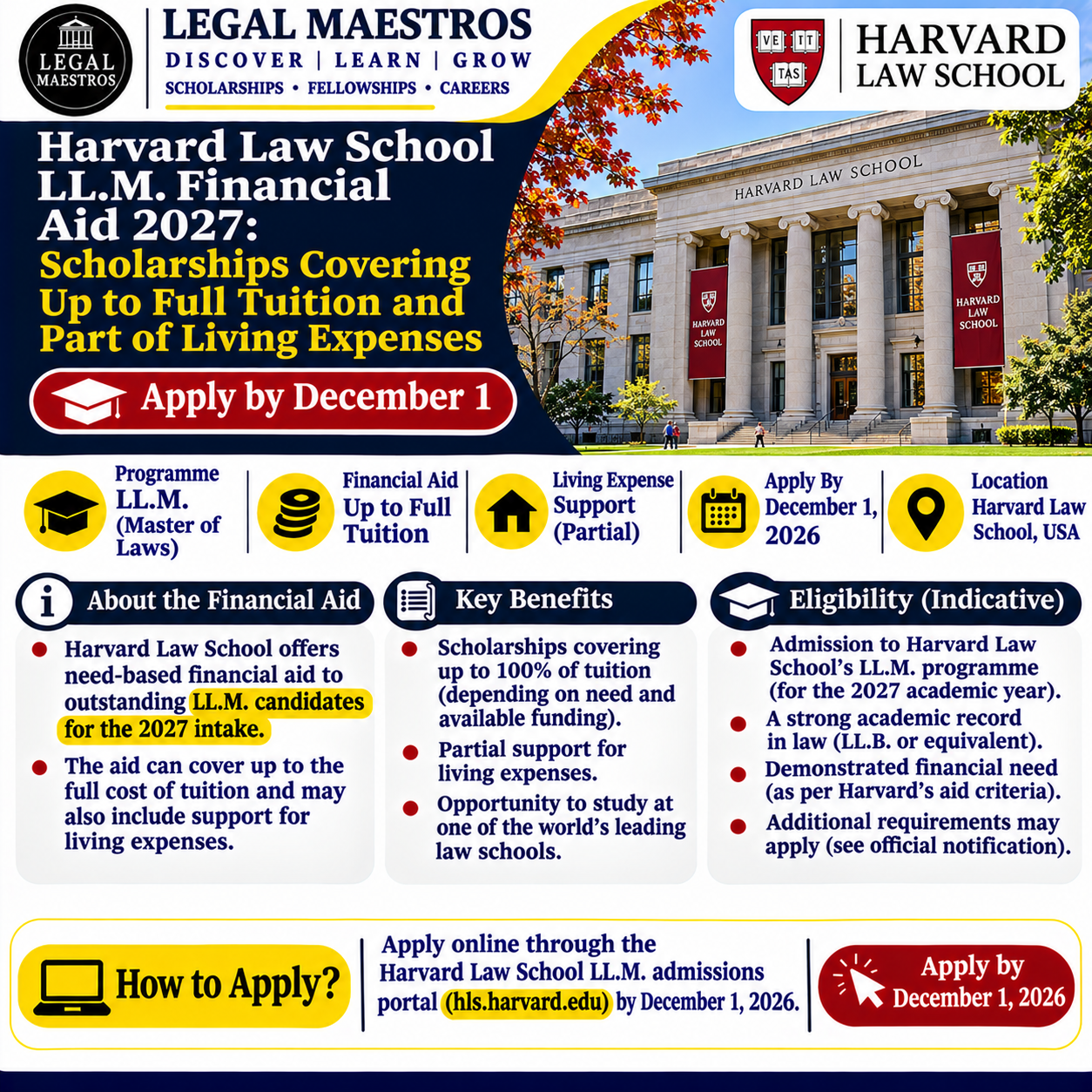
Harvard Law School, located in Cambridge, Massachusetts, United States, has opened applications for its Master of Laws (LL.M.) programme for the 2027–2028 academic year.
The university offers need-based financial assistance to eligible students who cannot meet the cost of studying at Harvard.
Financial aid is available to international applicants, including law graduates and practising lawyers from India.
The assistance may take the form of scholarships, educational loans or a combination of both. A small number of students demonstrating particularly serious financial need may receive grants covering the full tuition fee and part of their living expenses.
The last date to apply for both LL.M. admission and financial aid is December 1, 2026.
About Harvard’s LL.M. Programme
The Harvard Law School LL.M. is a one-year postgraduate programme designed for students who have already completed their first degree in law.
Need Help With Your PhD or LLM Thesis?
Explore our thesis and dissertation writing support services for PhD and LLM students. Get subject-specific academic assistance for your research project.
Explore Our Services →The programme brings together approximately 180 students from different countries and legal backgrounds each academic year.
Its participants include practising lawyers, legal academics, government officials, judges, researchers and professionals working with international organisations.
Students are able to choose from a wide range of subjects taught at Harvard Law School.
The programme is intended to help participants develop their legal understanding while learning from different legal systems and professional experiences.
The 2027–2028 LL.M. programme will begin in August 2027.
About Harvard’s Need-Based Financial Aid
Harvard Law School provides financial assistance through its Graduate Program Financial Aid Office.
The university does not offer ordinary LL.M. financial aid solely on the basis of academic merit.
Instead, the amount of assistance depends primarily on the student’s demonstrated financial need.
Harvard examines the financial resources available to the applicant and their family before determining the amount of support required.
Financial assistance can include grants, which do not need to be repaid, and educational loans, which must be repaid according to their terms.
The actual award differs from one student to another.
Receiving admission to Harvard Law School does not automatically guarantee a scholarship.
Scholarship Amount and Benefits
Harvard has not announced a fixed scholarship amount that every admitted student will receive.
According to the university’s official financial aid information, the average grant awarded during the 2025–2026 academic year was approximately US$47,000.
The average educational loan was approximately US$25,000 for the same academic year.
Harvard states that its average grant is approximately half of the tuition fee.
A small number of students with particularly serious financial need may receive grants covering the entire tuition fee and part of their living expenses.
However, these larger awards are limited.
Most recipients receive a financial assistance package consisting of a grant, a loan or both.
The university has not guaranteed an equivalent grant amount for the 2027–2028 intake.
Is a Fully Funded Scholarship Available?
Harvard Law School confirms that some students may receive grants covering full tuition and part of their living expenses.
However, this does not mean that every LL.M. student who demonstrates financial need will receive a fully funded scholarship.
The university awards its financial assistance according to individual circumstances and available resources.
For the 2026–2027 academic year, Harvard reported that every LL.M. student who demonstrated financial need received some form of assistance.
This included students receiving grants, loans or a combination of the two.
Some students received only loans.
Applicants should therefore distinguish between receiving financial assistance and receiving a scholarship that does not have to be repaid.
Tuition Fees and Cost of Studying
Studying at Harvard Law School involves considerable expenses.
For the 2026–2027 academic year, Harvard published an LL.M. tuition fee of US$84,400.
The university’s estimated total cost of attendance for a single student was US$127,250.
This amount included tuition fees, health insurance, university charges, accommodation, food, books, travel and personal expenses.
The estimated housing cost was US$18,900, while food expenses were estimated at US$6,760.
Harvard also included US$6,898 for health insurance and health services fees.
These figures relate to the 2026–2027 academic year. The final costs for students entering in August 2027 may differ.
Applicants should review the updated fee schedule before accepting an admission offer.
Financial Assistance for Indian Students
Indian law graduates can apply for Harvard Law School’s LL.M. programme and seek need-based financial assistance.
Harvard accepts applications from candidates who hold a recognised first degree in law from a university outside the United States.
This includes applicants with qualifications such as an LL.B., BA LL.B. or BBA LL.B., subject to the university’s assessment.
Financial assistance is not restricted to American citizens.
However, international students are not eligible for United States federal student loans.
They may qualify for certain private educational loans or, in limited circumstances, other loans arranged through Harvard.
Some international applicants may also qualify for scholarships administered by the wider Harvard University.
Those scholarships may have their own eligibility conditions and separate deadlines.
Eligibility Criteria
Applicants must hold a first degree in law from a recognised institution.
Harvard requires either a Juris Doctor degree from an approved American law school or a first law degree from a foreign law school.
Candidates in the final year of their legal studies may apply if they will complete their degree by June 2027.
The university assesses applicants on the basis of their academic performance, recommendations, professional interests and personal achievements.
Previous professional experience is not compulsory.
However, Harvard states that applicants who have completed at least two years of work or further study after their first law degree often submit stronger applications.
The university is particularly interested in applicants who can explain how the LL.M. will contribute to their future legal or academic careers.
Can Fresh Law Graduates Apply?
Yes. Harvard Law School does not impose a compulsory minimum period of professional experience for international LL.M. applicants.
Therefore, an Indian law graduate may apply without having completed two years of legal practice.
However, admission is highly competitive.
The university receives approximately 1,600 applications for around 180 places in the LL.M. programme each year.
Candidates are expected to demonstrate academic ability, clear professional interests and the potential to contribute to the programme.
Previous research, internships, professional assignments and other achievements may help the admissions committee understand an applicant’s background.
Final-year students must complete their law degree before the university’s prescribed deadline.
How Financial Need Is Assessed
Harvard determines financial aid based on the applicant’s individual financial circumstances.
The university considers information about the applicant’s income, savings and other financial resources.
It also requires financial information concerning the applicant’s parents.
Where the applicant is married, the financial circumstances of their spouse may also be considered.
The university uses this information to assess how much the applicant and their family can reasonably contribute towards the cost of education.
Harvard then determines whether the applicant qualifies for a grant, an educational loan or a combination of both.
Applicants must provide accurate financial information.
The university may require supporting documentation to verify the details submitted in the financial aid application.
Separate Financial Aid Application
Candidates seeking financial assistance must complete a separate financial aid form through Harvard’s online application system.
The admission application and financial aid application are two different components of the process.
Applicants may prepare both forms at the same time.
However, Harvard requires candidates to submit their admission application before submitting the financial aid application.
The financial aid form also requires parental financial information and, where applicable, spouse information.
Importantly, the financial aid application must be submitted by December 1, 2026.
Harvard has warned that applicants who wait until receiving an admission offer before seeking financial aid are extremely unlikely to receive a grant.
By that stage, most scholarship funds may already have been allocated.
Does Applying for Financial Aid Affect Admission?
No. Harvard Law School has clarified that admission and financial assistance decisions are made separately.
Applying for need-based assistance does not reduce the applicant’s chances of being admitted.
The admissions committee first evaluates applicants on the basis of academic and other relevant criteria.
Financial aid applications are reviewed after admission decisions have been made.
This means that students who require scholarship assistance should submit the financial aid application at the same time as their admission materials, without worrying that requesting support will disadvantage them.
English Language Requirements
Harvard Law School requires English-language proficiency from applicants who do not qualify under its educational-language rules.
The university accepts TOEFL scores but does not accept IELTS as an alternative.
For TOEFL iBT examinations taken before January 21, 2026, the minimum overall score is 100, with at least 25 in each section.
For tests taken after January 21, 2026, Harvard requires an overall score of at least 5.5 under the revised scoring system.
The minimum section scores are 5.5 in reading and listening, and 5.0 in writing and speaking.
Applicants who completed their full-time legal education entirely in English may not be required to submit TOEFL results under the stated rules.
Harvard also permits certain candidates to request a language-test waiver, although such waivers are granted very rarely.
Applicants should review the official requirements carefully before deciding whether to take the examination.
Documents Required
Candidates must complete Harvard Law School’s online LL.M. admission application.
The application requires an updated curriculum vitae or resume.
Applicants must also submit academic transcripts and degree certificates from their previous universities.
At least two and no more than three recommendation letters are required.
These may come from law professors or professional supervisors who are familiar with the applicant’s academic and professional work.
A personal statement is compulsory.
TOEFL results must be provided where applicable.
Candidates applying for financial aid must also complete the financial assistance form and provide the required financial information.
The LL.M. application fee is US$90.
Harvard permits applicants experiencing extreme financial hardship to request a fee waiver through the online application process.
Personal Statement Requirements
Harvard requires applicants to prepare a personal statement containing two parts.
The first part concerns a significant legal problem or issue.
Candidates must identify the problem and develop a legal strategy or theoretical approach to addressing it.
The university expects substantive legal analysis rather than a general description of a research interest.
The second part concerns the applicant’s personal and professional background.
Candidates must explain why they wish to pursue an LL.M. at Harvard and how the programme relates to their previous experiences and future plans.
The complete personal statement must not exceed 1,500 words.
The first part must account for at least half of the total statement.
Harvard does not accept revised personal statements after the application has been submitted.
Recommendation Letters
Applicants must arrange at least two recommendation letters.
Harvard allows a maximum of three.
The university particularly values recommendations from individuals who have directly observed the applicant’s academic or professional abilities.
Law professors, research supervisors and professional employers may provide suitable references.
The recommendation letters must be submitted through Harvard’s online application system.
Harvard does not accept recommendation letters through the LSAC service or by ordinary email.
Applicants should contact their referees well before the deadline to ensure that all letters are submitted on time.
Selection Process
The Harvard LL.M. admissions process is highly competitive.
The admissions committee considers academic results, professional achievements, recommendations, the personal statement and other relevant information.
The university seeks applicants with strong legal backgrounds and clearly developed academic or professional interests.
Admission decisions for the 2027–2028 intake are expected around the end of March 2027.
Financial aid applications are reviewed separately after admission decisions.
Applicants who are offered admission will be informed about the financial assistance available to them through the university’s established process.
A candidate may receive admission without being offered a grant.
Other Sources of Funding
Harvard encourages international students to explore financial assistance outside the Law School.
Applicants may consider scholarships from government agencies, charitable foundations, employers and other educational organisations.
Harvard University also administers certain scholarship programmes through its Committee on General Scholarships.
Some of these awards are available only to students from particular countries or academic backgrounds.
Their application requirements and deadlines may differ from the Harvard LL.M. admission process.
The university also notes that some students may be able to obtain part-time employment on campus.
Such employment can provide approximately US$3,500 during an academic year for six to eight hours of work per week.
However, these positions are not guaranteed and cannot be arranged through the Graduate Program Office before arrival.
How to Apply?
Interested and eligible candidates must apply through the official Harvard Law School Graduate Program application system.
Applicants should first visit the LL.M. admissions page and review the requirements for the 2027–2028 academic year.
They must then complete the online admission form and upload the prescribed documents.
Candidates should prepare their CV, personal statement and academic records before starting the application.
They must also register their referees so that the required recommendation letters can be submitted online.
Applicants who require financial assistance must complete the separate Financial Aid Application available through the same application system.
The financial aid form requires information about the applicant’s resources, parental finances and spouse’s finances where applicable.
Candidates must submit their admission application before submitting their financial aid form.
Both components must be completed by the prescribed deadline.
Official Application Links
Official LL.M. Application Portal: https://graduateprogram.law.harvard.edu/
Official Graduate Programme Application Information: https://hls.harvard.edu/graduate-program/graduate-program-admissions-and-financial-aid/apply-to-the-graduate-program/
Official LL.M. Financial Aid Information: https://hls.harvard.edu/graduate-program/graduate-program-admissions-and-financial-aid/ll-m-admissions/ll-m-tuition-and-financial-aid/
Official Application Deadline and Documents: https://hls.harvard.edu/graduate-program/graduate-program-admissions-and-financial-aid/ll-m-admissions/ll-m-application-deadlines-and-materials/
Official Admissions FAQs: https://hls.harvard.edu/graduate-program/graduate-program-admissions-and-financial-aid/ll-m-admissions/ll-m-admissions-faq/
Official Email for Admission Queries: GPQuery@law.harvard.edu
Application Deadline
The last date for submitting applications for Harvard Law School’s LL.M. programme for the 2027–2028 academic year is December 1, 2026, at 11:59 PM US Eastern Time.
The same deadline applies to the separate need-based financial aid application.
Harvard recommends that applicants submit their materials by November 15, 2026, to allow sufficient time for processing. However, December 1 remains the official final deadline.
Candidates must ensure that their application and required supporting documents are submitted within the prescribed period.
Harvard states that applications with missing supporting materials may still be reviewed, but incomplete files are placed at a competitive disadvantage.
Indian law graduates and practising lawyers interested in the LL.M. programme can apply for admission and need-based financial assistance through Harvard’s