About the University of Oxford
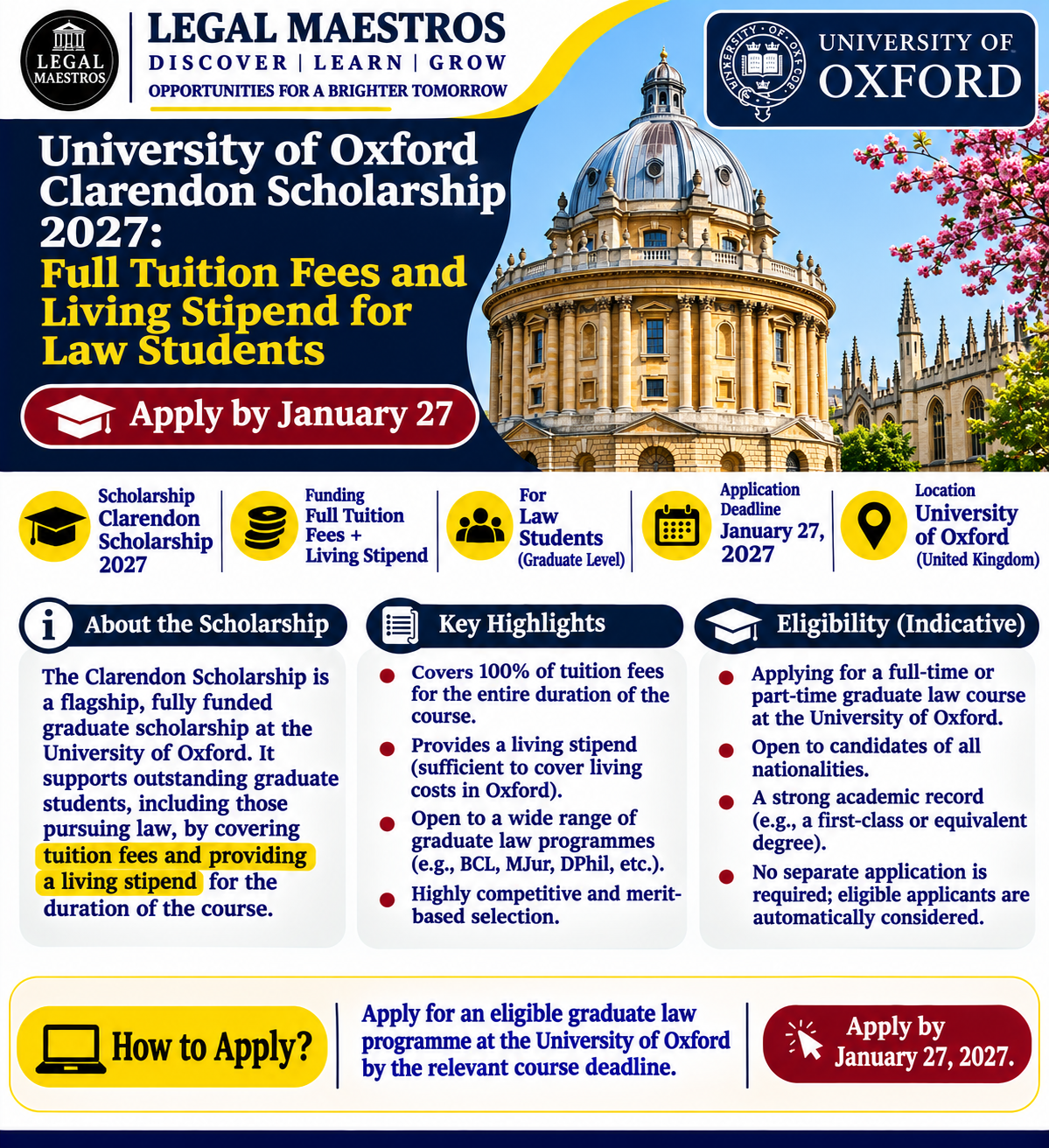
The University of Oxford in the United Kingdom is accepting applications for its Clarendon Scholarship for the 2027–2028 academic year. The scholarship provides full financial assistance to selected students pursuing postgraduate taught and research programmes at the university.
Indian law graduates, practising lawyers and legal researchers interested in pursuing the Bachelor of Civil Law (BCL), Magister Juris (MJur) or Doctor of Philosophy (DPhil) in Law may be considered for the scholarship.
Selected candidates will receive full coverage of their course fees and financial support towards living expenses during the funded period.
The scholarship is open to applicants from all countries. There is no restriction based on nationality or ordinary residence.
For the BCL, MJur and DPhil in Law programmes, the last date for submitting applications is 27 January 2027.
About the Clarendon Scholarship
The Clarendon Fund is one of the University of Oxford’s major graduate scholarship programmes.
Need Help With Your PhD or LLM Thesis?
Explore our thesis and dissertation writing support services for PhD and LLM students. Get subject-specific academic assistance for your research project.
Explore Our Services →It was established in 2001 to support academically outstanding postgraduate students. Initially, the programme focused on international students, but it was later expanded to include applicants from the United Kingdom and other countries.
The scholarship is supported primarily through funding connected with Oxford University Press and additional partnerships within the university.
Clarendon supports students pursuing both taught postgraduate degrees and research programmes.
The scholarship is awarded on the basis of academic excellence and the applicant’s potential to make a meaningful contribution to their chosen field.
Unlike scholarships restricted to a particular nationality or academic discipline, Clarendon considers eligible applicants across the university.
Law students are among those who may receive funding through this programme.
Courses Covered for Law Students
Oxford’s Faculty of Law offers several postgraduate programmes whose eligible applicants may be considered for Clarendon funding.
Three particularly relevant options are the Bachelor of Civil Law, Magister Juris and DPhil in Law.
The Bachelor of Civil Law (BCL) is an advanced postgraduate law degree intended primarily for students from common-law jurisdictions.
Despite its name, the BCL is not an undergraduate degree. It is a postgraduate programme involving advanced legal study.
The course normally takes ten months to complete.
The Magister Juris (MJur) is another postgraduate law programme, designed primarily for students from civil-law jurisdictions.
It also normally takes ten months to complete.
The DPhil in Law is Oxford’s doctoral research programme. It is equivalent to a PhD and allows students to undertake original research under academic supervision.
The full-time DPhil generally takes three to four years, while the part-time programme takes six to eight years.
The Clarendon Fund also supports other eligible postgraduate degrees. Applicants should check the funding arrangements for their chosen course.
Can Indian Law Graduates Apply?
Yes. Indian law graduates are eligible to compete for the Clarendon Scholarship.
Oxford has expressly confirmed that the scholarship is open to candidates of all nationalities.
Applicants who have completed a recognised LL.B., BA LL.B., BBA LL.B. or equivalent law qualification may seek admission to eligible postgraduate law programmes, provided they meet the academic requirements.
For Indian law graduates, the BCL is generally the more relevant taught postgraduate option because India follows a common-law legal tradition.
The MJur is primarily designed for candidates from civil-law jurisdictions.
Indian candidates interested in advanced legal research may also apply for the DPhil in Law.
Applicants must first satisfy the university’s admission requirements for their chosen programme.
Being eligible for admission does not automatically mean that a candidate will receive the Clarendon Scholarship.
Eligibility Criteria
The Clarendon Scholarship is available to candidates applying for a new master’s or doctoral degree at Oxford.
Applicants must submit their course applications by the relevant December or January funding deadline.
There is no separate Clarendon scholarship application.
The university considers applicants from all countries and academic disciplines.
However, selection is highly competitive.
Oxford places considerable importance on academic achievement, research potential and the candidate’s suitability for the proposed programme.
For the BCL and MJur, applicants are ordinarily expected to possess a first-class undergraduate degree in law or an equivalent qualification.
The DPhil in Law also normally requires a first-class law degree or an equivalent academic qualification.
Many successful DPhil applicants already possess a master’s degree, although Oxford states that this is not a formal admission requirement.
Candidates holding Indian degrees should consult the university’s international qualification equivalency guidance.
Academic Performance Requirements
The Clarendon Fund selects students primarily on academic merit.
Oxford states that most successful scholarship recipients have an outstanding academic record, often equivalent to a first-class honours degree.
The university may examine the candidate’s marks, academic distinctions, university prizes and position within their graduating class.
Research experience and publications may also be considered where relevant.
However, Oxford does not require every applicant to have published academic articles.
The importance of particular achievements may differ between taught postgraduate programmes and doctoral research courses.
Candidates applying for a DPhil should demonstrate that they are capable of undertaking independent research and contributing original scholarship to their field.
Strong recommendation letters and a clearly developed research proposal can be important parts of this assessment.
Scholarship Amount and Financial Benefits
The Clarendon Scholarship covers 100% of the course fees for selected students.
This benefit applies to both domestic and international fee-status students.
Full-time scholarship recipients also receive an annual grant towards living expenses.
Oxford has stated that this amount will be at least equal to the minimum doctoral stipend rate established by UK Research and Innovation (UKRI).
For the 2025–2026 academic year, Clarendon recipients received at least £20,780 annually towards living expenses.
The exact annual stipend applicable to the 2027–2028 academic year has not yet been confirmed.
Applicants should therefore treat the earlier figure as a reference rather than a guaranteed amount for the new intake.
Part-time scholarship recipients receive a study support grant instead of the standard full-time living stipend.
The amount depends on the nature and duration of their programme.
Scholarship Duration
Clarendon funding normally continues for the period during which the student is liable to pay university course fees.
For a one-year postgraduate law programme, the scholarship generally covers the relevant academic period.
For a doctoral programme, funding is normally linked to the prescribed period of fee liability.
Oxford may, in certain circumstances, extend living-cost support beyond that period.
However, such extensions are discretionary.
The scholarship does not automatically cover continuation charges that may arise after the standard fee-liability period.
The precise duration and financial arrangements are confirmed in the scholarship offer documents issued to successful candidates.
DPhil in Law Research Opportunities
The DPhil in Law is particularly relevant for candidates interested in university teaching, legal scholarship and advanced research.
Oxford’s Faculty of Law supports research across several legal disciplines.
These include constitutional and public law, human rights law, jurisprudence, public international law, private law, business law, legal history, taxation and law and technology.
Researchers may also work on subjects involving computers and law, medical law and other specialised areas.
Applicants are expected to propose a research project that can be undertaken within the university’s available supervisory expertise.
The DPhil programme includes research methodology training and opportunities to participate in academic discussions.
Students may also be able to undertake teaching or research assistance assignments during their studies, subject to the university’s arrangements.
Research Proposal Requirements
Applicants seeking admission to the DPhil in Law must submit a detailed research proposal.
For the 2027–2028 intake, Oxford requires a proposal of 600 to 1,000 words.
The proposal should explain the research question, its originality and the approach the candidate intends to follow.
Applicants should also demonstrate that the proposed project is feasible within the time available.
The university considers the clarity of the research question, the applicant’s understanding of the subject and their ability to develop a reasoned academic argument.
DPhil applicants must additionally submit one academic writing sample of no more than 2,000 words on a legal subject.
Candidates should follow the prescribed word limits carefully because documents that do not meet the requirements may affect the assessment of their application.
Documents Required
Applicants must complete the online application for their chosen Oxford graduate course.
For the BCL, applicants are required to provide academic transcripts, an updated CV, a personal statement and an academic writing sample.
The personal statement must not exceed 300 words.
The legal writing sample must not exceed 2,000 words.
Candidates must also register three referees, preferably academics who can comment on their academic ability.
DPhil applicants are required to provide their research proposal, a legal writing sample, transcripts, CV and references.
The application requirements may differ between programmes, so applicants should consult the relevant course page before uploading their documents.
There is no additional set of documents required solely for the Clarendon Scholarship.
English Language Requirements
Oxford requires applicants to demonstrate proficiency in English according to the standards prescribed for their chosen course.
For the BCL, MJur and DPhil in Law, the university specifies its higher-level English language requirement.
For IELTS Academic, the minimum overall score is 7.5, with at least 7.0 in each component.
Oxford also accepts certain other recognised English-language qualifications.
Applicants may qualify for an exemption under the university’s rules, depending on their educational and language background.
Candidates should check the current requirements carefully, particularly because Oxford has published changes concerning acceptance of revised TOEFL iBT results.
Selection Process
The Clarendon Scholarship does not have a separate application or interview process.
Candidates are assessed for admission to their chosen postgraduate programme.
During the admissions process, academics within the relevant department identify strong applicants who may be nominated for Clarendon funding.
For law applicants, the Faculty of Law decides which candidates to nominate.
The nominations are then reviewed through Oxford’s academic divisional scholarship selection process.
The final selection is based on academic merit, future potential and suitability for the proposed course.
Admission to Oxford and selection for Clarendon funding are separate decisions.
A candidate may be offered admission without receiving a scholarship.
Scholarship Results
Oxford normally begins making Clarendon scholarship offers during the spring.
According to the official scholarship timeline, most initial offers are communicated by the end of April.
Successful candidates receive an email containing their scholarship offer.
The university subsequently provides a detailed funding breakdown and confirms the applicable arrangements.
Unsuccessful applicants are generally not contacted individually.
Oxford advises candidates who have not received a scholarship offer by mid-June to assume that they have not been selected, although a limited number of later nominations may occur.
How to Apply?
Interested candidates must apply through the University of Oxford’s official graduate admissions portal.
Applicants should first select the postgraduate law programme they wish to pursue.
Those interested in advanced taught legal education can examine the BCL or MJur.
Candidates planning to undertake original doctoral research can apply for the DPhil in Law.
After selecting the programme, applicants must complete the online application and upload the required academic documents.
They must also register their referees and ensure that the relevant references are submitted according to Oxford’s instructions.
No separate application, additional fee or additional form is required for Clarendon consideration.
Every eligible candidate who submits a qualifying graduate application by the relevant funding deadline is automatically considered.
Official Clarendon Scholarship Page: https://www.law.ox.ac.uk/admissions/scholarships-index/other-sources-funding-index/clarendon-scholarships
Official Clarendon Funding and Eligibility: https://www.ox.ac.uk/admissions/graduate/fees-and-funding/funding/clarendon/applicants
BCL Course and Application: https://www.ox.ac.uk/admissions/graduate/courses/bachelor-civil-law
MJur Course and Application: https://www.ox.ac.uk/admissions/graduate/courses/magister-juris
DPhil in Law Course and Application: https://www.ox.ac.uk/admissions/graduate/courses/dphil-law
Official Email for Law Scholarship Queries: student.funding@law.ox.ac.uk
Application Deadline
The last date for applying to Oxford’s BCL, MJur and DPhil in Law programmes for the 2027–2028 academic year is 27 January 2027.
The application deadline is 12 noon UK time.
Oxford has confirmed that applicants who submit their complete applications by the relevant deadline will automatically be considered for Clarendon funding.
The BCL and MJur programmes are expected to begin on September 28, 2027.
The DPhil in Law programme is expected to begin on September 27, 2027.
Interested candidates should complete their applications through the official university portal before the deadline, ensuring that all academic documents and required references meet the prescribed requirements.