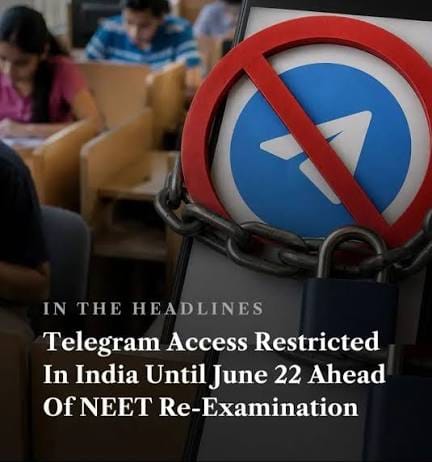
Millions of Indian smartphones displayed a blank, rotating wheel this week the moment you opened the messaging app. Suddenly, Telegram went dark across the country. India’s Ministry of Electronics and Information Technology switched it off on 16 June, but this was not some accidental technical snag. This was a deliberate government decision, blocking all access in the country until 22 June, precisely aligned with the massive NEET-UG 2026 re-examination on 21 June.
The move to temporarily ban the platform came at the insistence of the National Testing Agency. It told the government that the platform was being flooded by a whole slew of huge cheating syndicates demanding vast amounts of money from desperate candidates to provide them with early access to the medical entrance exam. While the vast majority of these were scams, the sheer volume of such operations triggered a panic among students. Convinced it could not effectively police the countless groups popping up, the government chose the nuclear option and shut down the whole network days before the exam.
The law tucked away in Section 69A
To take an action this far-reaching, the government pulled out its biggest legal gun. Section 69A of the Information Technology Act – the very same law used in 2020 to shut down TikTok and many other Chinese apps from Indian phones almost overnight. It allows authorities to order any digital information be blocked from public access. However, this power cannot be wielded whimsically; a government must prove it’s necessary for national sovereignty or to maintain public order.
At first glance, using a national security law to shield a medical exam may seem like a massive leap. But government lawyers argued this was a crisis requiring urgent action for public order. According to them, allowing the creation of masses of defrauded and enraged students rioting in streets over faked question paper leaks is a real threat. And with millions of rupees changing hands between cheating mafias through dubious bank accounts, it had spiralled from a mere cheating racket into an organised crime operation of national importance. Invoke Section 69A and the government is on a far higher pedestal; a platform has to comply before arguing about it later.
A very specific tech loophole
The temporary shutdown is not merely intended to stop people from sending messages. The real targeting is a unique feature of Telegram that had made it exceptionally dangerous in the eyes of the NTA: the message editing functionality.
A clever, highly manipulative trick devised by scammers was this: an administrator of a channel would post something completely innocent days before the exam. Perhaps an unrelated photo or a well-wishing message. And when the actual exam questions were finally published, the administrator would edit this old message to include the leaked question paper PDF. Because the app retains the original timestamp of the first message, it would appear that the channel had access to the leaked paper for three days beforehand. This edited screenshots of the documents would then spread like wildfire across WhatsApp and Twitter, presenting seemingly irrefutable evidence of a security breach. To prevent this, the government also did something unprecedented, forcing Telegram legally to completely disable the edit feature for Indian users until 30 June. This would prevent anyone from back-dating evidence of the breach.
Battle of the courtroom
Telegram, however, did not take the shutdown lying down and challenged the central government in the Delhi High Court. The app argued that blocking an entire communication app used by millions was absurd and went against the proportionality principle. If a crime is committed on a highway, you put up roadblocks on it. You don’t demolish it. The government’s response was more practical. It produced documents from the Indian Cybercrime Coordination Centre and told the judge that unlike typical messaging apps, Telegram depended heavily on automatic bots. The moment a police official identified and shut down a scamming group on a given channel, the bots would automatically reroute the members to a completely new channel within seconds, without requiring human intervention. You cannot, it argued, arrest a bot, and there was no way to outpace an automated system with traditional police work. The only effective way to halt the ceaseless cycle of cheating, it submitted, was a nationwide ban. The High Court took both arguments under consideration and reserved its verdict, keeping the ban in effect.
Band-aid on a bleeding system
While lawyers engage in a battle of the courtroom about access to servers, a much more fundamental discussion has been going on about what the root of the problem is. A messaging app does not breach the walls of a printing press; a smartphone does not unlock the security clasp on a delivery box. The leak happens somewhere in the physical world: someone along the chain of custody takes a bribe. By the time the paper makes it to a digital channel, the security breach has already occurred. Critics of the government contend that using technology censorship to hide a failure of physical infrastructure is merely deflecting from corrupt officials in charge of the actual examination papers. If the testing infrastructure was truly secure, nothing could be leaked online. The government counters that, while fixing the physical leaks, it must address the immediate digital spread, arguing that the sheer anonymity and speed offered by apps such as Telegram turn minor leaks into major national crises. This use of Section 69A marks an interesting legal precedent – it shows a government perfectly prepared to plunge millions into digital darkness to safeguard the sanctity of a single Sunday morning exam.