Pune Court Asks Rahul Gandhi to Respond After Complainant Offers Pen Drive of Alleged Defamatory Savarkar Speech
New Evidence Introduced in high profile defamation case.
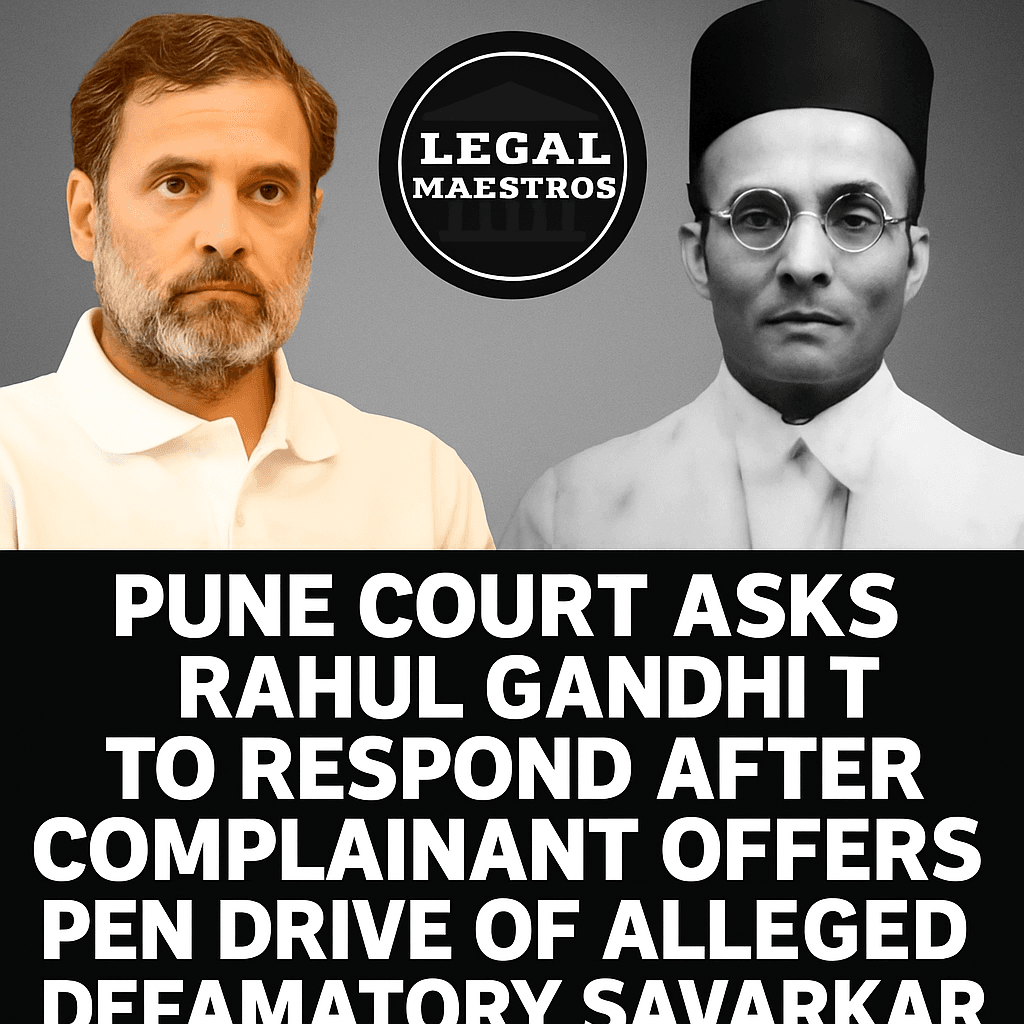
In a defamation case filed against him, Congress party leader Rahul Gandhi has been ordered by a special court in Pune to make a formal response concerning new evidence provided in the case. The case, which has received a lot of political interest, is one in which Satyaki Savarkar, the grand-nephew of the late Hindutva thinker, Vinayak Damodar Savarkar, filed allegations. The recent directive of the court followed after the complainant exposed two pen drives comprising of video footage of a speech that was offered by Gandhi in London. The point is a significant twist to the jurisprudential struggle that has been going on since the beginning of 2023.
The Special Judge, who hears the cases involving the Members of Parliament and those of the Legislative Assembly, Amol Shinde, passed the order after hearing a case on Thursday. The judge requested the defense team to file their written response by the following scheduled hearing, which will be on the 16 th of December, 2025. This is a procedural measure that will make sure that the accused will have a just chance to challenge the admissibility of the new electronic evidence. The court is now in the evidencing phase, which is a very important step and the complainant should be in a position to provide his allegations with practical evidences.
The delivery of pen drives was necessitated when a technical hitch made the previous evidence ineffective. Satyaki Savarkar had earlier filed a Compact Disc (CD) in a court of law which claimed to host the same video recording of the alleged defamatory speech. When the court however tried to play the CD at the time of examination-in-chief, it was discovered that it was blank. This sudden technical malfunction saw the proceedings put at risk of being stalled, and the complainant tried to find other ways to put the video on a judicial record.
For any queries or to publish an article or post or advertisement on our platform, do call at +91 6377460764 or email us at contact@legalmaestros.com.
Controversy of Electronic Records Admissibility.
The inception of the pen drives created an instant legal controversy between the two opposing counsels in court. The attorney of Satyaki Savarkar, Sangram Kolhatkar, said that the pen drives were a necessary recreation of the lost evidence because of the malfunctioning CD. He stressed that the content of the video was the same as that which was supposed to be displayed. To substantiate this filing, the legal department also provided a certificate as required under Section 65B of the Indian Evidence Act that is a mandatory pre-requisite of the admissibility of any electronic records in Indian courts.
Advocate Milind Pawar, the defense counsel of Rahul Gandhi, objected strongly to this new filing on the other side. He contended that the admission by the prosecution of new evidence during the middle of the hearing particularly when the first evidence did not load was procedurally unsound. The defense now argued that they had to take time researching on the application and the new material and then it could be formally adopted by the court. They also doubted the upholding of the process and the validity of the act of handing pen drives at this point and the fact that it contravened the set out criminal procedure rules.

The major issue of the defense is that the electronic evidence is not altered and is original. The objection causes the court to refuse playing the video in the open courtroom at once. Rather, the judge chose to give a due process of law and gave the defense an opportunity to submit in writing or orally an objection. This is to make sure that the natural justice principles are maintained which provides the accused with the right to question the provenance and validity of the evidence presented against him.
The Allegations of Defamation and London Speech.
The essence of this court case is a speech made by Rahul Gandhi in his trip to the United Kingdom in March 2023. The Congress leader spoke to the people in London, and gave special mention to Vinayak Damodar Savarkar, which was very distasteful to his family. As per the complaint that was made by Satyaki Savarkar, it was alleged by Gandhi that the Satyaki Savarkar had authored a book where he had indicated an incidence involving him and his friends beating up a Muslim man. Gandhi is quoted saying that Savarkar wrote that he was happy after the act.
Satyaki Savarkar has strongly protested against such an event having occurred and that his grand-uncle had ever written such a passage. In his complaint, he had claimed that the comments were absolutely made up and ill-intentioned, to bring into disrepute a saintly freedom fighter. In his argument, he held that no such confession or anecdote could be found in the literature of Savarkar. This complaint was made on the ground of Section 500 of Indian Penal Code which addresses punishment of defamation. Should he be found guilty, the prison sentence is up to two years.
The scandal shows how much of an ideological divide there is in the history of Indian politics. Savarkar is an evergreen controversial leader who was praised by the right wing community as a patriot but condemned by the left and centrist parties due to various reasons. The complainant did not find the remarks of Gandhi Rahul to be falling within the scope of political criticism but considered them as a factual falsehood in a bid to character assassinate him. What the court now has to do is to ascertain whether the speech was actually uttered as alleged and whether the speech qualified legally as defamation of a criminal nature.
Preliminary Hearings and Delays During Procedures.
There have been a number of procedural hitches and delays in this case since its initiation. Prior to the matter of the blank CD the court was first required to establish whether there was sufficient prima facie evidence to go ahead and charge Rahul Gandhi at all. The local police had been first ordered by the court to carry out an investigation under Section 202 of the Code of Criminal Procedure. The police report which was later submitted found that the speech was actually within the public domain and that the allegations prima facie constituted to defamation.
After the police report, summons were sent by the court to Rahul Gandhi who later appeared before the court to give his plea. He was innocent of the charges and this was a prelude to witnessing the entire trial. The case has since been taken to the evidence stage. The court had also earlier on denied the complainant the right to play a YouTube link of the speech. The judge himself had already decided that no YouTube video could be played directly without certification in place on the one hand by the platform or the uploader, which supported the high standards of digital evidence.