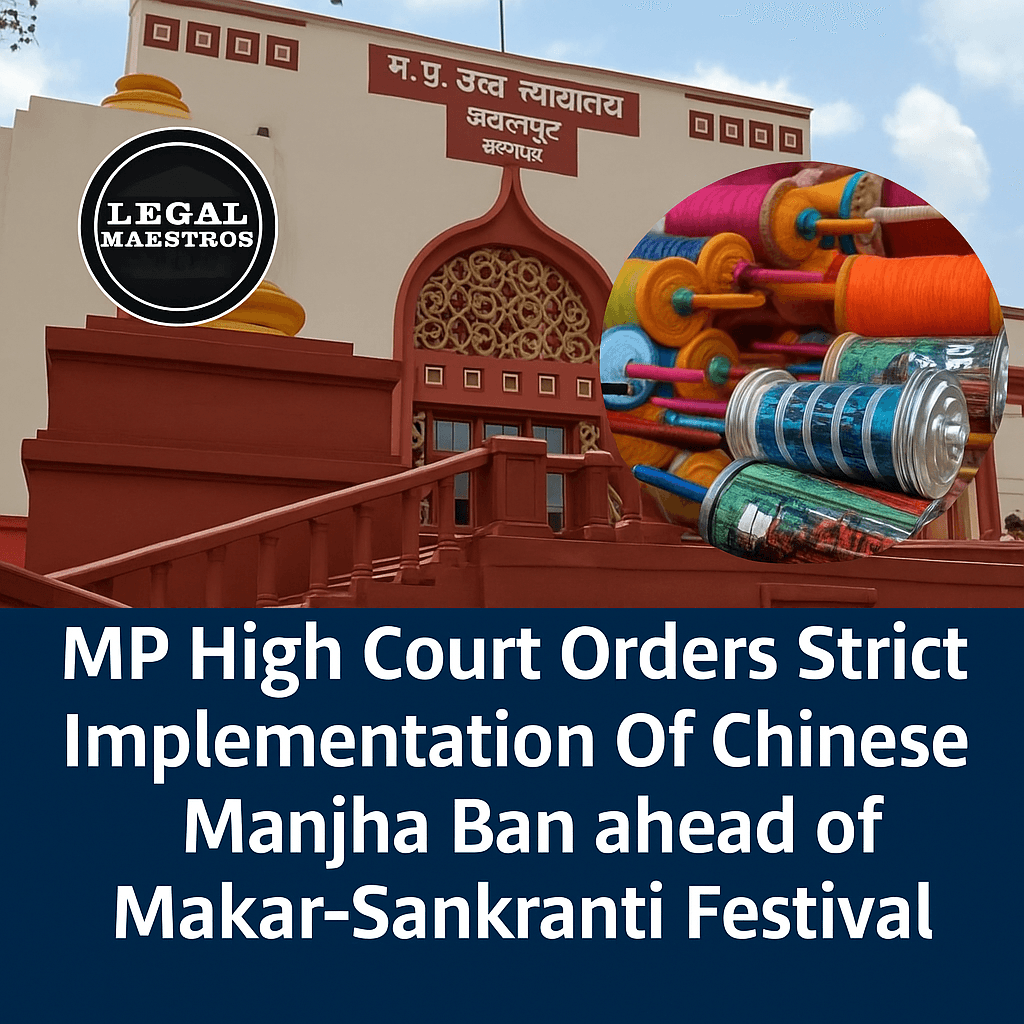
MP High Court Orders Strict Implementation Of Chinese Manjha Ban ahead of Makar-Sankranti Festival
Ban to be enforced Strictly Directs High Court.
The Madhya Pradesh High Court at Indore has made a very tough stand on the sale and consumption of Chinese manjha. This order is like an inevitable intervention only weeks ahead of the famous kite-flying festival Makar Sankranti. The division bench which included Justice Vijay Kumar Shukla and Justice Binod Kumar Dwivedi showed a lot of dissatisfaction with the earlier attempts made by the local administration. They observed that the deadly synthetic thread is still openly marketed in markets despite the bans that exist. The court has now ordered that the police and district collectors should immediately, visibly and effectively proceed to put this illegal trade to end.
The judges pointed out that the ban cannot be just on paper but it needs to be operationalized on the ground to save lives. The case the court was hearing was a public interest litigation that raised the critical threat of such sharp strings to both human beings and birds. The bench has particularly directed the authorities to provide a compliance report by the next hearing date that is set to take place on January 12, 2026. This schedule will make the administration responsible, and take prompt actions before the festival celebrations take off. The court has a stern tone, which shows that any laxity in officials will be taken as an offence.
The order issued by the High Court has fourteen districts which are under the jurisdiction of the bench of Indore to ensure that they are thoroughly implemented. Such areas incorporate the big urban centers such as Indore and Ujjain along with Dewas, Dhar, Ratlam and Mandsaur. These districts have been made personally liable to the performance of the ban by the Collectors and Police Superintendents of those districts. The court has instructed them to establish special inspection teams that will raid the godowns and shops that may be having the contraband. These teams will be required to make surprise checks to instill fear to the black marketeers.
For any queries or to publish an article or post or advertisement on our platform, do call at +91 6377460764 or email us at contact@legalmaestros.com.
The court has also asked the administration to initiate a massive public awareness campaign through print and electronic media. According to the judges, it is as important to control the demand as it is the supply of the thread. The parents are being advised to take care of their children and not allowing them buy or use Chinese manjha. The government has been requested to sensitize people on the legal implications of using the prohibited substances. The holistic approach of the court is focused on getting the community involved in the war against this perilous tradition.
Terrible Death Spurs Court Intervention.
What directly caused this judicial cautioning of eyes was a heart-wrenching episode which caused a shaking of the city of Indore. One of the most terrible incidents occurred when a sixteen year old boy by the name of Gulshan died in a very horrifying way because of a wayward kite string. The teenager was riding a motorcycle on the by-pass of Tejaji Nagar when the sharp synthetic thread cut his throat. The accident occurred when he was taking his brother and friends back home on a trip to Ralamandal. Although the patient was rushed to the hospital, the extent of the cut resulted in excessive loss of blood hence he died prematurely.

This accident brings into focus how deadly the Chinese manjha is particularly when two-wheeler riders are the ones who are usually taken by surprise. The thread is fine and transparent such that a rider traveling with speed hardly notices it. The glass-covered surface, when coming in touch with the skin, is like a knife, which cuts through soft tissue in a moment. The death of Gulshan caused an outrage among people and appeals to the state administration to act. This incident caused the High Court to become aware of this so that the loss of innocent lives is averted on the city roads.
Health care practitioners in the area have been complaining of an alarming increase in serious injuries in the kite-flying season. Medical practitioners in large hospitals have reported that injuries by manjha of the Chinese are usually deep and intricate. The synthetic nylon versions are very strong and cannot break as opposed to the old cotton thread that snaps when pressurized. This tensile force enables the string to slice through muscle and also arteries and bone (where it is possible). Surgeons are forced to make complex surgeries to fix the nerves and tendons which have been cut by these strings.
It is not only a threat of fatal throat cuts; a vast number of individuals are victims of deep cuts on their hands and fingers. Young children have the habit of cutting their hands in the attempt to pull the kite string and they end up damages permanently. According to another recent accident in the Khajrana region, a man lost his thumb when his foot caught in the sharp thread. These recurrent incidents prove that the manjha that the Chinese have is not a toy but a weapon that can kill. The court noted that life and safety of the citizens has priority and cannot be at stake due to recreational activities.
Risks of Synthetic Strings and Glass Coated Strings.
The major cause of the ban is the hazardous material composition of the Chinese manjha. As opposed to the standard Indian saddi handicraft of using cotton thread and covering the thread with a combination of rice flour and glass dust, the Chinese one is nylon monofilament. This Drum Buffer Rope makes it appear unnatural through the use of this synthetic base that enables it to be unbroken by bare hands as a result of its tensile strength. It is commonly covered in metallic powder or processed glass in order to provide it a sharp cutting edge. This is why it is popular with kite fighters who desire to cut the kites of their opponents with ease.
This power is precisely what causes it to pose a threat to the safety of the population and the environment, however. The nylon is non-biodegradable and may take decades before it decomposes in the environment. It gets stuck in trees, power lines, and even in bridges and forms permanent traps to birds and animals. Every year thousands of birds such as pigeons, eagles and owls are killed or maimed after colliding with such strings. During the festival period, cases of birds with severed wings and legs are flooded in veterinary hospitals and animal rescue shelters.
The synthetic strings have a metallic coating that is also a severe threat of electrocution. In case the thread is in contact with high-tension power lines, it may become a conductor of electricity.