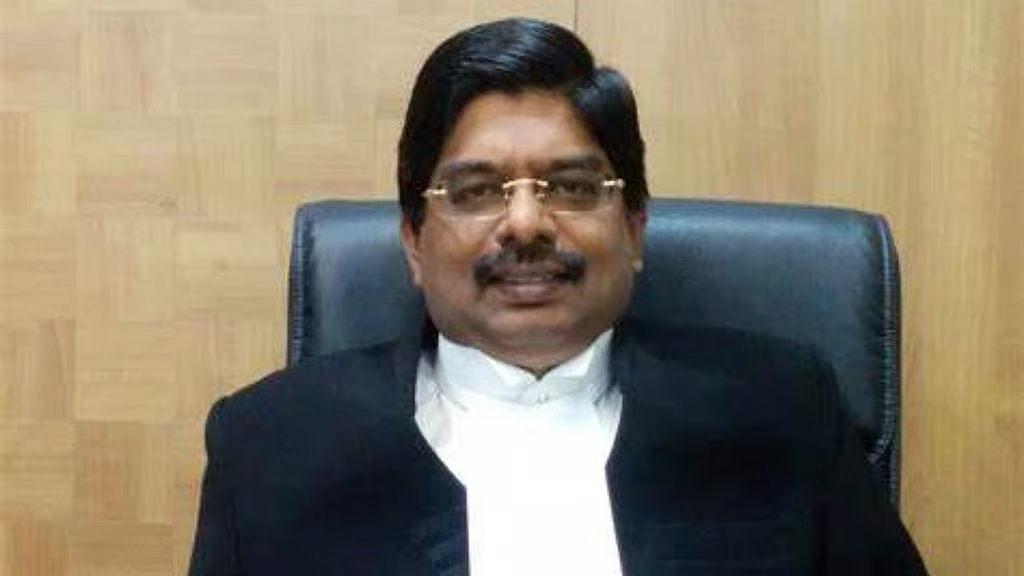
Following a hot-polemic week in politics, the debate on the gender representation in the legislature of India has gone off-track. Only a day after the ambitious attempt by the government in linking the reservation of women with a complicated process of delimitation did not clear the Lok Sabha, Dravida Munnetra Kazhagam (DMK) Rajya Sabha MP P. Wilson came to the limelight. On Saturday, April 18, 2026, he presented a Private ember Constitution Amendment Bill which suggests a far simpler route to reaching the long-desired thirty-three percent quota of women in Parliament and State Assemblies.
The Gist of the Proposal.
Simplicity is the gist of the bill prepared by Wilson. Although in the recent failed proposal, the Constitution (131st Amendment) Bill, the government sought to push women to be reservation-bound, by restructuring the entire electoral map, and adding more seats, Wilson plan proposes we just jump over all that. He is advocating the adoption of the reservation into the existing strength of 543 seats in the Lok Sabha.
In so doing the bill will steer clear of the administrative quagmire of another census or the contentious delimitation exercise, which may horrify many opposition parties is merely a means of postponing the reservation itself indefinitely. The proposal is not only to the Lok Sabha but also covers State Legislative Assemblies, the National Capital Territory of Delhi and the Union Territories of Puducherry and Jammu and Kashmir. This is so that the end result, according to the MP, is to ensure that such reservations become part of our democracy, and not a temporary solution, which dissipates after a few elections.
Breaking the Link with Delimitation
The largest controversy of the recent days has been that of the connection of women reservation with the process of delimiting. The government claimed that a new census and consequent delimitation was required to complete the reservation. But Wilson in his bill assumes the stance that there is no necessity to wait until such time-consuming processes take place.
To him postponing reservation in the name of awaiting a census is counterproductive. According to his bill, the current structure is more than enough to support this historic change. By concentrating on the current number of seats, the legislation will seek to avoid the political acerbic which has often resulted whenever discussions are made on the need to change the constituency lines and which often triggers fears among the southern states that their political representation would be watered down because they have been successful in controlling their population.
The Political Climate
This legislative action is very sensitive. The collapse of the government bill on April 17 with 298 votes in favor and two-thirds of the two-thirds majority being missed has created a colossal vacuum in the national discourse. The political lines were well drawn with 230 members against that bill with opponents claiming that the reservation was being linked with the census in an effort to essentially change the voter system in India.
Wilson, who is being instructed by the Chief Minister of Tamil Nadu, M.K. Stalin, is driving the message that the government is only delaying it as an indication that it does not mean it. He has not only introduced the bill, but also made a notice under the Rajya Sabha rules, rule 267. This was a radical step, an effective request of the Chair to place all other business on hold and have a desperate urgent discussion as to why women should be given their rightful portion of power immediately.
Sought Permanence in Representation.
The most noticeable part of the pitch by Wilson is his insistence on permanence. Many considered the 2023 “Nari Shakti Vandan Adhiniyam” to be a landmark, yet it included conditions and clauses about the sunset, which were criticized by some. The bill by Wilson is presented as a constitutional amendment that is permanent. It aims to create a system, where, beginning with the next election, women will be assured a place in the top decision-making organs of the land.
Another arrow in his quiver is the financial argument. To increase the seats to 850 which was a proposal in the unsuccessful government scheme would have imposed a great burden on the exchequer of the people which was not necessary. The bill by Wilson does not incur these costs because it operates within the existing infrastructure of the existing 543 Lok Sabha seats and the existing state legislative assembly set ups.
What Happens Now
The future of the legislative route is unclear at the moment. It is reported that the Chairman of the Rajya Sabha had refused to allow the discussion of the bill by Wilson or his notice under Rule 267. This refusal has further spurred the flames, as the DMK and other opposition members have tripled their efforts in their arguments that the ruling party is playing technicalities to evade giving women their rightful role in the leadership of the country.
The debate on whether we should have women in Parliament as a special session is now whether we should or whether we should not; and when and how. The action taken by Wilson makes sure that the emphasis is on taking action. It remains to be seen whether or not this bill by this particular member of parliament will struggle to accumulate sufficient momentum to compel a shift in strategy but it has at least put the government on the defensive regarding the allegation that it is putting its efforts more into political engineering than the dire need of gender equity.
The nation is keeping an eye on. The necessity of women representation is no longer a fringe benefit, but the main line of a high stakes confrontation between long-range planning by the government and structural change demanded by the opposition. This much is certain: the debate surrounding this bill is nowhere near its end and it is likely to influence the political discourse before the next general elections.