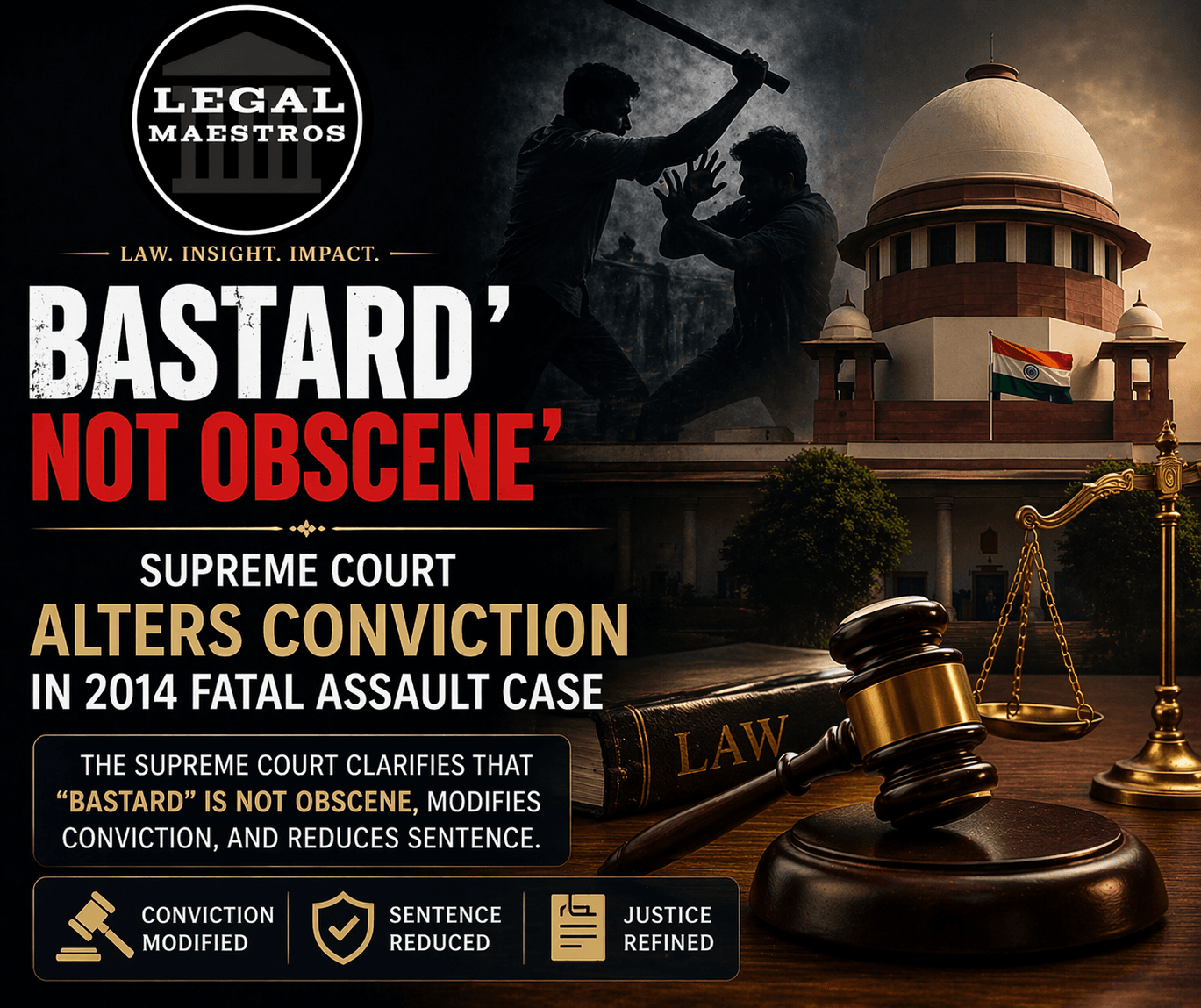
‘Bastard Not Obscene’: Supreme Court Alters Conviction in 2014 Fatal Assault Case
Introduction
In a recent decision, the Supreme Court of India had important observation on what constitutes obscenity in criminal law. When the Court was deciding a case involving a deadly attack in 2014, it ruled that the usage of the phrase bastard is not considered an obscene act by law.
Case History.
The case came about as a result of a violent incident between members of the same family due to a dispute on a property. In the fight, some abusive words were exchanged and one individual was even killed.
The accused were found guilty of culpable homicide in the lower courts as well as the use of obscene language as provided under the Indian Penal Code under Section 294.
The issue was also appealed to the Supreme Court.
Facts Before the Court.
The main question before the Court was whether the words bastard were used in the midst of a quarrel and if it constituted an offence of obscenity according to Section 294 IPC.
Supreme Court’s Analysis
The case the Supreme Court looked at was the definition of obscenity by the law. It said that words could be obscene, they had to be able to awaken sexual or lustful feelings in the mind of an ordinary person.
The Court ruled that abusive language when used in anger or in a fight does not necessarily become obscene. The word “bastard,” though offensive and insulting, does not have a sexual or lustful meaning.
Hence, the Court found that the law of obscenity could not be used to punish such language.
Changes in Conviction
By this argument, the Supreme Court quashed the conviction of the accused in pursuant to Section 294 IPC.
Nevertheless, the Court still considered the part of the accused in the assault. It analysed whether the act amounted to murder or a lesser offence like culpable homicide.
The Court, taking into account the facts, such as that the incident occurred spontaneously in the course of a quarrel, changed the conviction to a minor offence and shortened the sentence.
Importance of the Judgment
This ruling is significant since it is a clear explanation of the distinction between abusive language and legally punishable obscenity.
The Court clarified not every bad or offensive word is to be treated as a criminal offense. Only those words which meet the legal test of obscenity can be punished under Section 294 IPC.
The ruling of the Supreme Court sheds light on the understanding of the obscenity laws in India. It keeps people out of unjust criminal prosecution over using abusive language and yet on the other end it does not prevent severe violence incidents to be punished. The fact that the judgment is rather balanced in its approach to safeguarding dignity and ensuring fairness in criminal law is commendable.
Keywords
Judicial decision, obscenity, Section 294 IPC, abusive language, bastard not obscene, culpable homicide, criminal law India, freedom of speech, interpretation of the law.