Section 66D IT Act: NTA Teams Up With I4C to Crack Down on the Viral Re-NEET Leak Video perpetrators The excitement of the NEET-UG 2026 re-examination-which was originally supposed to conclude on Sunday-has finally eased. Students anxiously awaited this Sunday as they planned to take their medical entrance exam-now postponed from its May date following accusations of paper leaks-which had affected more than 20 lakh students across India. Then, a fraudulent video started doing the rounds of social media; the re-exam papers were said to be released.
This viral video claimed to have evidence from private chat conversations and leaked papers.
As expected, this triggered intense pressure among thousands of families. That it all proved false is a thing of joy for the authorities. As per sources, the National Testing Agency did not issue only a casual rebuttal when news of the video broke on Telegram and other popular platforms. They responded aggressively by declaring the entire clip fabricated.
An officially approved confirmation then followed that the examinations had continued undisturbed and the purported leaks had no basis.
They also informed that they would collaborate with Indian Cyber Crime Coordination Centre (I4C) to find the individuals behind the fabricated clips by invoking the relevant provisions of the Information Technology Act. # The Online Scammers’ Digital Trail The NTA’s current approach-actively identifying and prosecuting the culprits responsible for online hoaxes-is unprecedented among Indian government organizations. Typically, the NTA’s protocol to such fake news has been a simple debunk notice; it seems to have understood this time the high stakes of the NEET UG paper leak scandal.
Having received widespread criticism and damage to its credibility following the scandal in May, the NTA now understands that even ridiculous lies and social media provocations-regardless of the evidence presented to refute them-could jeopardize the retest. The I4C’s inclusion transforms the effort from a PR exercise to a genuine criminal inquiry. Police and other agencies will be identifying and locating suspects, tracing their computer IPs, determining their roles, and bringing them in to account.
The core of the current crackdown is Section 66D of the IT Act, which penalizes an individual for impersonation with intent to deceive via the use of computer resources.
Such impersonations may result in imprisonment and significant financial penalties, including significant sums of cash for fake question sets distributed through some popular applications, as well as ransom demands in some cases-up to 25,000 Indian rupees. Abhishek Singh, the Director General of NTA, took personal responsibility to curb the spreading fake news. The government took preemptive action and momentarily shut down access to select messaging sites to dismantle the network and the flow of fraudulent news. # Massive Security Operation Parallel to the online chase for the perpetrators, the exam was conducted with extraordinary security measures.
The agency’s spokesperson referred to this as ‘Team Bharat’ and a multi-agency collaborative approach to conduct the exam smoothly.
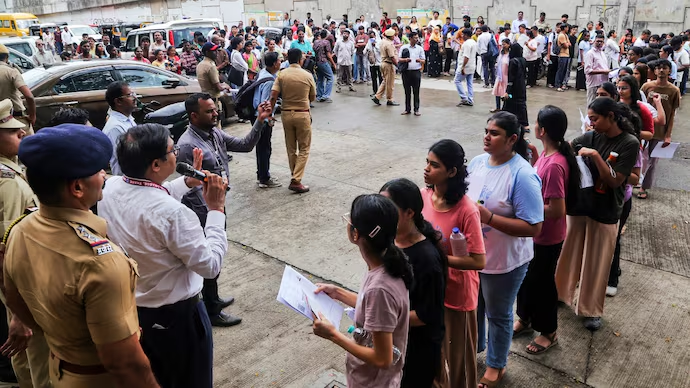
They said they had put in place about seven hundred thousand staff to help in the smooth conducting of exams. It had also arranged to conduct the exam in a 144-degree secure setting in more than 5000 locations worldwide. It had a network of more than five hundred thousand people on ground to guard the exams.
As many as 5,440 exam centers in 14 countries across the globe were established for the exams conducted across 13 languages. They also took a slew of steps to streamline the system from printing of question papers to movement and their safe storage by deploying some highly trained officials and agencies. Students were given entry to their respective venues after their biometric verification.
There was Face identification facility, as well as they were asked to carry, or the venue they reached there will carry no metal object in it.
They also installed signal jammer and also took precautions against those who carry smartwatches, mobile phones or smart bands as the centers came with advanced monitoring techniques in place. There were some individual incidents involving fraud attempts to sneak in devices but the well-trained personnel immediately dealt with them successfully. The examination was an elaborate operation for everyone involved, requiring tremendous effort to complete within just 37 days for this reexamination in a dozen languages. # The harsh realities of exam anxiety: ‘Team Bharat’ This whole issue of the trending fake NEETUG paper leak news reveals the stark and ugly side of contemporary Indian education.
A large number of the scams in education today aim to prey upon desperate or hopeful students who want a brighter future for their children.
For students looking for a shot at success, this is the apex opportunity. The pressure to succeed is enormous, and with it comes the susceptibility to such deceptions. It is clear the online fraudsters see the desperation as an opportune moment to prey on these opportunities, selling worthless, false guarantees to anxious students in exchange for cash sums.
For instance, a teenager who spent his entire childhood studying is susceptible to any such “guaranteed shortcut” he or she finds online, hoping to crack the tough exam. The sheer need to alleviate the anxious pressure to achieve can make any, even the most nonsensical information, desirable. To counter this barrage of deceit, th