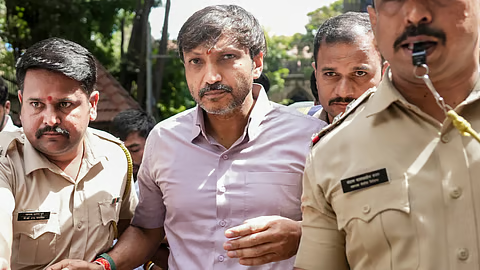
A Decades-Old Murder Case Ends in Acquittal A special CBI court in Mumbai just threw out one of the most high-profile murder cases in Maharashtra’s political history. Former state Home Minister Padamsinh Patil walked free on Saturday. The judge acquitted him along with seven other men accused of orchestrating the brutal 2006 assassination of Congress leader Pavanraje Nimbalkar.
The verdict drops the curtain on a legal drama that dragged through the courts for nearly twenty years.
Patil is now 86 years old. He arrived at the courthouse in a wheelchair while an ambulance idled outside. The prosecution spent over a decade trying to prove he ordered a hit on his own cousin over intense political and business rivalries. They failed completely.
Special Judge Satyanarayan Ramjivan Navandar ruled that the investigating agency could not prove the chain of circumstances beyond a reasonable doubt.
The Kalamboli Highway Shootout The violence that started this massive legal fight happened on a busy road back on June 3, 2006. Pavanraje Nimbalkar was riding in his car with his driver Samad Kazi. They were traveling from Mumbai toward Osmanabad.
Two hitmen forced their vehicle to stop near Kalamboli in Navi Mumbai. The assailants opened fire right there on the Mumbai-Pune expressway. Both Nimbalkar and his driver died instantly in the front seats.
Need Help With Your PhD or LLM Thesis?
Explore our thesis and dissertation writing support services for PhD and LLM students. Get subject-specific academic assistance for your research project.
Explore Our Services →The local Navi Mumbai police initially handled the crime scene.
But the victim’s wife Anandibai refused to accept their findings. She went straight to the Bombay High Court in 2008. She filed petitions claiming the state police were botching the job on purpose to protect powerful people. The High Court agreed the local investigation looked incredibly lazy and handed the entire mess over to the Central Bureau of Investigation.
The Central Bureau of Investigation Takes Over Federal investigators swooped in and arrested Patil in June 2009.
He managed to secure bail a few months later from a sessions court in Raigad. The CBI painted a very specific picture of the motive. They claimed the relationship between the two cousins went completely sour after the 2002 elections.
The breaking point allegedly involved money and power. The prosecution argued they were fighting bitterly over the management and financial control of the Terna Sugar Factory. Nimbalkar had actively opposed how Patil ran the business.
He even contested an assembly election against Patil in 2004.
The CBI told the court that Patil hired contract killers and paid them roughly Rs 30 lakh to eliminate his rival permanently. They hauled in other accused men like businessman Satish Mandade and former excise inspector Mohan Shukla to face the judge. A Complete Breakdown of Evidence The trial officially kicked off in 2011. It was a massive undertaking.
The court dragged in 128 different witnesses to testify over the years.
Even anti-corruption activist Anna Hazare took the stand at one point because of alleged threats. But the actual evidence presented by the CBI was a complete disaster. The judge pointed out massive procedural failures right away.
The investigating officers never bothered to seize the mobile phones of the accused men. They completely ignored call detail records. Those phone logs were the only way to prove the men were actively communicating to coordinate a hit.
Without them the conspiracy theory lost a huge chunk of its foundation.
The physical evidence was just as bad. The CBI brought up a burnt car they claimed was used during the murder. But the official police seizure report somehow described the car as being green. The judge openly asked how anyone could determine the paint color of a vehicle that was entirely destroyed by fire.
The witness statements regarding where this car was actually found clashed constantly.
The Approver Who Ruined the Prosecution The biggest reason the case collapsed was the star witness. The CBI built their entire prosecution around a man named Parasmal Jain. He was originally one of the accused men.
He claimed he accepted the initial murder contract before passing the job down to the actual shooters. Jain asked the court for a pardon and turned into an approver for the state. He promised to tell the whole truth.
The judge ended up calling him a blatant liar.
His testimony was a disorganized mess. Jain changed his story multiple times during the trial. He gave the court four completely different versions of the route he supposedly traveled on the day of the killings. Jain also told the court he agreed to organize the hit because he desperately needed Rs 50,000 to pay for medical treatments.
The judge looked at Jain’s financial records and immediately called his bluff.
Jain owned multiple properties and businesses. He had plenty of gold and substantial assets. The idea that a wealthy businessman would coordinate a violent highway assassination for a tiny sum of money made zero sense.
Jain even tried to claim he was tortured into making statements during illegal police custody back in 2009. The judge threw his testimony in the trash. Without their star witness the CBI had absolutely nothing linking Patil to the shooters.
Unanswered Questions and the Political Fallout The sudden acquittal sent shockwaves through the local political scene.
Padamsinh Patil is a heavy hitter. He is a senior leader in the Nationalist Congress Party faction led by Sharad Pawar. He is also the stepbrother of current Maharashtra Deputy Chief Minister Sunetra Pawar. Nimbalkar’s family is furious.
His son Omprakash Rajenimbalkar currently sits as a Lok Sabha Member of Parliament for the Shiv Sena faction led by Uddhav Thackeray.
He told reporters the verdict was extremely surprising and deeply unfortunate. The legal battle is definitely not over. The CBI released a brief statement confirming they plan to challenge the trial court’s decision.
They intend to drag the case up to the Bombay High Court. The victim’s family is threatening to push the matter all the way to the Supreme Court if necessary. For now all eight accused men are officially clear of the murder charges.
They walk away after two decades of court dates and endless legal maneuvering.
The Kalamboli highway murders remain officially unsolved in the eyes of the law.