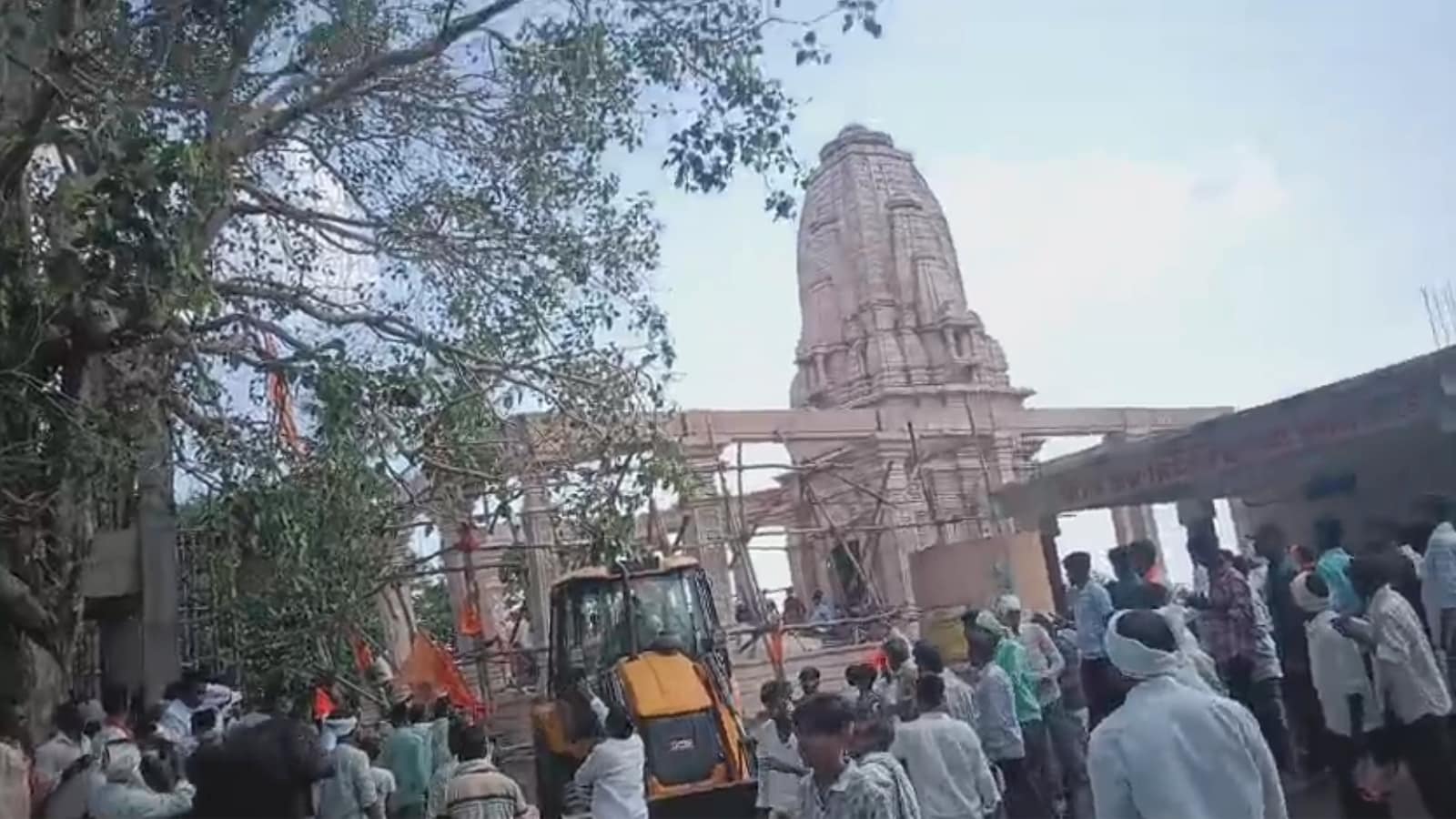
Five people died after the roof of an under-construction temple collapsed on the afternoon of June 20, 2020, in Yashwadi village in Maharashtra’s Parbhani district. Over two dozen others were injured when large slabs of pink stone from a 30-year-old Hanuman temple’s assembly hall crushed worshippers during the evening prayers and community lunch on Saturday.
The construction work on the temple was not completed yet, but the management decided to inaugurate it. Many people gathered at the temple on the occasion of Hanuman worship. Suddenly, half the building collapsed around 3:30 PM.
The roof was under construction.
More than two dozen people injured are receiving treatment at the government and private hospitals. “Most of the people at the site were buried under huge pink stone slabs from the roof. Locals immediately rushed for rescue and we found more than two dozen people alive in the debris after two hours. Five people were found dead,” Manwat police station inspector A.
Sutar told TOI. According to police, the stone structure was being built by a private construction company. There was preliminary evidence of a design flaw, they stated.
Preliminary investigations in the roof-collapse incident have revealed some stark lapses in construction practices, which led to the death of five people and injured several others in an under-construction temple in Yashwadi village of Manwat Taluka in Parbhani district. Five men were declared dead by the doctors while over two dozens received injuries when the large roof, with heavy blocks of pink stone on its surface from Rajasthan, caved in all of a sudden and landed over devotees during prayers. This could be said to be another case in series, where construction lapses and gross violations of standards led to fatalities. The local authorities have now taken cognisance of the findings of a structural engineering investigation by the local tehsildar and other visiting experts.
The tragedy at the Hanuman temple in Yashwadi has highlighted lax construction practices in many religious sites across the state, which largely depend on donations for development and hire external contractors with little oversight. Several, including Chief Minister Devendra Fadnavis, have acknowledged the need to reinforce building safety norms. The construction firm had supposedly used wooden scaffolding to support heavy Rajasthani pink stone slabs; an obvious violation as metal scaffolding would have been mandated for such a weight. The over-three-year construction duration also suggests that the wood may have rotted.
“An inquiry into the structural integrity of the building will be conducted under Section 401 of the CrPC,” said district collector P.R. Dongre at a press conference Monday. “The district administration will review the entire construction process to identify any safety violations or construction malpractice by the contractor.”
The temple complex has been sealed.
“We will not hesitate to initiate criminal action against the responsible parties,” a police official told a media outlet. The chief minister has already ordered a probe into the accident.
The structural survey team also reported lapses on the part of the builders to use temporarily propped structure, wooden scaffolds instead of strong and rigid metal frame supports, under the massive heavy stones on the building. “Since it was the structure on the over-head, then, normally, in such a complex construction work, the scaffolding must be more rigid to ensure safety standards. Using light-wood supports proved a disaster on this scale,” observed R.
Deshpande, an independent construction expert who visited the site. The prolonged, slow pace of work also had made the situation more dangerous as wooden structures are more vulnerable to weakening with passing time.
How do you think state governments should enforce stricter safety regulations on religious sites that rely on private donations and independent contractors for large-scale construction?