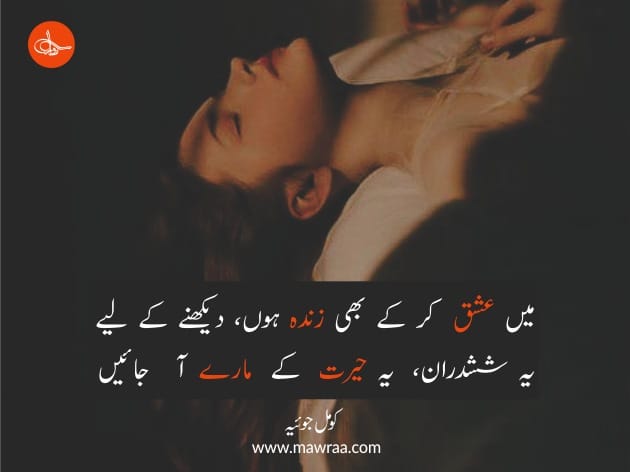
The word ‘ishq’ ( love ) is often found in Urdu poetry, and many people think it means love between a man and a woman. But that is not so. Let me explain.
There is a well known sher (couplet) of the great Urdu poet Ghalib:
“Ishq ne Ghalib nikamma kar diya
Warna hum bhi aadmi the kaam ke “
What does this mean? To answer this question one must first understand that Urdu poetry has often an outer, literal, superficial meaning, and an inner, metaphorical, real meaning.
https://www.hastakshepnews.com/2024/08/understanding-urdu-poetry-insights-by.html
Take, for instance Faiz’s sher :
“Gulon mein rang bhare baad-e-naubahaar chale
Chale bhi aao ki gulshan ka kaarobaar chale“
Now the literal superficial meaning of the sher is:
“Among the flowers a colourful breeze of the new spring is blowing
Come, so that the work of the garden can be done “
But that is not what Faiz is really intending to convey. In this sher, the word ‘gulshan’ ’ must not be understood literally. It really means the country. Nor must the first misra (line) in the sher be understood literally.
The sher really means :
“The objective situation in the country is ripe (for a revolution)
Come forward patriots, the country is in great distress, and needs you “
Thus, to understand Urdu poetry one must not just go by the direct, outer, literal meaning but probe below and try to figure out the inner real meaning, which the poet is conveying indirectly, by metaphors, hints, allusions, suggestions and indications.
The word ‘ishq’ which occurs frequently in Urdu poetry, is often misunderstood as physical love and attraction between a man and a woman. But that is not usually its real purport. Urdu poetry has a heavy sufi influence, and among sufis the word ishq really connotes love not for a woman but for God (ishq-e-haqiqi).
The Persian mystic Mansur Al Hajjaj (858-922) used to say ‘anal haq’ (I am God) for which he was misunderstood and beheaded. What he really meant was that he had annihilated his ego and given up all physical desires, and so had acquired divinity.
Thus, the word ishq in Urdu poetry really means a passion for an ideal, a noble principle, for which one is prepared to selflessly give up all comforts, and even his life.
Ghalib writes :
“Ishq par zor nahi hai yeh woh aatish Ghalib
Ki lagaaye na lage aur bujhaaye na bane”
Here again, the word ‘ishq’ must not be understood as mere physical attraction between man and woman. It means an intense obsession or infatuation, which cannot be rationally explained, and which consumes a person like fire.
Two of the most important intellectual creators of modern Europe were the great thinkers and writers, Voltaire and Rousseau ( both Frenchmen ). While Voltaire emphasised reason, Rousseau said that without passion and emotion mere reason makes one a selfish calculating being, who will do nothing for the welfare of the country or for others, but will only think and care for his own and his family’s comfort.
All great revolutionaries had ishq in this sense i.e. a selfless passion for serving one’s country even at the risk of losing all one has, even his life.
In America, George Washington was a very rich landowner, but when he was called upon to create and lead the Continental army in the American War of Independence ( 1775-81 ) against the British rulers, he accepted, though he was taking the risk of being hanged if the British had caught him.
The Britishers like Cromwell who fought for liberty and against the absolutism of King Charles I in the 17th century, the great French leaders in the French Revolution of 1789, Robespierre and Marat, and the Russian leader Lenin, all had the fire of ishq in them, that is, an intense passion for serving their countries selflessly.
In our own country great fighters against British rule like Bhagat Singh, Surya Sen, Chandrashekhar Azad, Bismil, Rajguru, Sukhdev, Ashfaqulla, Khudiram Bose etc gave their lives for their ishq, and ‘sarfaroshi ki tamanna ab hamaare dil mein hai’ became the battle anthem of the freedom struggle.
So Ghalib’s sher ( mentioned at the beginning ) must be understood to mean “ I too could have made a lot of money and lived in comfort had I not been consumed by a passion ( in his case poetry ), which made me an impractical man, careless of my own welfare and comfort “.
Today when our country is facing huge challenges, social, economic and political, with massive poverty, unemployment, child malnutrition, and almost total lack of proper healthcare and good education for our masses, genuine patriots with the passion of ishq for the country are sorely required in large numbers to lead a revolution and alleviate the people’s plight.