The country’s highest court is undergoing a significant makeover. The Supreme Court Collegium has just referred five names to the Union government for appointment. Chief Justice Surya kant presided over the meetings. It’s the first significant round of recommendations since he was appointed to the top job at the end of last year. They wish to recruit four sitting high court chief justices, along with a private lawyer.
The timing is no accident. The government has just hurried through an ordinance to increase the number of Supreme Court judges from 34 to 38. President Droupadi Murmu signed the documents in a rush. It is virtually unheard of to use an executive ordinance to add bench. The so-called excuse is always one of having huge case backlogs. But it gave the Collegium a bunch of new empty chairs to fill right before two more senior judges retire this coming June.
Only the Second Time in History
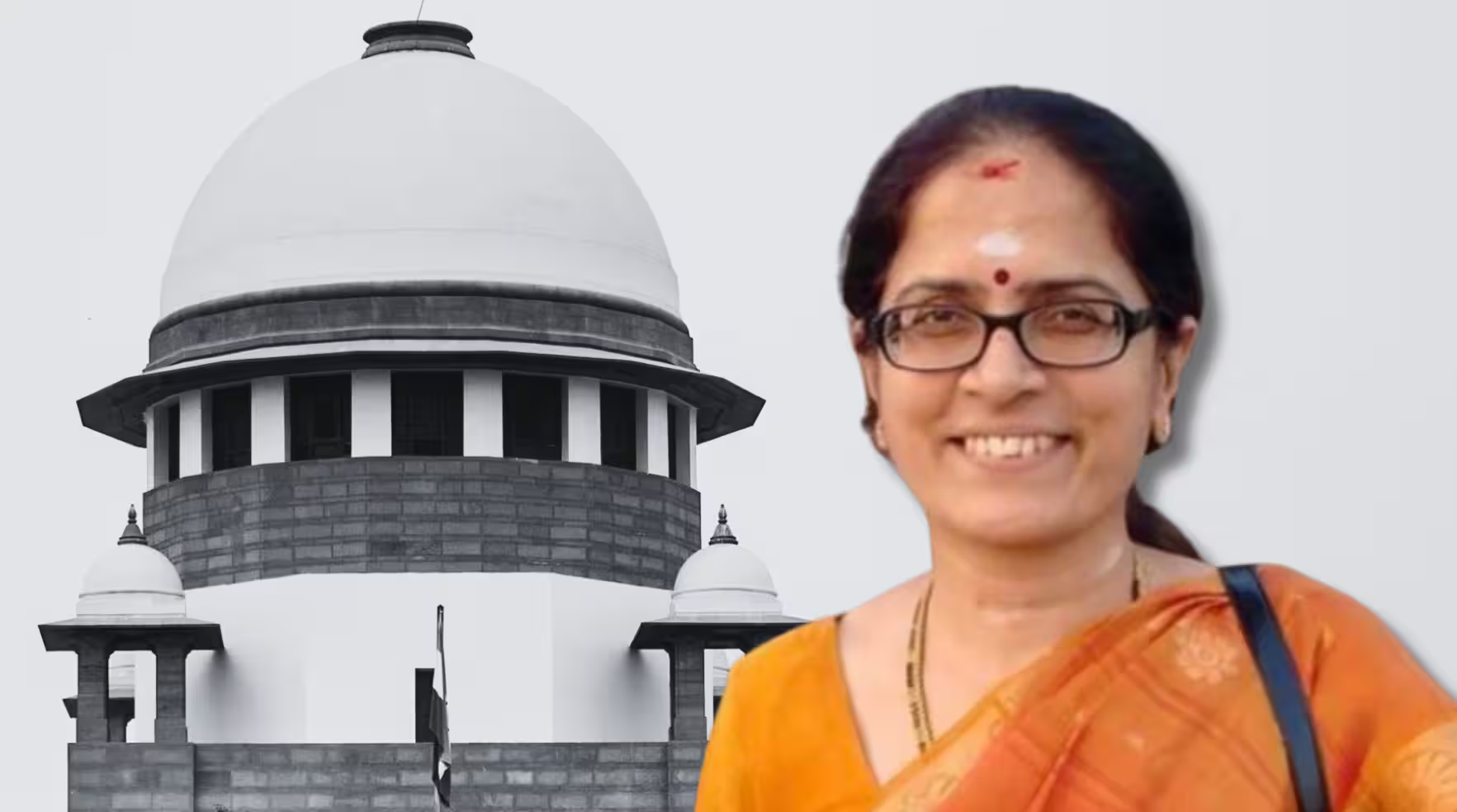
Not a judge is the largest name on the list. V. Mohana is an Advocate in Delhi. The Collegium wants to remove her from the Bar and place her on the bench!
This is practically always avoided. This is the first woman to make the direct leap in 76 years this court has operated. Few years ago it was Indu Malhotra. Mohana will be the first woman and 12th in the history of the Supreme Court to have a clear file with the government.
She is from Chennai. A first generation lawyer, she had come to Delhi in the late eighties after completing her law college studies in Coimbatore. Back then, she was doing the grunt work in the chambers of bigwigs such as former Attorney General K.K. Venugopal. For the following 40 years she developed a large non-public practice without any frills. She typically dealt with constitutional and civil litigation matters.
Need Help With Your PhD or LLM Thesis?
Explore our thesis and dissertation writing support services for PhD and LLM students. Get subject-specific academic assistance for your research project.
Explore Our Services →She did get in the limelight in the army case. Mohana was one of the main advocates to push for the court to finally issue a verdict for the Indian Army allowing women officers to get permanent commissions. She also opposed the government in the NJAC debates in 2015 when the government attempted to kill the Collegium system.
She even filed a lawsuit against the Supreme Court! The administration tried to set strict cutoff dates and appearance quotas for lawyers trying to get an official chamber. Mohana said it unfairly targeted senior advocates who were newly appointed whose physical ability was not sufficient to meet those quotas in the small window of time available to them on the registry. She fights hard. She receives a long five-year period for her to stay elevated if she is, if she isn’t, then she’s at the mandatory retirement age of 65 in 2031.
Omitting the Line of Seniority
The Collegium did not simply rely on a seniority list and take the best of the lot. They actively shopped some very high level folk to get the guys they wanted. The system refers to it as supersession.
Justice Arun Palli is the current Chief Justice of Jammu & Kashmir and Ladakh High Court. He was selected by the Collegium. For that, they needed to jump over his previous colleague, Justice Gurmeet Singh Sandhawalia.
These numbers here are just devastating. Now the Chief Justice of the Himachal Pradesh High Court is Sandhawalia. He is easily 5th in the seniority list of high court judges in the country. Palli finishes at the bottom of the list at 28th place. Palli received a tap on the shoulder, however. If Sandhawalia had been elevated, he would have been the first Sikh judge for the Supreme Court since 2017. The five men on the Collegium passed. As always, their official response contained no detail of how exactly one man was preferred over his far more experienced counterpart.
In fact, Palli began his career as a lawyer in Punjab. Prior to becoming a judge he served as an Additional Advocate General. Recently in Kashmir, he caught the eye in the matter of rejecting a Public Interest Petition (PIP) presented by politician Mehbooba Mufti. She wished prisoners to be removed from jails located outside the area. Palli said that she was using his courtroom as a political platform.
The Three Other Men Moving to Delhi
The remaining entries are all big names from all over the country. Justice Sheel Nagu is the presiding officer of the Punjab and Haryana High Court. His entire career was in Madhya Pradesh.
He has some pretty extreme track record. He was also previously in the news for pressuring prisons to provide patients with adequate medical care if they had serious heart and kidney problems. She was not the first controversial spiritual leader to be acquitted by his bench: In 2002, the controversial Gurmit Ram Rahim was acquitted in a very publicized murder by a journalist. Nagu was also called upon to investigate a fellow judge, following the discovery of piles of burned currency notes in a fire at an official residence.
Then comes Justice Shree Chandrashekhar. Currently, he is standing at the No 1 rank at the Bombay High Court. After working as a private lawyer for 19 years and presiding thousands of cases, he went on to become a judge in Jharkhand. His bench has given some big verdicts in criminal cases since he came to Mumbai last year. He gave his nod of approval to the acquittal of all 22 cops and officials in the infamous Sohrabuddin Shaikh fake encounter case. He also quashed the pending charges in the Malegaon blast case of 2006.
One more member of the group is Justice Sanjeev Sachdeva. He was the Chief Justice of Madhya Pradesh but served the entire time in Delhi. He used to represent the Bar Council of India. If he is pulled up, there will be two local judges on the highest bench in the capital.
If the central government duly signs all five names without playing with the files, the Supreme Court will lash on 37 judges. That means just one spot is remaining on the newly expanded roster.