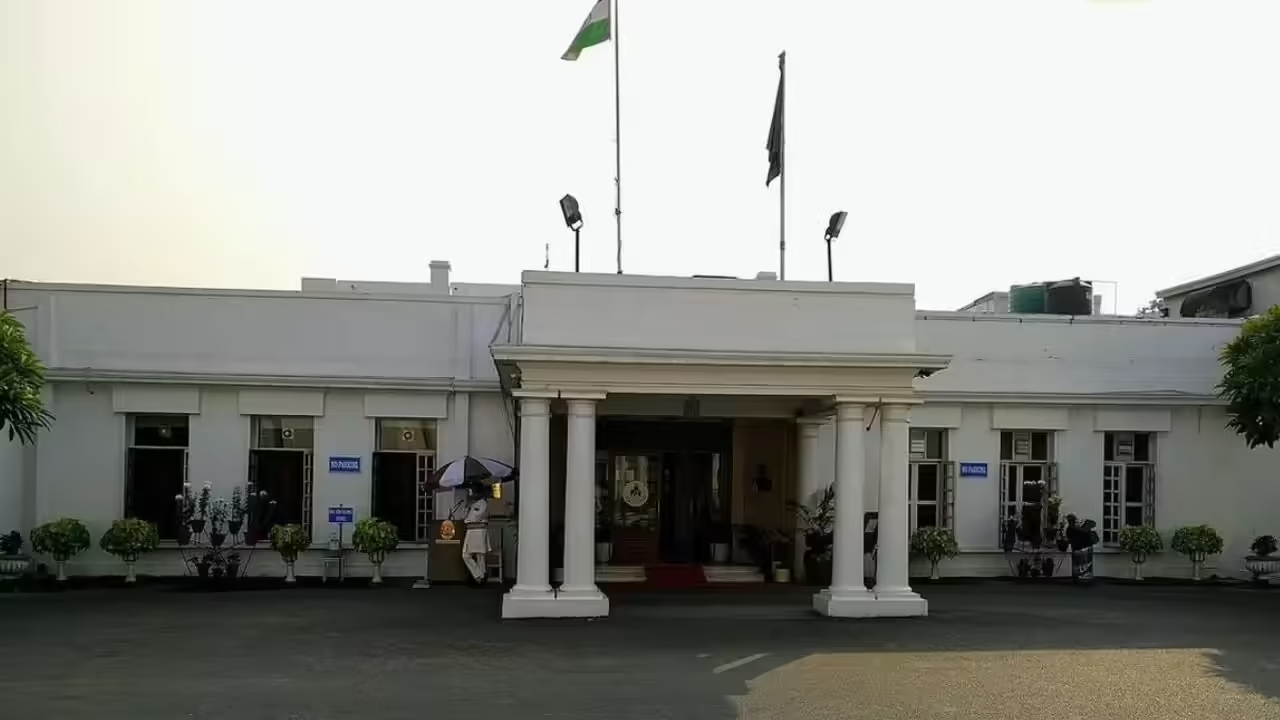
The historic Delhi Gymkhana Club has been notified to vacate its 27.3-acre property by June 5 by the Land and Development Office (L&DO) under the Ministry of Housing and Urban Affairs. The club was in a high-security area near Lok Kalyan Marg, home to the Prime Minister, and the Centre had to say that it was necessary to strengthen and secure the defence infrastructure, along with “urgent institutional requirements”.
The sudden eviction has made the legal framework relating to public land and constitutional property rights very apparent. The battle is mostly about the powers of the Centre under the original lease deed and public premises laws and the protection provided by Article 300A of the Constitution
Here are some legal mechanics and some questions to the constitution, what does this mean?
The Legal Arsenal: Lease Deeds and Public Land Law
The government’s main legal defence is that it owns the land and that the club is a lessee.
The land was allotted to the Perpetual Lease: The Imperial Delhi Gymkhana Club (as it was then called) in 1928 on a perpetuity lease for keeping a social and sporting club in particular. But, perpetual leases are not forever. The L&DO relied on Clause 4 of the lease deed which provided that the lease could be terminated by the President of India (the lessor) and the premises be “re-entered and resumed” by the lessor if the land was needed for an overriding public purpose.
The legal position of the person occupying the premises shifts after the Centre has made a final order for resumption of the premises under the statutory public land law, the Public Premises (Eviction of Unauthorised Occupants) Act, 1971. If the club does not remove by June 5, it can be called an “unauthorised occupant. The Centre can then begin an expedient eviction process via a designated estate officer, rather than through a long and drawn out civil court process
Need Help With Your PhD or LLM Thesis?
Explore our thesis and dissertation writing support services for PhD and LLM students. Get subject-specific academic assistance for your research project.
Explore Our Services →Strictly speaking, from a contractual and statutory perspective, it is the Centre’s right to regain possession of the land for national security and governance purposes.
The right to life is guaranteed in Article 300A of the Constitution.
The Centre is focusing on contract law, but the club and legal professionals are focusing on constitutional protections. According to Article 300A, “No one shall be deprived of his property except in accordance with the law.
The right to property was abolished as a Fundamental Right in 1978 by the 44th amendment, but the 300A has re-introduced the right of the property as a Constitutional Right. The Supreme Court has consistently ruled that the State cannot take away from a citizen or entity in an arbitrary manner, even if the State is the final landowner.
The eviction order throws up a number of questions in the context of Article 300A:
Article 300A states that property cannot be taken away without a proper procedure. Legal experts wonder what a 14-day notice to vacate a big, 113-year-old structure, with hundreds of staff members, is entitled to and whether it is considered “due process” or “arbitrary state action.
- Judicial review on “Public Purpose”: Centre has quoted public security and defence infrastructure. The power to resume leased land is not absolute, but courts are normally deferring to the government on issues of national security. Judicial review may be used to challenge the legality of the decision, whether the purpose is a public purpose, the eviction is mala fides (bad faith) or the eviction is arbitrary.
- Compensation Limitations: The Gymkhana Club is located on leased government land, as opposed to private land acquired under the Land Acquisition Act of 2013, which has strict terms for compensation. The rights of compensation are very restricted here and the procedural fairness of the eviction is even more important. The analysis of the broader context and next steps
The eviction scheduled for May 2026 isn’t a one-time occurrence. It’s the result of years of conflict between the club and the government. The Centre started taking over the management of the club in 2020 when the National Company Law Tribunal (NCLT) ruled the club’s activities were being carried out in a manner “prejudicial to public interest”. In addition, the L&DO has recently taken over other buildings in Lutyens’ Delhi, such as the building of the United News of India (UNI) and neighbouring slum complexes, on similar security and strategic grounds
What happens next?
The Club’s Response: The management of the Gymkhana Club requested an immediate meeting with the Ministry of Housing and Urban Affairs for clarification and to stop the takeover that was scheduled to happen on June 5.
The sudden displacement of more than 600 workers, many of whom have been working at the sporting facilities and lawns for decades, has led to the Human Cost: The Gymkhana Employee Welfare Association having raised alarms.
The threat of litigation: The club and/or members are likely to approach the Delhi High Court or Supreme Court. The question that will be key to the legal challenge will be whether the Centre’s use of Clause 4 for national security is in accordance with the non-arbitrary criteria of Article 300A.