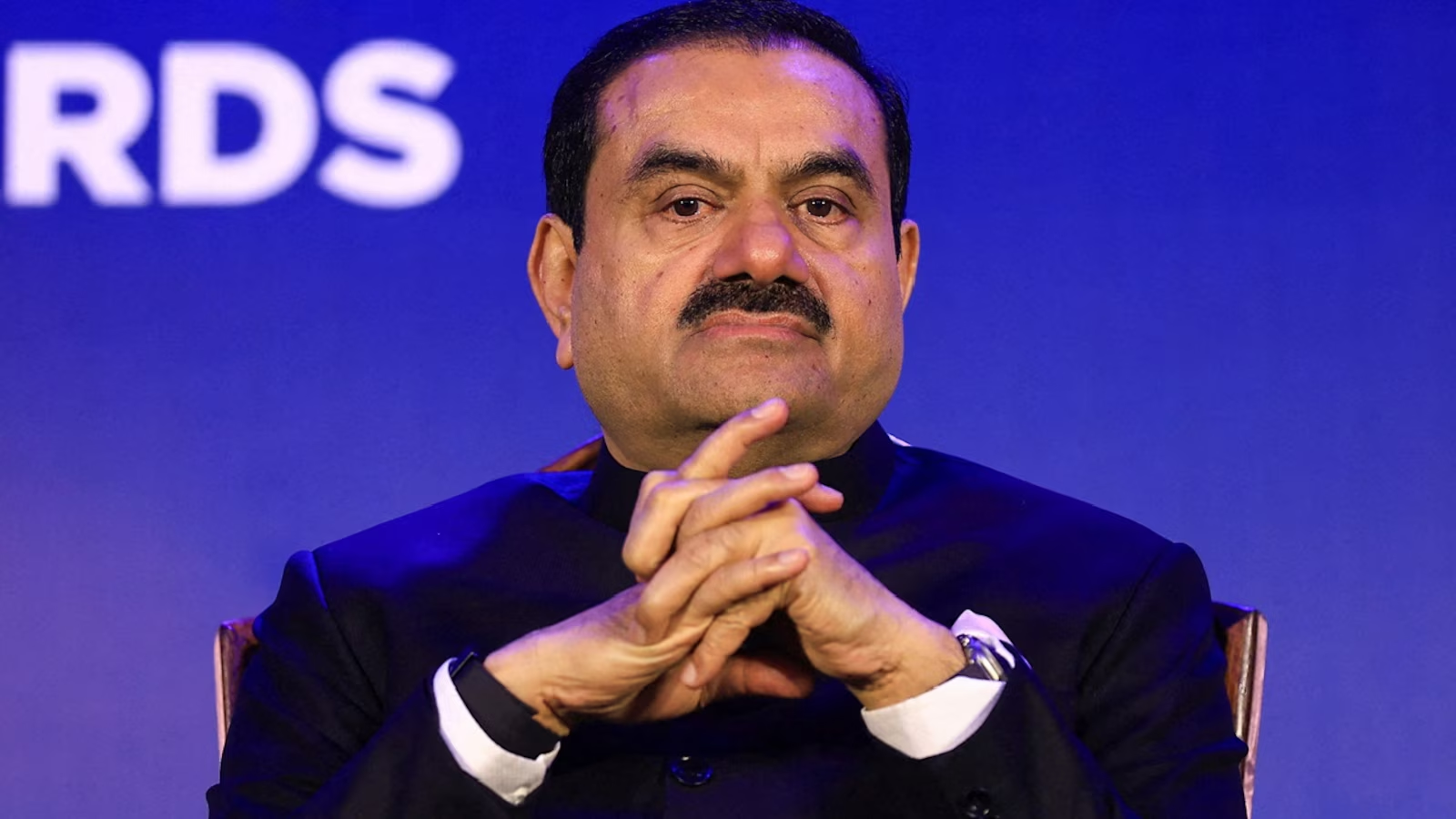
High-profile scalps are always in the air of the Southern District of New York. The federal indictment against Gautam Adani and his inner circle for months had been the talk of the global financial circuit, a multi-billion-dollar bribery and fraud case that seemed like the American justice system finally had the goods on a global giant. However, recently, the law is silent and is being used strategically. A gavel’s bang is not the sound in which a “trial of the century” ends, but rather a lawyer’s whisper, as US authorities now seek to drop the criminal charges and the SEC indicates a “settlement” with quietude.
It’s a gorgeous tucker. Federal prosecutors were only just a few moments ago drawing a picture of a giant, $250 million pay-to-play scheme to mask the importation of American dollars in order to win Indian energy project business. Words like code names, erased messages, and the type of electronic tracks that typically lead to a prison sentence. After that, the gears jammed.
The retreat points to a jumbled mix of “long arm of US law” and the “immovable object of international diplomacy. The frenzied memos are almost visible flying between the State Department and the Department of Justice. Adani is not only a billionaire but a key figure in India’s infrastructure development and, consequently, the strategic partnership with the United States. A geopolitical nightmare was always going to be in his pursuit to the bitter end. It would appear as though Washington’s law-taking has been softened by a pinch of “realpolitik.
The most telling aspect of this winding down is the SEC’s settlement in its civil suit. A settlement is typically a round figure for a company this size, and a “neither admit nor deny” statement that essentially lets everyone get rid of it without the hassle of a public case. This is a big, albeit costly, sigh of relief for the Adani Group. It opens the door towards the international bond market and eliminates the “fugitive” label attached to them, which has been a problem in their expansion abroad.
As you’d expect, the reaction is bisected in the middle. In the Mumbai and Ahmedabad boardrooms this will be a complete vindication: a result that India’s original charges were a “hit job” by the short-sellers and “overzealous” Western regulators. They will mention that there isn’t a “smoking gun” to withstand the scrutiny of a US court.
On the other side of the fence, critics will see this as a textbook case of “too big to jail” on a planetary scale. What does that say about the integrity of the global financial system if the US can’t or won’t prosecute a case of this magnitude? It sets a precedent that is cynical: When you’re important enough to the cause of your country, you may as well be beyond the reach of the laws of the nations in which you invest.
This resolution is not devoid of awkwardness which legalese cannot entirely obscure. The DOJ is seldom seen backing down in a tussle like this unless there is evidence they can’t pursue or the diplomatic costs are too great. In selecting the exit ramp, the US has tacitly acknowledged that a few are simply beyond its reach, not because of geographical location, but because of the massive heft they bring to the global order.
As paperwork gets filed and the headlines inevitably get shorter, Gautam Adani again makes his appearance as the ultimate survivor. He has survived a short-seller’s attack that had cost him billions of dollars in market capitalization, and he now has withstood a federal indictment from the world’s mightiest legal system. The cases will be dropped, the suits will be settled and the “special relationship” between Washington and New Delhi will stand. The diplomats get out of this relatively clean, but for anyone who thinks that the law should be oblivious to how much money a person has or the phone number of his prime minister, it leaves a bit of a bitter taste.