State Government Liable for Accidents Involving Election Requisitioned Vehicles
Introduction to the Supreme Court Judgment
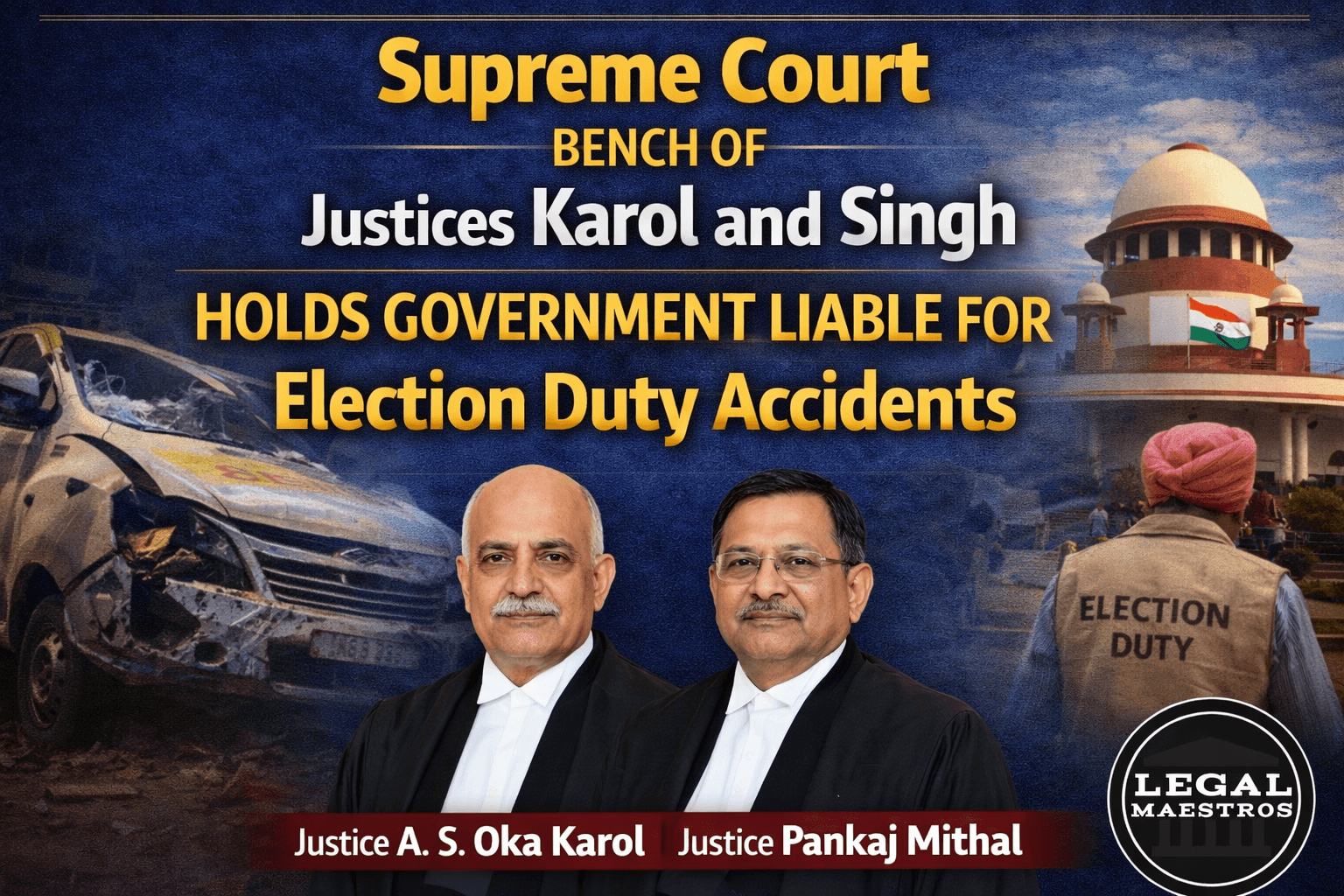
The Supreme Court of India recently delivered a crucial judgment regarding motor accident claims involving privately owned vehicles that are taken over by the government for public duties. The bench, comprising Justice Sanjay Karol and Justice Nongmeikapam Kotiswar Singh, addressed a dispute over who should pay compensation when a requisitioned vehicle causes a fatal accident.+4
Background of the Case
The case stems from a tragic accident that occurred on January 23, 2010, between a bus and a motorcycle, which resulted in the death of the motorcycle rider. The bus was owned by Kidzee Corner School in Gwalior but had been officially requisitioned by the District Magistrate and District Election Officer for the purpose of conducting Gram Panchayat Elections. The legal heirs of the deceased filed a claim, and the Motor Accident Claims Tribunal initially awarded a compensation of Rs 5,13,500. Later, the High Court of Madhya Pradesh increased this compensation to Rs 27,01,556 and ruled that the government authority, rather than the bus’s insurance company, was responsible for paying the amount. The government authority then appealed this decision to the Supreme Court.+4
The Core Legal Argument
The main question before the Supreme Court was whether the government authority or the National Insurance Company should bear the financial liability for the accident. The appellant argued that since the bus had an active insurance policy at the time of the accident, the insurance company should pay. They also argued that holding public authorities liable while they are carrying out public duties would set a negative precedent, as the government does not officially own these requisitioned vehicles.+2
The Supreme Court’s Reasoning and Decision
The Supreme Court dismissed the appeal and upheld the High Court’s decision, firmly placing the liability on the state authorities. The justices reasoned that when the government requisitions a vehicle, it takes complete control and possession away from the original owner. During this period, the owner cannot decide how, when, or where the vehicle is used. The Court explained that an insurance policy is a commercial contract based on the regular, voluntary use of a vehicle by its owner. Forcing an insurance company to cover risks during a compelled government deployment would be unfair and falls outside the agreed terms of the insurance contract. Furthermore, the Court noted that the authorities chose to use the driver provided with the bus instead of appointing their own government staff, meaning they implicitly accepted responsibility for the driver’s operation of the vehicle during the election duty. Therefore, the state, having total operational control, must take responsibility for any consequences that arise during the requisition period.
Keywords: Supreme Court of India, Motor Accident Claims, Requisitioned Vehicles, Election Duty, State Liability, Insurance Company, Justice Sanjay Karol, Justice Nongmeikapam Kotiswar Singh
Need Help With Your PhD or LLM Thesis?
Explore our thesis and dissertation writing support services for PhD and LLM students. Get subject-specific academic assistance for your research project.
Explore Our Services →