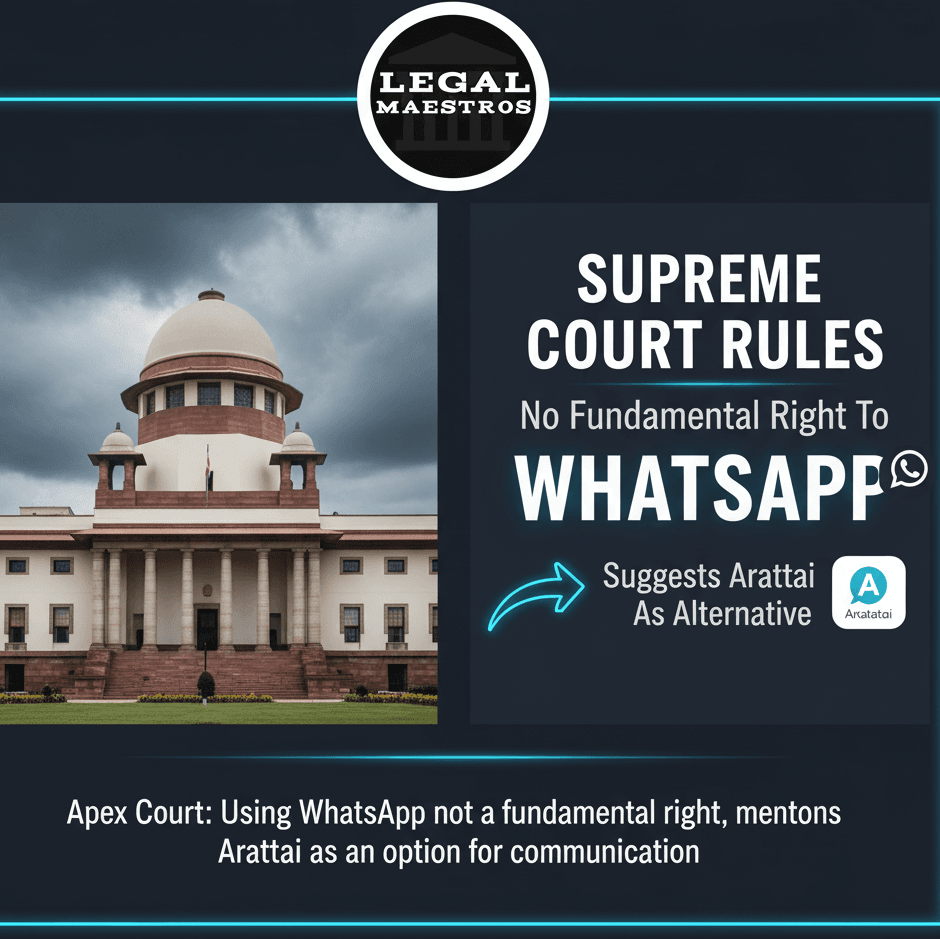
The Core of the Legal Challenge
The case came to the highest court, when a team of petitioners appealed the conditions of service and privacy policy of WhatsApp that is owned by the international technology giant Meta. The petitioners claimed that today WhatsApp has become a necessary and indispensable service in India that can be used to communicate with others every day, both about personal and professional matters. They argued that due to its high levels of integration into the contemporary life, the right to use it without invading their privacy should be made a fundamental right.
The case was mostly grounded on the principle rights to freedom of speech and expression (Article 19) and the right to life and privacy (Article 21) of the Constitution. As implied in the plea, any arbitrary modification of the policies of WhatsApp, which impacts the privacy of the data of a user, violates these constitutional guarantees. The petitioners were practically requesting the court to make the use of one particular and dominant means of communication a privileged basic right.
The case was a trial of how the constitutional laws of India would work in case of the strong and foreign-owned digital platforms that have already become their own version of the public squares. The main issue was whether a private company that is so large and powerful can also be subjected to similar demands as state regarding the defense of the basic rights of Indian citizens.
The Supreme Court’s Decisive Verdict
The Supreme Court court, however, made a definite distinction between the right to communicate and the right to use a certain, privately-owned application. The court said that basic rights mostly limit the state and its instrumentalities and not a private entity such as WhatsApp. The judges explained that the right to privacy is considered to be a basic right, but it does not mean that a citizen has a right to use the platform of his/her choice.
The court said in its observation that WhatsApp is self-service and users accept its terms and conditions when they register. The court rationale was that nobody is being compelled to use the application, and a user is at liberty to abandon the platform in case they are not at ease with its policies. This perspective successfully separates the legal right to free expression in general, and the medium of that expression in particular.🗣️
The decision confirms that even the most popular and dominant commercial service cannot be considered a public utility to which citizens are entitled by right. The court found that compelling a private company to act in a specific manner resting on the basic rights would amount to the usurpation of judicial powers. The ruling strictly imposes the responsibility on the user to select services that conform to his/her privacy preference.
Need Help With Your PhD or LLM Thesis?
Explore our thesis and dissertation writing support services for PhD and LLM students. Get subject-specific academic assistance for your research project.
Explore Our Services →A Nudge Towards a Homegrown Alternative
The court specifically mentioned in relation to the hearing perhaps the most unexpected news about Arattai, an Indian developed messaging application. Ruling out the plea, the judges noted that users are not satisfied with the conditions of WhatsApp but have an opportunity to use the indigenous application, citing an example of the app. This recommendation is broadly being understood as an indication of support to this push by India towards digital sovereignty and self-reliance in the technology area. 🇮🇳.
Arattai or chat in Tamil is an Indian-made secure messaging application that is frequently marketed as a rival to worldwide giants such as WhatsApp and Telegram. Its mention by the court is more than a throwaway line, a nod to the government projects of Make in India and Aatmanirbhar Bharat (self-reliant India). It represents a rising wave in the Indian establishment to encourage local technology and to lessen reliance on international platforms that typically save Indian user data on servers located outside the nation.
This legal support to a homegrown application is a very strong declaration. It postulates the future in which data localization and the use of native software would become a more salient aspect of the national policy in India. This comment by the court is in line with other countries in the world that are increasingly guarding their online worlds and citizen privacy information.
Implications for Users and Tech Giants
The ruling of the Supreme Court has extensive implications on the technology users as well as those companies that provide technological services. To the Indian citizens, it might be clear that though their privacy is a fundamental right, it is more protected by statutory laws (such as a Data Protection Act) as opposed to direct constitutional redresses against the companies themselves. Now, the user is advised to be more critical of the applications he/she uses and permissions he/she grants.
It is a huge victory to the big tech companies such as Meta. It strengthens their legal status as non-governmental organizations which are not bound to the same constitutional status of government agencies. Although they will be obliged to observe the laws of the land, this ruling places a limit on suing them in cases of abuses of fundamental rights. It enables them to establish their conditions of service provided that they are not unlawful under the existing laws.
This ruling forms an essential precedent in the debate on the strength and responsibility of big tech currently underway in the world. It brings out the point that the responsibility of regulating these platforms and safeguarding user rights is always the mandate of the legislature and the government who should formulate powerful laws to regulate the digital frontier.