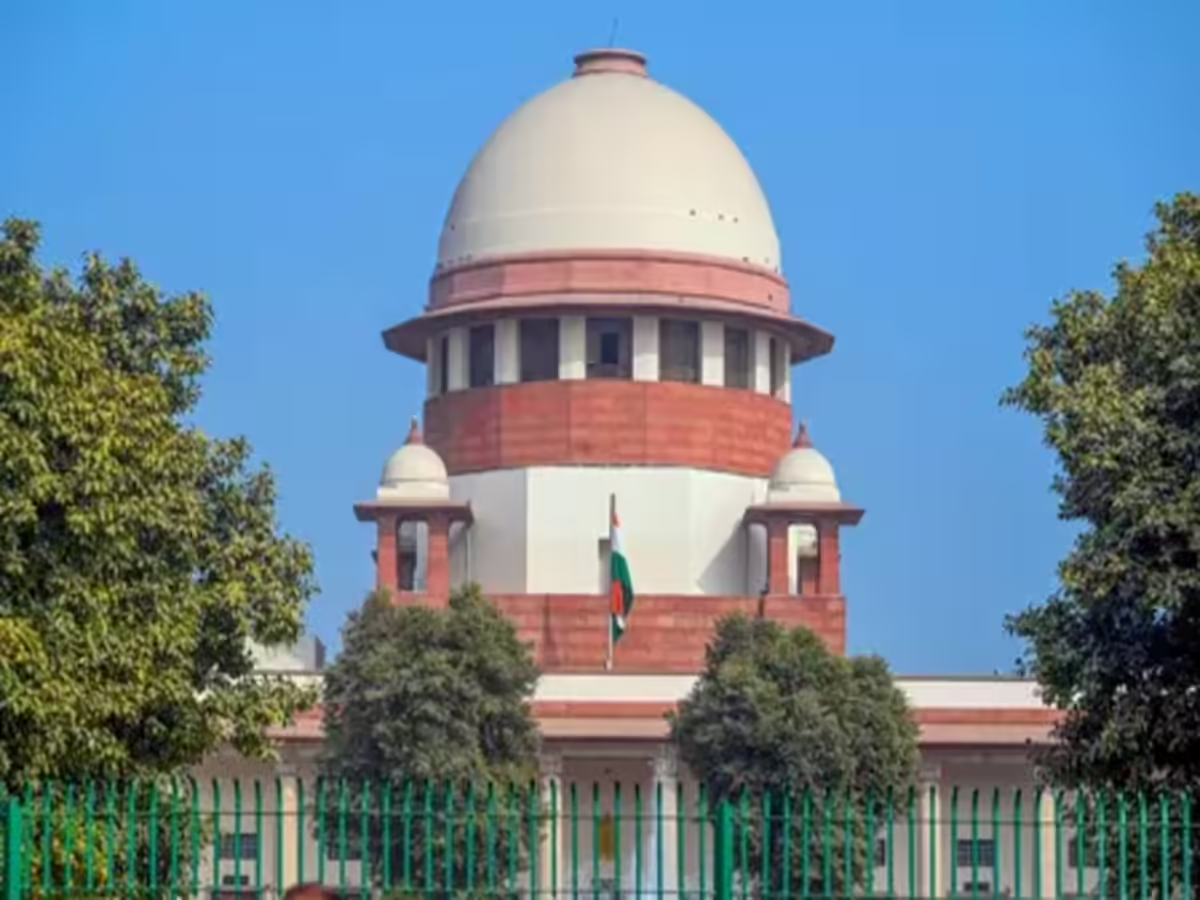
Imagine if you are a private student sitting in Saudi Arabia preparing for the last and the most important exam of your life that can get you into a decent college back in India, when the news of war and conflict between major countries in the region like US, Israel and Iran reach your doorstep and as result you see school suddenly being shut, tests cancelled midway and you left stranded and confused. This was no less than a dream turning to be a nightmare for thousands of Indian students in Western Asia, preparing for their CBSE class 12 board exams to determine their fate. The decision to postpone the exams from March 15 onwards in many of the gulf countries – Bahrain, Kuwait, Oman, Qatar, UAE and Saudi Arabia – had left students with no viable solution until finally on March 27, the CBSE announced some tentative plans, however, only for the school students that left the private candidates high and dry. Finally the Supreme court of India, after a drawn-out legal battle of over three months has now cleared the path for the embattled private students by approving a unique marking scheme to help them pass this crucial year.
The Quandary of a Private Candidate
The issue originated from the way examinations are usually conducted and evaluation is done in a holistic manner, especially for the regular school candidates. Since they appear for various internal tests and periodic examinations right throughout the year, the CBSE simply looked into their academic records. Once the final tests were cancelled they considered an average score based on the student’s performance in prior examinations.
Private candidates don’t have the luxury of such records because they appear for board examinations independently.
After being told of this unique dilemma faced by the private candidates, the CBSE simply chose not to award marks and rather decided to put ‘Result Later’ against the students’ files. This lead to a nationwide pandemonium as colleges were due to commence classes and admission forms of these students were yet to be filled. It prompted a Saudi Arabian based student, Pransu Jigarkumar Patel who appeared for his improvement examination from Al Jubail to file a case in the apex court, demanding his results to be declared on an equal footing. Patel, had been able to appear in his physics and chemistry exams before cancellation but, was left to wait to appear in the other three exams: Mathematics, computer Science and English.
The 40-60 Formula for Relief
After the case landed on their laps, the Supreme Court took serious action and asked the government on June 8 to provide a remedy and not keep thousands of students at bay while rest of the world marches ahead. Prompted by the SC’s stern stance, the government back-tracked and worked on a fresh policy that was introduced in court on Monday, in the form of new guidelines to evaluate students under the 40-60 marking system which has now received SC’s approval. According to Solicitor General Tushar Mehta, before the apex court which comprise of Justices S.V.N Bhatti and Vipul M.
Pancholi, the evaluation of private candidates was proving to be a daunting task in absence of internal marks from previous evaluations.
So they decided upon to introduce a comprehensive formula. With this new policy, any candidate who was not able to take their cancelled papers will be evaluated based on a mix of previous marks obtained by the student in their Class X examination (weighted 40 percent of average in three top subjects) and the Marks obtained by the student in their last appeared board exam of Class XII for that particular paper/subject (weighted 60 percent). The policy states that any such student who had passed their class X examination through some other educational board other than CBSE shall be given marks as per the best three results of the student with that board at Class X level. Patel’s marks have already been declared as per this strategy and the same has been e-mailed to him as well as put on his DigiLocker.
Case is Over: Court to Evaluate and Pass!
The lawyer for Patel, Vineet Jindal wanted some concessions and further permission from the court to procure his physical copies of the answered scripts, for which he was shot down by the judges saying, you can ask for it, only if it is in your originally filed writ. They clearly stated that since the case originally was only for seeking the delayed results, then you can’t ask for it in such a late stage of the argument. The Court also maintained that they usually don’t interfere in administrative works and are not willing to become a third testing agency.
Since the core of the case was about seeking the marks, the government came up with a solution to evaluate the candidates, the issue is resolved now, they clarified.
The court acknowledged the new policy and dismissed the case. However, the government has put up one last assurance for any student unhappy with this calculation, that they can appear in the upcoming regular examination and those marks would be final.