About the University of Cambridge
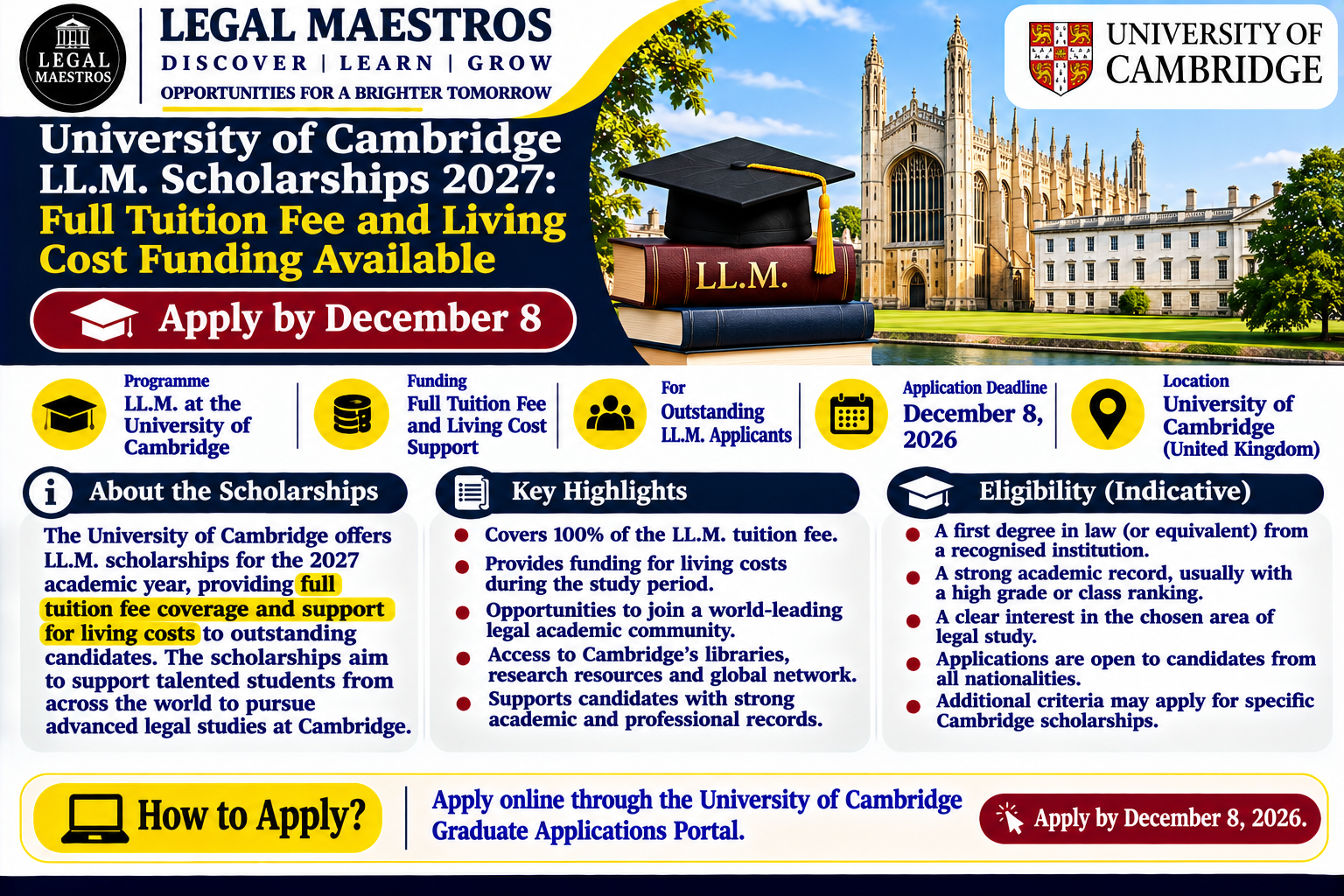
The University of Cambridge in the United Kingdom has invited applications for its Master of Law (LL.M.) programme for the 2027–2028 academic year. Eligible international law graduates, including students from India, can apply for admission and seek financial assistance through several university scholarship programmes.
Funding opportunities are available through the Cambridge Trust, Faculty of Law and individual Cambridge colleges. Some scholarships cover the full tuition fee and provide financial support towards living expenses, while others offer partial assistance.
The university also offers a scholarship specifically for Indian law graduates interested in intellectual property law.
The LL.M. programme will begin on October 1, 2027. The last date for admission and the main university funding application is December 8, 2026.
About the Cambridge LL.M. Programme
The Cambridge LL.M. is a nine-month, full-time postgraduate law degree offered by the Faculty of Law.
The programme is intended for law graduates who want to undertake advanced legal study after completing their first degree in law.
Need Help With Your PhD or LLM Thesis?
Explore our thesis and dissertation writing support services for PhD and LLM students. Get subject-specific academic assistance for your research project.
Explore Our Services →It is suitable for candidates interested in legal research, university teaching and professional legal practice.
Unlike a general postgraduate law programme where students study several compulsory subjects, the Cambridge LL.M. gives students considerable flexibility in selecting their courses.
Students choose four papers from the subjects available during the academic year.
The university generally offers around 30 LL.M. papers, although the exact subjects may change from year to year.
The programme begins in October and normally finishes in June of the following year.
Subjects Available for LL.M. Students
Cambridge offers advanced legal education across several areas of law.
These include international law, commercial law, corporate law, intellectual property, constitutional law, criminal law, jurisprudence and legal history.
Students interested in international business transactions may choose papers dealing with corporate and commercial legal issues.
Those interested in public law can explore constitutional questions, international legal obligations and related subjects.
The university also provides opportunities for students to examine legal questions through theoretical and comparative approaches.
Most papers are assessed through examinations at the end of the academic year.
Students may be permitted to complete a dissertation instead of an examination in one paper, subject to the availability of that option and approval of the proposed topic.
Eligibility Criteria
Candidates applying for the Cambridge LL.M. must ordinarily possess a first-class bachelor’s degree in law or an equivalent qualification from an overseas institution.
The university expects successful applicants to have achieved excellent academic results.
According to Cambridge’s official admission requirements, successful candidates are generally placed within the top 10% of law students in their jurisdiction.
However, securing a first-class degree does not guarantee admission because the programme receives applications from academically strong candidates worldwide.
Cambridge may also consider applicants who do not hold a first-class law degree in exceptional circumstances.
Such candidates must demonstrate academic ability equivalent to being among the top 10% of lawyers in their jurisdiction, potentially through substantial professional legal experience or other recognised qualifications.
Can Indian Law Graduates Apply?
Yes. Indian applicants holding recognised law degrees may apply for the Cambridge LL.M.
Candidates who have completed a five-year integrated degree, such as BA LL.B. or BBA LL.B., can apply if their qualifications meet Cambridge’s academic equivalency requirements.
Graduates holding a three-year LL.B. after completing an earlier undergraduate degree may also apply.
The university assesses qualifications obtained outside the United Kingdom according to its international academic requirements.
Final-year law students are also permitted to submit applications.
However, candidates who receive conditional admission offers must satisfy the prescribed academic requirements by July 31, 2027.
Indian applicants should review Cambridge’s international qualifications guidance before submitting their applications.
Scholarships and Financial Assistance
The University of Cambridge offers several funding opportunities for LL.M. students.
These include scholarships administered by the Cambridge Trust, awards supported by the Faculty of Law and financial assistance offered by individual colleges.
The funding arrangements differ considerably.
Some awards cover the entire tuition fee and provide maintenance assistance, while others contribute only towards tuition or living costs.
Cambridge has confirmed that a limited number of law-specific Faculty of Law and Cambridge Trust scholarships are available to eligible LL.M. offer holders.
Several colleges also offer law-specific studentships and bursaries.
Applicants should examine the eligibility conditions of each award because the application procedures and funding amounts are not identical.
Prathiba M Singh Cambridge Scholarship for Indian Students
One of the most relevant scholarships for Indian law graduates is the Prathiba M Singh Cambridge Scholarship.
The award is offered through the Cambridge Trust in partnership with Justice Prathiba M Singh, an Indian alumna of Cambridge’s Faculty of Law.
The scholarship is available specifically to Indian applicants pursuing the LL.M. at Cambridge.
Selected candidates receive financial assistance covering international tuition fees and maintenance sufficient for one person.
Cambridge’s 2027–2028 funding database indicates approximately two awards under this scholarship.
Applicants must demonstrate a strong interest in intellectual property law.
They must also show a positive intention to pursue a legal career in India after their studies.
Financial need is another important eligibility requirement.
Candidates are considered on the basis of academic merit and financial circumstances.
There is no separate scholarship application, but applicants must submit their Cambridge admission application by the funding deadline and complete the relevant funding information.
Shortlisted candidates will be invited to an interview in New Delhi.
Cambridge Trust Masters Studentship
Another funding opportunity is the Cambridge Trust Masters Studentship for applicants with international fee status.
The studentship provides assistance covering the university’s international tuition fee.
It is available for eligible one-year postgraduate courses, including the LL.M., subject to the Trust’s restrictions.
However, this award does not automatically include living expenses.
The Cambridge Trust has also specified that applicants who already hold, or are about to complete, a master’s or doctoral qualification are not eligible for this particular studentship.
This requirement is especially important for Indian applicants who already possess an LL.M. or another postgraduate degree.
Candidates applying for this studentship do not need to complete a separate scholarship application.
They must submit their postgraduate admission application and indicate their interest in university funding.
Henry Arthur Hollond LL.M. Studentship
Trinity College offers the Henry Arthur Hollond Studentship in Law for candidates intending to pursue the Cambridge LL.M.
The studentship is awarded primarily on academic merit.
For the 2027–2028 academic year, Cambridge’s funding database lists one principal award.
The published funding range is approximately £41,913 to £61,869, depending on the applicable costs and circumstances.
The award may cover university fees, maintenance, student visa costs, the immigration health surcharge and return travel expenses for international students.
It also provides a research allowance of £500.
The college may offer partial awards in certain circumstances.
Where several candidates demonstrate outstanding academic merit, preference may be given to applicants specialising in non-commercial areas of law or those interested in academic careers.
Candidates do not necessarily have to name Trinity College in their initial university application, but they must be willing to transfer to Trinity if required.
The application deadline follows the LL.M. funding deadline.
W.M. Tapp Studentships in Law
Gonville & Caius College also provides financial assistance through the W.M. Tapp Studentships in Law.
These studentships are available to eligible candidates intending to undertake the Cambridge LL.M.
For the 2027–2028 academic year, the university’s funding database indicates approximately three awards for LL.M. applicants.
The studentship can cover approved university and college fees, together with maintenance support.
Recipients may also receive a £500 annual college scholarship, and certain additional allowances may be available under the scheme.
Candidates must submit a separate studentship application with the required documents and references.
The college gives particular consideration to applicants who select Gonville & Caius as their first-preference college or are willing to transfer.
The deadline for this separate studentship application is January 5, 2027.
However, applicants must still submit their Cambridge LL.M. admission application by December 8, 2026.
Jacobson Scholarship in International Law
St Catharine’s College offers the Jacobson Scholarship for postgraduate students interested in public or private international law.
The scholarship is available to eligible LL.M. and PhD applicants.
For the LL.M. programme, awards are generally in the range of £10,000 to £15,000, according to the current funding information.
The scholarship primarily supports maintenance expenses.
LL.M. recipients are expected to choose at least three papers from those designated as international law subjects.
Selection is based on academic merit.
Applicants must be willing to become members of St Catharine’s College if selected.
The scholarship follows the relevant LL.M. application and funding deadline.
Candidates should review the additional funding questions and eligibility requirements published by the college.
Gates Cambridge Scholarship
The Gates Cambridge Scholarship is another major funding opportunity available to eligible international postgraduate applicants.
The programme supports outstanding students from countries outside the United Kingdom.
Indian candidates may apply if they meet the scholarship’s requirements.
Gates Cambridge provides comprehensive financial support for selected scholars, including eligible university costs and maintenance assistance.
Candidates are assessed on academic excellence, their reasons for selecting the course, leadership potential and commitment to improving the lives of others.
Applicants interested in this scholarship must complete the Gates Cambridge section of the university application.
They must also provide an additional Gates Cambridge reference.
The scholarship is highly competitive and is not automatically awarded to students who receive an LL.M. admission offer.
English Language Requirements
Cambridge has prescribed specific English-language requirements for LL.M. applicants.
For IELTS Academic, candidates must obtain an overall score of 7.5, with at least 7.0 in listening, reading, writing and speaking.
The university’s LL.M. course page also lists TOEFL iBT requirements of 110 overall, with at least 25 in each component. Applicants taking the revised TOEFL should verify the applicable scoring requirements with Cambridge.
An important condition is that applicants who are required to demonstrate English proficiency must ordinarily obtain the required test results before submitting their LL.M. application.
Cambridge provides only limited exemptions based on nationality and recent educational qualifications from countries recognised under the relevant UK rules.
An Indian applicant should not assume that studying law in English automatically removes the language-test requirement.
The university also does not permit applicants to combine scores from different test sittings to meet the prescribed requirements.
Documents Required
Candidates must submit their applications through the official Cambridge postgraduate Applicant Portal.
The application requires academic transcripts showing the applicant’s previous educational qualifications and results.
An updated curriculum vitae or resume is also compulsory.
Applicants must prepare a statement explaining their reasons for applying. The university’s application guidance specifies a limit of 5,000 characters for this section.
Two references are required.
For candidates currently studying at a university, both references must be academic.
For candidates who have completed their studies, Cambridge provides some flexibility regarding professional references, depending on how long they have been away from higher education.
Candidates seeking Gates Cambridge funding must provide an additional reference.
Applicants must also complete the funding section if they wish to be considered for scholarships.
Selection Process
Cambridge follows a competitive admission process for the LL.M.
Applications are assessed together after the closing date rather than being selected individually on a rolling basis.
The Faculty of Law considers academic qualifications, references, the applicant’s statement and other relevant information.
Candidates meeting the minimum academic requirement are assessed according to the overall strength of their applications.
The university also limits admission offers according to the number of LL.M. places available.
The Faculty of Law aims to finalise admission decisions by March 1, 2027.
Scholarship selection is conducted separately through the relevant funding organisations and colleges.
Receiving admission does not guarantee scholarship funding.
Scholarship Selection and Results
The Cambridge Trust generally begins awarding scholarships in February.
Many awards are made during February and March, although some partnership-funded scholarships involve additional procedures, including interviews.
These decisions may therefore be communicated later, particularly between April and June.
The Trust continues considering eligible candidates and reallocating declined awards until the end of July.
Candidates who have not received a scholarship offer by the end of July should ordinarily assume that they have not been selected.
The university does not guarantee individual notifications to unsuccessful scholarship applicants.
Tuition Fees and Living Expenses
Students who do not receive full financial assistance must arrange their own funding.
Cambridge charges tuition fees according to the applicable fee classification.
International students ordinarily pay the overseas tuition rate.
The university also requires students to demonstrate that they have sufficient money to meet their living expenses during the course.
For 2027–2028, Cambridge estimates basic living expenses at approximately £15,525 for nine months for a full-time student without dependants.
This estimate is separate from tuition fees and other possible expenses.
Applicants receiving partial scholarships will need to arrange financial support for any remaining costs.
The exact fee liability should be checked using Cambridge’s official course finance calculator.
How to Apply?
Interested candidates must apply through the University of Cambridge’s official postgraduate admissions portal.
Applicants should visit the LL.M. course page and review the academic and English-language requirements.
They must then create an account on the Applicant Portal and complete the application form.
Candidates should upload their academic transcripts, CV, statement of reasons for applying and English-language test results where required.
They must also provide the details of two referees and ensure that their references are submitted before the application deadline.
Applicants seeking financial assistance must select the option indicating that they wish to be considered for funding.
The portal may display additional scholarship questions for particular awards.
Candidates should complete these sections carefully because failure to indicate interest in funding may prevent consideration for Cambridge Trust scholarships.
Some college studentships require a separate application and may have different deadlines.
Official LL.M. Programme: https://www.postgraduate.study.cam.ac.uk/courses/directory/lwlwllll
Official LL.M. Funding Information: https://www.postgraduate.study.cam.ac.uk/courses/directory/lwlwllll/finance
Official Application Instructions: https://www.postgraduate.study.cam.ac.uk/courses/directory/lwlwllll/apply
Cambridge Trust Scholarships: https://www.cambridgetrust.org/postgraduate-applicants/
Prathiba M Singh Scholarship: https://www.cambridgetrust.org/scholarship/prathiba-m-singh-cambridge-scholarship/
Official University Funding Search: https://www.student-funding.cam.ac.uk/
Official Email for LL.M. Enquiries: llm@law.cam.ac.uk
Application Deadline
Applications for the Cambridge LL.M. programme for the 2027–2028 academic year opened on September 9, 2026.
The last date for submitting applications is December 8, 2026, at 11:59 PM UK time.
The main university funding deadline is also December 8, 2026.
Candidates must complete their application, submit the required documents and ensure that their referees provide the necessary recommendations by the deadline.
Some scholarship programmes, including the W.M. Tapp Studentship, have separate application requirements and deadlines.
The Cambridge LL.M. programme is scheduled to begin on October 1, 2027, and will continue for nine months.