About Columbia Law School
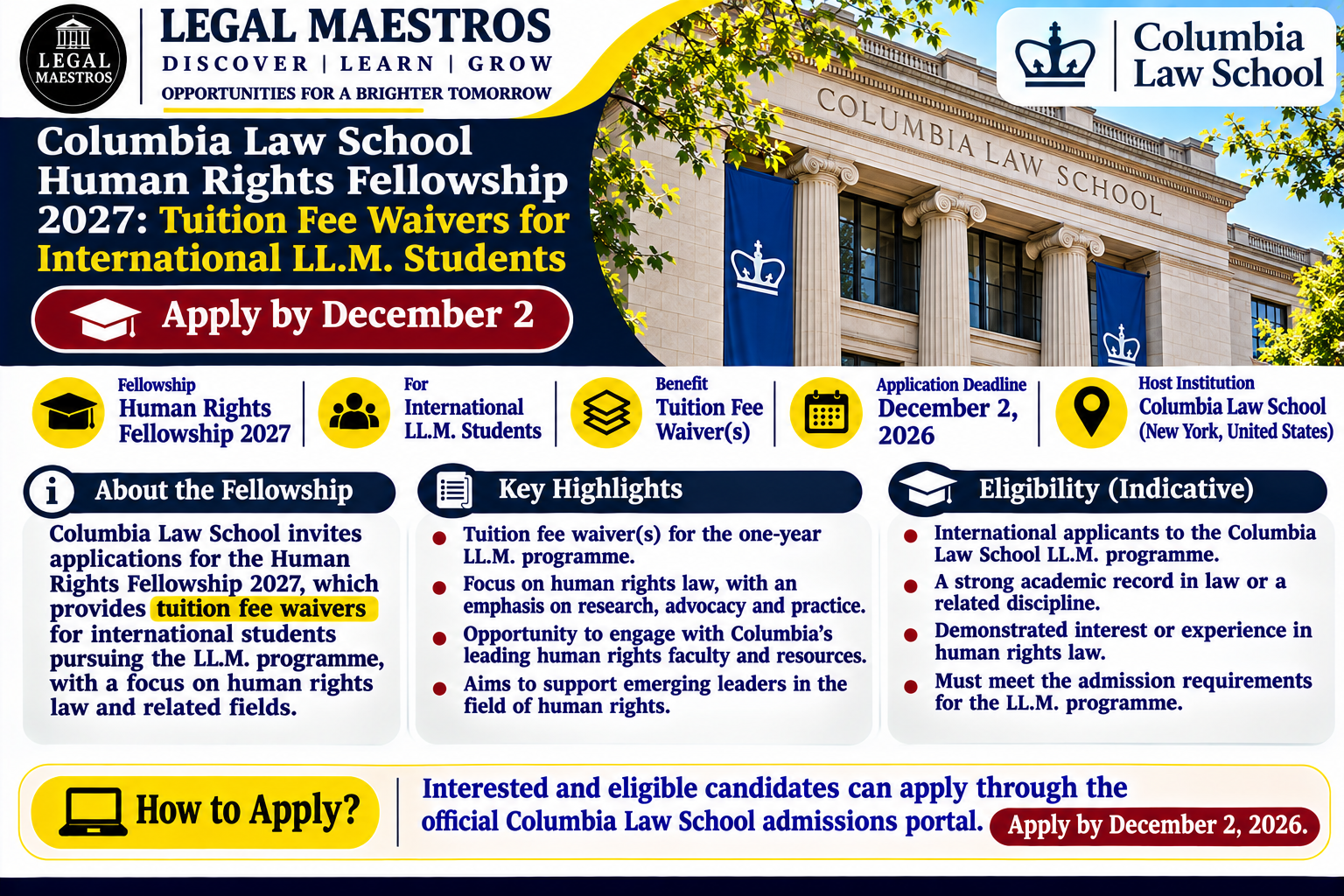
Columbia Law School, part of Columbia University in New York, United States, is inviting applications for its Human Rights LL.M. Fellowship for the 2027–2028 academic year. The fellowship supports lawyers and legal researchers who have experience working on international human rights issues and wish to continue their careers in human rights practice or academia.
The programme provides financial assistance towards LL.M. tuition fees, along with academic mentoring and opportunities to participate in human rights research and activities at Columbia Law School.
Applications are open to eligible international candidates, including Indian law graduates who meet the university’s admission and fellowship requirements.
The last date for submitting applications is December 2, 2026.
About the Human Rights LL.M. Fellowship
The Human Rights LL.M. Fellowship is jointly administered by Columbia Law School’s Human Rights Institute and its Office of Graduate Degree Programs.
The fellowship is intended for individuals who have demonstrated exceptional potential in international human rights work.
Need Help With Your PhD or LLM Thesis?
Explore our thesis and dissertation writing support services for PhD and LLM students. Get subject-specific academic assistance for your research project.
Explore Our Services →The programme supports candidates who want to strengthen their understanding of human rights law and develop careers involving legal practice, academic research, public interest advocacy or other forms of human rights work.
Unlike a conventional research fellowship that appoints researchers for a particular project, this fellowship provides financial assistance to candidates admitted to Columbia’s LL.M. programme.
Selected fellows will pursue the regular LL.M. degree while also participating in activities connected with the Human Rights Institute.
The university expects fellows to devote a significant part of their academic work to human rights.
About the LL.M. Programme
Columbia Law School offers a one-year, full-time LL.M. programme for law graduates from different countries.
The programme begins in August and allows students to choose courses from the university’s legal curriculum.
Students can study subjects connected with international law, constitutional law, human rights, comparative law, criminal justice and other legal disciplines.
The LL.M. programme also provides opportunities to participate in academic activities, legal clinics, research and discussions with faculty members.
Students receiving the Human Rights Fellowship are expected to make human rights a significant part of their academic experience.
The fellowship is therefore particularly relevant for applicants who already have experience in international human rights work and wish to develop that experience further.
Eligibility Criteria
Applicants must first satisfy the admission requirements for Columbia Law School’s LL.M. programme.
Candidates must possess a first degree in law from a recognised institution. This is generally the degree that qualifies a person to enter the legal profession in their jurisdiction.
Indian candidates holding a recognised LL.B. or integrated law degree may therefore be eligible to apply.
However, the fellowship has additional requirements beyond ordinary LL.M. admission.
Applicants must demonstrate previous experience in international human rights work.
They must also show a strong commitment to pursuing a career in human rights practice, academic research or teaching.
Columbia Law School has not prescribed a specific minimum number of years of professional experience for this fellowship.
The university also does not mention a separate age limit for applicants.
Candidates who are still completing their first law degree should note that Columbia ordinarily considers final-year applicants only in exceptional circumstances.
Who Can Apply from India?
Indian lawyers, law graduates and legal researchers who meet the academic and professional requirements can apply.
The fellowship may be relevant for professionals who have worked on international human rights issues through legal practice, research institutions, non-governmental organisations or academic projects.
For example, lawyers with experience involving international human rights standards, access to justice, refugee protection or the rights of vulnerable communities may have relevant backgrounds.
However, working in a field connected with social justice does not automatically satisfy the fellowship’s requirements.
Applicants must be able to demonstrate meaningful experience in international human rights work.
The university considers the applicant’s previous achievements, academic background and commitment to future human rights work when evaluating fellowship candidates.
Scholarship Amount and Financial Benefits
Columbia Law School’s Human Rights Fellowship provides tuition fee assistance to selected LL.M. students.
The official fellowship announcement states that awards may range from partial to full tuition waivers.
However, the university’s general LL.M. financial aid FAQ states that full tuition waivers are not granted and that most assistance covers only part of the cost of studying.
These statements appear together on Columbia’s official website. Applicants should therefore confirm the exact funding arrangement with the university before making financial commitments.
The fellowship announcement does not promise a separate monthly stipend for living expenses.
Accommodation, travel, health insurance and other expenses are also not expressly guaranteed under the fellowship.
Students who require additional financial assistance may need to explore other funding arrangements.
Academic Mentoring and Career Support
Apart from tuition assistance, the Human Rights Fellowship provides several academic and professional opportunities.
Selected fellows receive career mentoring and skill development support from faculty members, staff and advisers associated with Columbia Law School’s Human Rights Institute.
The mentoring programme focuses on both human rights practice and academic scholarship.
Fellows may receive guidance on developing their research interests, understanding professional opportunities and preparing for careers in the human rights field.
The university also organises events involving human rights advocates, researchers and scholars.
These activities provide opportunities for fellows to interact with professionals working on different international human rights issues.
Research Opportunities at the Human Rights Institute
Selected fellows can participate in research projects undertaken by Columbia Law School’s Human Rights Institute.
The Institute works on human rights issues through research, legal education, advocacy and engagement with different institutions.
Fellows may have opportunities to contribute to academic discussions and research activities relevant to their interests.
The fellowship is intended to support candidates who want to combine legal knowledge with practical human rights work.
Participants are expected to remain actively involved in the university’s human rights community throughout their studies.
Human Rights Clinic Opportunities
Another feature of the fellowship is the opportunity to be considered for Columbia Law School’s Human Rights Clinic.
The Human Rights Clinic provides students with practical exposure to human rights advocacy and legal problem-solving.
Its work involves developing legal and advocacy strategies for addressing human rights concerns.
Fellowship recipients receive special consideration for admission to the clinic.
However, selection for the fellowship does not automatically guarantee admission to the Human Rights Clinic.
The clinic has its own admission and participation arrangements.
English Language Requirements
Columbia Law School requires applicants to demonstrate English proficiency unless they qualify for an automatic waiver.
For IELTS Academic, the university requires an overall score of 8.
For TOEFL iBT examinations taken before January 21, 2026, the minimum score is 105.
For the revised TOEFL iBT introduced on January 21, 2026, Columbia states a preferred overall score of 5.5, with at least 5 in each section.
Applicants who completed their first law degree entirely in English in a country where English is an official language may qualify for an automatic test waiver.
Indian applicants who meet these conditions should check the university’s guidance carefully.
Columbia may still request English-language evidence during the admission process.
Documents Required
Applicants must submit a complete LL.M. admission application to be considered for the fellowship.
The application requires an updated resume or curriculum vitae, academic transcripts, degree certificates and a personal statement.
Candidates must also provide two letters of recommendation. Columbia prefers one recommendation from a law professor and another from a professional supervisor.
The letters should discuss the applicant’s previous work and future potential as a human rights advocate, researcher, scholar or practitioner.
Applicants must submit English-language test results where required.
International academic records and recommendations are processed through the Law School Admission Council’s Credential Assembly Service.
The LL.M. application carries a non-refundable fee of US$85. Additional LSAC processing charges may apply.
Personal Statement for the Fellowship
The personal statement is particularly important for candidates seeking the Human Rights Fellowship.
Columbia Law School requires applicants to indicate that they wish to be considered for merit-based financial assistance.
Candidates interested in the Human Rights Fellowship should explain their reasons for seeking the award in their personal statement.
The statement should describe the applicant’s relevant human rights experience and explain how the LL.M. programme relates to their professional or academic goals.
Columbia limits the personal statement to two pages, with standard formatting requirements.
The university also requires applicants to prepare their application materials independently. It expressly prohibits assistance from third parties or artificial intelligence tools in completing application components.
Applicants must therefore write their statements themselves and ensure that all submitted materials represent their own work.
Selection Process
Candidates must first be admitted to the LL.M. programme before they can receive the Human Rights Fellowship.
Columbia considers academic qualifications, professional experience, recommendations, the personal statement and other application materials during the admission process.
For the fellowship, applicants must also demonstrate their previous international human rights experience and future commitment to the field.
The financial aid process is separate from admission decisions.
Applying for a merit-based award does not reduce the applicant’s chances of receiving admission.
Columbia generally communicates LL.M. admission decisions around mid-March.
Most financial aid decisions are released shortly after admission decisions.
The university has not specified the number of Human Rights Fellowships that will be awarded for the 2027–2028 academic year.
How to Apply?
Interested candidates must submit their applications through Columbia Law School’s official LL.M. admission process.
Applicants should first visit the LL.M. application page and review the academic, language and documentation requirements.
The personal statement, resume and application fee are submitted through Columbia’s Application Portal.
Academic transcripts, degree certificates, recommendations and English-language test results are processed through LSAC.
Candidates must indicate in their application that they wish to be considered for merit-based financial assistance.
They should also identify the Human Rights Fellowship in their personal statement and explain why their previous experience and career plans make them suitable for the award.
There is no separate application form for the Human Rights Fellowship.
Completing the LL.M. application and indicating interest in merit-based aid allows the applicant to be considered for relevant named fellowships.
Official Fellowship Details: https://www.law.columbia.edu/admissions/graduate-admissions/llm/financing-your-columbia-llm/human-rights-fellowship
Official LL.M. Application Process: https://www.law.columbia.edu/admissions/graduate-admissions/llm/application-process
Official Application Portal: https://apply.law.columbia.edu/
Official Financial Aid Information: https://www.law.columbia.edu/admissions/graduate-admissions/llm/financing-your-columbia-llm
Official Email for Admission Queries: gradprograms@law.columbia.edu
Application Deadline
The last date for submitting applications for Columbia Law School’s LL.M. programme for the 2027–2028 academic year is December 2, 2026.
The same deadline applies to candidates seeking consideration for the Human Rights Fellowship.
The online application must be submitted by December 2.
Applicants must also send the required academic documents and recommendations to LSAC by the prescribed deadline. Where an English-language test is required, it must be taken no later than December 2.
Columbia has advised applicants to arrange their supporting materials by November 15 to allow sufficient time for processing.
The one-year LL.M. programme will begin in August 2027.
Eligible lawyers and legal researchers interested in the fellowship can submit their applications through Columbia Law School’s official admissions system before the deadline.