About the University of Edinburgh
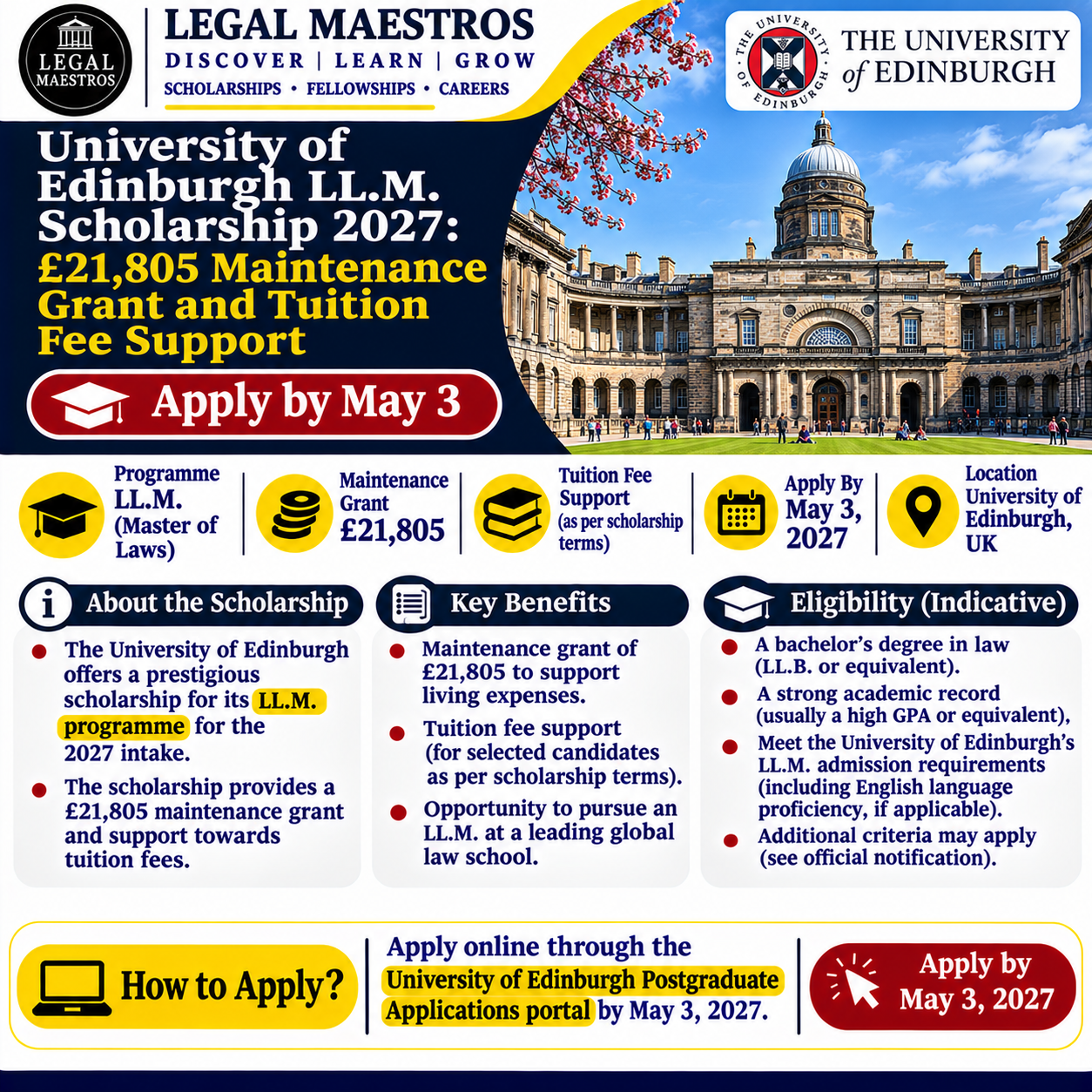
The University of Edinburgh in Scotland, United Kingdom, has announced scholarship opportunities for students interested in pursuing an LL.M. by Research in Scots private law during the 2027–2028 academic year.
The scholarships are offered by the Edinburgh Legal Education Trust, an organisation established to advance legal education and research in Scotland.
Selected full-time students will receive financial assistance covering tuition fees at the United Kingdom’s home-student rate, along with a maintenance grant currently valued at £21,805.
The programme is open to eligible law graduates from different countries, including India. However, international students may have to arrange additional funding to meet the difference between domestic and overseas tuition fees.
The last date for submitting scholarship applications is 3 May 2027.
About the Edinburgh Legal Education Trust
The Edinburgh Legal Education Trust was established in 1996 to support legal education and academic research in Scotland.
Need Help With Your PhD or LLM Thesis?
Explore our thesis and dissertation writing support services for PhD and LLM students. Get subject-specific academic assistance for your research project.
Explore Our Services →The Trust provides scholarships for postgraduate researchers studying Scots private law at the University of Edinburgh.
It supports candidates interested in developing advanced knowledge of private law and producing original legal scholarship.
The Trust also encourages researchers who wish to continue their academic work beyond the master’s level.
Over the years, several scholars supported by the organisation have completed doctoral research and subsequently pursued careers in university teaching, legal practice and academic writing.
The Trust has also supported the publication of doctoral research as academic books.
About the LL.M. by Research Programme
The LL.M. by Research is a postgraduate research degree offered by Edinburgh Law School.
Unlike a conventional taught LL.M., which generally consists of several taught courses and examinations, the research degree focuses primarily on independent academic work.
Students undertake a substantial research project under academic supervision.
The programme ordinarily lasts one year for full-time students.
Part-time students may complete the degree over two years.
Candidates are required to produce a thesis of up to 30,000 words.
The programme provides an opportunity to examine a specific legal question in considerable detail.
Students are also expected to participate in research training and academic activities organised by Edinburgh Law School.
Number of Scholarships
The Edinburgh Legal Education Trust has announced that one or more scholarships may be awarded for the 2027 intake.
The exact number of awards has not been fixed.
The Trustees retain discretion to decide how many scholarships will be offered and whether any scholarship should be awarded.
The programme is competitive, and candidates must demonstrate their suitability for postgraduate legal research.
The Trust offers separate arrangements for full-time and part-time researchers.
The funding benefits under these two arrangements are different.
Scholarship Amount and Financial Benefits
The full-time scholarship covers tuition fees at the UK home-student rate.
Selected recipients also receive a maintenance grant, currently valued at £21,805 for the academic year.
The maintenance grant is intended to support living expenses during the one-year research programme.
According to the Trust’s regulations, the allowance is paid in four equal instalments.
These payments are scheduled for 15 September, 15 December, 15 March and 15 June.
Tuition fee contributions are paid directly by the Trust to the University of Edinburgh.
The Trust may also provide limited assistance towards research expenses.
This additional assistance would not normally exceed £400 in a year.
The published funding amount is a scholarship allowance, not an employment salary.
Important Funding Condition for Indian Students
Indian applicants should pay particular attention to the tuition fee arrangement.
The scholarship covers tuition fees only up to the amount charged to students with UK home fee status.
International students are ordinarily charged a higher tuition fee.
Therefore, an Indian student classified as an overseas-fee-paying student may need to arrange funds to pay the difference.
For example, if the university charges an international student more than the domestic tuition rate, the scholarship does not automatically cover that additional amount.
The maintenance grant of £21,805 is separate from the tuition contribution.
The announcement also does not guarantee additional financial assistance for international travel, visa expenses or the immigration health surcharge.
Applicants should check their individual fee classification and the published international tuition rate before accepting admission.
The scholarship should not be described as fully funded for all international students.
Part-Time Scholarship
The Edinburgh Legal Education Trust also offers a scholarship for part-time LL.M. by Research students.
The part-time programme lasts two years.
Under this arrangement, the scholarship covers tuition fees at the UK home-student rate.
The Trust may also provide limited support for research expenses.
However, the part-time scholarship does not include the £21,805 maintenance allowance offered to full-time recipients.
Indian candidates should also confirm whether their immigration status permits part-time study before applying.
The full-time scholarship is therefore the more relevant option for international applicants seeking living-cost support.
Eligibility Criteria
Applicants must possess an appropriate academic qualification before the LL.M. by Research programme begins.
According to the Trust’s regulations, candidates must hold an honours degree in law.
Alternatively, applicants may possess an ordinary degree in law together with an honours degree in another discipline.
Candidates must also be accepted for admission to the University of Edinburgh’s LL.M. by Research programme.
The university’s general minimum entry requirement for the research degree is a UK upper second-class honours degree, commonly known as a 2:1, or its international equivalent, in law or a relevant social science subject.
However, the scholarship has its own law-degree requirements.
Meeting the university’s general admission criteria does not automatically establish scholarship eligibility.
Applicants must also propose research falling within Scots private law.
Can Indian Law Graduates Apply?
Yes. The Trust’s published eligibility rules do not restrict applications to British citizens or residents of Scotland.
Indian law graduates may apply if their qualifications satisfy both the university’s admission requirements and the Trust’s scholarship criteria.
Candidates holding recognised law degrees, including BA LL.B., BBA LL.B. or LL.B., may be considered, subject to the assessment of their qualifications.
The university will determine whether the applicant’s academic record meets the UK degree-equivalency requirements.
Candidates interested in applying should also have a strong academic interest in private law research.
A previous LL.M. is not expressly required under the scholarship rules.
However, applicants should understand that the research must concern Scots private law.
A research proposal dealing exclusively with Indian law, without a substantial Scottish private law connection, would not ordinarily match the advertised subject requirement.
Research Areas
The scholarship supports research in Scots private law.
Private law generally concerns legal relationships between individuals, organisations and other private parties.
Relevant research may involve Scots contract law, property law, obligations, delict, trusts, succession or related areas.
The Trust places particular emphasis on doctrinal legal research.
This means that applicants should focus on legal rules, principles, judicial decisions and the development of private law doctrine.
Historical and comparative perspectives are welcomed.
For example, an applicant may examine a particular doctrine of Scots contract law and compare its development with the corresponding position in another legal system.
A comparative project involving Indian and Scottish private law may be suitable if Scots private law remains central to the research.
However, the Trust has clarified that proposals focusing mainly on legal theory or socio-legal issues are not its preferred areas.
Research Proposal
Applicants are expected to identify their own research topics.
The project should present a clear question involving Scots private law and explain why the proposed research is academically important.
Candidates should demonstrate familiarity with relevant legislation, judicial decisions and academic literature.
The research proposal should also identify the methods that will be used to investigate the chosen subject.
For a doctrinal private law project, this may involve detailed examination of legal sources and scholarly commentary.
Applicants proposing comparative research should explain the importance of comparing the Scottish legal position with another jurisdiction.
The project should be realistic for a one-year research degree involving a thesis of up to 30,000 words.
Edinburgh Law School advises students to ensure that the proposed topic fits the research interests of its academic staff.
Research Supervision
Students admitted to the LL.M. by Research programme receive academic supervision during their studies.
Supervisors provide guidance on the research project, relevant literature, methodology and academic progress.
The University of Edinburgh considers the availability of suitable supervision during its admission process.
Applicants should therefore examine the research interests of Edinburgh Law School faculty members.
Candidates interested in Scots private law may also seek informal guidance from academics working in that field.
The Trust’s official regulations provide contact details for Professor Kenneth Reid and Professor Andrew Steven for enquiries concerning the scholarships.
Such enquiries do not replace the formal university admission or scholarship application.
Opportunity to Continue Towards a PhD
An important feature of the scholarship is the possibility of progressing from the LL.M. by Research to doctoral study.
The Trust explains that the LL.M. can serve as an initial stage of research leading towards a PhD.
In certain circumstances, a student may be permitted to transfer to the PhD programme during the LL.M. year.
The research completed during the master’s programme may then contribute to the doctoral project.
The Trust states that funding for the full three years of doctoral study is often made available to full-time scholars who make this transition.
However, additional doctoral funding is not automatic.
Progression depends on the university’s academic requirements and the Trust’s funding decisions.
Applicants interested in long-term academic careers may find this arrangement particularly relevant.
Residence and Employment Requirements
Full-time scholarship recipients are expected to devote their time to their research.
The Trust requires scholars to live in Edinburgh or sufficiently close to the city to attend Edinburgh Law School regularly.
The scholarship is therefore not intended as a fully remote research award.
The Trust also places restrictions on paid employment during the scholarship period.
Part-time teaching or other employment directly connected with the scholar’s research may be undertaken, but it must not exceed three hours per week.
Other forms of paid employment require permission from the Trustees.
Scholarship recipients must also disclose any other awards or funding they receive.
The Trust may review the scholarship amount when additional funding becomes available.
English Language Requirements
The University of Edinburgh requires applicants to demonstrate sufficient proficiency in English.
For IELTS Academic, the published requirement for the LL.M. by Research is an overall score of 7.0.
Candidates must obtain at least 7.0 in writing and 6.5 in each of the remaining components.
The university also accepts other recognised English-language qualifications, including TOEFL iBT and certain Cambridge English examinations.
Some applicants may satisfy the language requirement through a degree taught and assessed in English.
However, this exemption applies only where the university’s specific conditions are satisfied.
Indian applicants should check whether their university appears on Edinburgh’s list of accepted institutions for English-language qualifications.
Applicants who do not meet the language requirements may receive conditional admission, depending on the circumstances.
Documents Required
Candidates must first prepare their application for admission to the LL.M. by Research programme.
The university requires academic transcripts and degree certificates showing previous qualifications.
Applicants must also submit a research proposal.
Academic references are required as part of the admission process, with the university’s programme page specifying two references.
Evidence of English-language proficiency may be required.
The application also asks for information about the candidate’s academic interests and research background.
After applying for admission, candidates must complete the separate Edinburgh Legal Education Trust Scholarship Application Form.
Applicants should follow the instructions contained in that form and submit the necessary information before the scholarship deadline.
Selection Process
Scholarship selection is conducted by the Trustees of the Edinburgh Legal Education Trust.
Candidates must satisfy the Trust’s eligibility requirements and meet the academic standards for admission to the University of Edinburgh.
The research proposal is particularly important because the scholarship is restricted to Scots private law.
The Trustees may consider the strength of the proposed research, the candidate’s academic qualifications and the suitability of the project for advanced study.
The Trust’s regulations state that preference may be given to candidates intending to continue towards a PhD.
However, applicants are not required to make an unconditional commitment to doctoral study.
The Trustees retain discretion to offer or decline scholarships.
A university admission offer does not guarantee scholarship selection.
How to Apply?
Interested candidates must first submit an application for admission to the University of Edinburgh’s Law LL.M. by Research programme.
Applications for the degree are submitted through the university’s official online admissions system.
Candidates should select the relevant course and September 2027 intake.
They must provide their academic qualifications, proposed research topic, research proposal and supporting documents.
After applying for admission, candidates should download the Edinburgh Legal Education Trust Scholarship Application Form from the university’s official research funding page.
The completed scholarship form must be sent to the Edinburgh Law School postgraduate research office at phd.law@ed.ac.uk.
The Trust confirms that applicants may seek scholarship consideration before receiving a final admission offer.
However, applicants must eventually obtain admission to the LL.M. by Research programme to receive the award.
Edinburgh Law School generally advises candidates seeking university or Law School scholarship funding to submit their course applications at least two weeks before the scholarship deadline.
Applicants should therefore begin the university application well before May 2027.
Official Application Links
Official Scholarship Announcement: https://www.law.ed.ac.uk/study/research-degrees/scholarships-funding
Official Trust Scholarship Regulations: https://edinburghlegaleducationtrust.co.uk/llm-full-time-1
LL.M. by Research Programme: https://study.ed.ac.uk/pprogrammes/postgraduate-research/993-law
University Admission Instructions: https://www.law.ed.ac.uk/study/research-degrees/how-to-apply
Part-Time Scholarship Information: https://edinburghlegaleducationtrust.co.uk/llm-part-time
Email for Scholarship Applications: phd.law@ed.ac.uk
Email for Informal Research Enquiries: kenneth.reid@ed.ac.uk or andrew.steven@ed.ac.uk
The official scholarship application form is available on Edinburgh Law School’s research scholarships and funding page.
Application Deadline
The published deadline for the Edinburgh Legal Education Trust LL.M. by Research Scholarship is 3 May 2027.
Applications should normally reach the university by that date.
The scholarship is intended for students beginning their research degrees in September 2027.
Candidates should apply for university admission before completing the separate scholarship form.
The full-time award provides tuition fee assistance at the UK home-student rate and a maintenance grant currently valued at £21,805 for the academic year.
The Trust may also provide up to £400 towards eligible research expenses.
Indian law graduates interested in Scots private law, including those considering comparative private law research, may apply if they meet the academic and scholarship eligibility requirements.
International applicants should confirm their overseas tuition fee liability because the award does not automatically cover the difference between UK home and international