About the Top Class Education Scholarship
The Ministry of Social Justice and Empowerment, Government of India, is inviting applications for the Central Sector Scholarship of Top Class Education for Scheduled Caste (SC) Students for the academic year 2026–27.
The scholarship provides financial assistance to eligible students pursuing higher education at selected institutions across India. It covers tuition fees and other non-refundable institutional charges, along with an academic allowance for educational and living expenses.
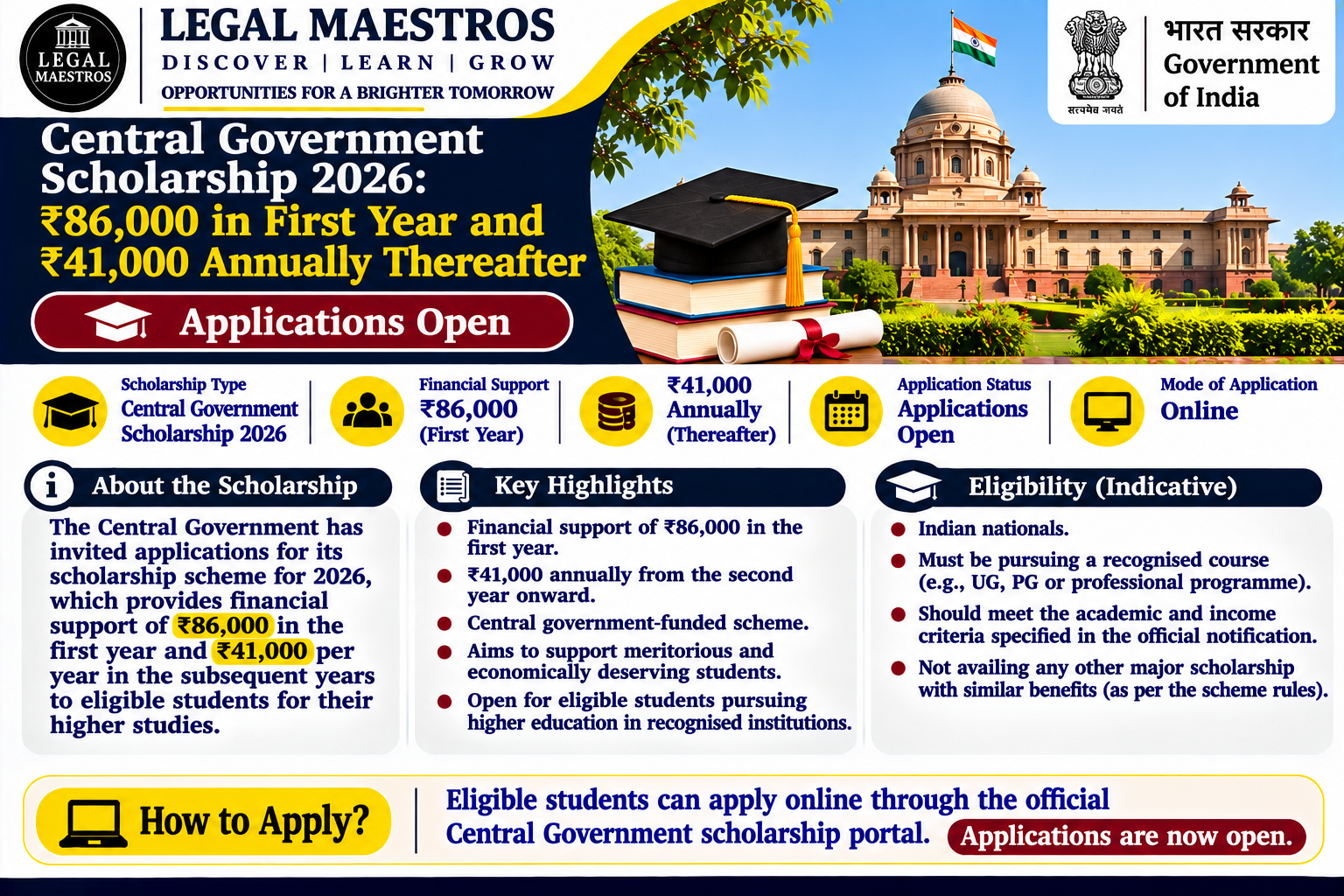
Selected students will receive an academic allowance of ₹86,000 in their first year and ₹41,000 in each subsequent year of study.
The scheme also covers eligible students pursuing law degrees at National Law Universities and other notified institutions.
Applications are being accepted through the National Scholarship Portal. The last date to apply is November 30, 2026.
About the Scholarship Scheme
The Central Sector Scholarship of Top Class Education for SC Students is implemented by the Department of Social Justice and Empowerment.
Need Help With Your PhD or LLM Thesis?
Explore our thesis and dissertation writing support services for PhD and LLM students. Get subject-specific academic assistance for your research project.
Explore Our Services →Its purpose is to provide financial support to meritorious Scheduled Caste students who have secured admission to recognised higher education institutions.
The scheme covers studies beyond Class 12, including undergraduate and other prescribed courses at institutions notified by the Ministry.
Unlike scholarships that provide only a fixed amount every month, this scheme covers eligible institutional fees and provides a separate academic allowance.
The scholarship is available only at institutions included in the government’s notified list. Admission to a recognised college alone does not automatically establish eligibility.
The Ministry has published scheme guidelines for the academic year 2026–27.
Scholarship Benefits
The scholarship provides financial assistance under two principal categories.
The first is support for tuition fees and other non-refundable charges collected by the institution.
For eligible government institutions, the scheme covers the prescribed tuition fees and non-refundable charges.
For private institutions, the maximum tuition fee assistance is ₹2 lakh per student per year.
The second benefit is the academic allowance.
Selected students will receive ₹86,000 during the first year of their course.
From the second year onwards, the academic allowance will be ₹41,000 per year.
This allowance is intended to help students meet educational and living expenses, including accommodation, books, stationery and computer-related requirements.
The amount is provided annually rather than as a monthly stipend.
Eligibility Criteria
Applicants must belong to the Scheduled Caste category.
The total annual family income from all sources must not exceed ₹8 lakh.
Candidates must have secured admission to a full-time prescribed course at an institution notified under the scholarship scheme.
The admission must have been obtained through the normal selection process followed by the institution.
Only students entering the first year of their course can be considered for a fresh scholarship.
Students who are already studying in their second, third or subsequent years cannot apply as fresh candidates.
However, students who were awarded the scholarship earlier may apply for renewal, subject to the applicable conditions.
The scheme also provides that no more than two siblings from the same family can receive benefits under it.
Scholarship for Law Students
The scheme is particularly relevant for students pursuing undergraduate law programmes at eligible National Law Universities.
The government’s notified institutional list includes several National Law Universities, including NLU Delhi, Gujarat National Law University, NALSAR University of Law, National Law University Odisha and other participating institutions.
However, the number of scholarship places available differs between institutions.
The notified list also specifies the course level for which scholarships are available.
For example, the National Law University Delhi entry in the published scheme document identifies undergraduate courses.
Students pursuing a five-year integrated law programme such as BA LL.B. or BBA LL.B. may therefore be eligible if their institution and course are covered by the notified list.
Students pursuing an LL.M. should not assume that they are automatically eligible merely because their university appears on the list. They must confirm whether their specific postgraduate course is covered.
Law students should check with their university’s scholarship or student welfare office before submitting an application.
Family Income Requirement
The total annual family income of the applicant must not exceed ₹8 lakh.
Income from all sources is considered while determining eligibility.
The scholarship guidelines specify that students whose parents or guardians are self-employed must provide an income certificate issued by a revenue officer not below the rank of Tehsildar.
For employed parents or guardians, income certification from the employer is required.
Where the family has additional income sources, the guidelines also provide for certification through the relevant revenue authority.
Applicants must provide accurate income information because the institution will verify the details before forwarding the application.
Reservation for Female Students
The scheme includes a provision for reservation of scholarship places for eligible SC female students.
According to the guidelines, 30% of the scholarship slots allocated to an institution are reserved for eligible SC girl students based on merit.
Female students selected through the overall merit list are not counted against these reserved places.
Where sufficient eligible female candidates are unavailable, the remaining reserved slots may be transferred to eligible male candidates according to the prescribed merit criteria.
This provision applies within the scholarship allocation made to each participating institution.
Selection Process
Selection is based on the eligibility requirements and the number of scholarship slots available at the applicant’s institution.
Where the number of eligible candidates exceeds the available slots, selection is made according to the candidates’ relative merit under the institution’s admission criteria.
For example, where admission to a law university is based on an entrance examination, the relevant admission merit or rank may be considered.
If two candidates have equal merit for the last available scholarship position, preference is given to the applicant with the lower family income.
The institution is responsible for verifying the candidate’s eligibility and recommending eligible students within its allocated scholarship limit.
Submitting an application on the National Scholarship Portal does not automatically guarantee selection.
Scholarship Duration and Renewal
The scholarship, once awarded, may continue until the student completes the approved course, subject to satisfactory academic performance and the scheme conditions.
Beneficiaries must continue their studies and meet the requirements for promotion to the next semester or academic year.
The guidelines provide for withholding or termination of assistance where a student fails to progress academically, with restoration provisions when the student is subsequently promoted.
Students who change their institution after receiving the scholarship may lose further eligibility under the scheme.
Scholarship recipients are also restricted from simultaneously receiving benefits under another similar Central or State Government scholarship scheme.
Applicants should therefore review the conditions before accepting multiple financial assistance awards.
Documents Required
Candidates must provide the documents and information prescribed through the National Scholarship Portal.
These include their Scheduled Caste certificate, family income certificate, admission-related information, bank account details and applicable fee information.
Applicants may also be required to provide their entrance examination rank or other admission merit details.
The institution will verify the information submitted before forwarding the application.
Candidates should ensure that the personal information provided in their scholarship application matches their official records.
Incorrect or incomplete information may delay verification or affect the application.
How Will the Scholarship Be Paid?
The scholarship amount is released through the Direct Benefit Transfer system.
The government transfers eligible tuition fee assistance and the academic allowance directly to the student’s bank account.
Students are responsible for depositing the required fees with their institution after receiving the payment.
The guidelines require the student to pay the institution within the prescribed period following receipt of the funds.
Applicants should ensure that their bank account details are correct and that the account meets the requirements for government scholarship payments.
How to Apply?
Interested and eligible students must submit their applications through the official National Scholarship Portal.
Applicants who have not previously registered must complete the One-Time Registration process.
The portal requires a One-Time Registration number, also known as OTR, for scholarship applications.
Students can generate their OTR using the official registration facility. The process involves Aadhaar-based identity verification and face authentication.
Once the OTR is generated, applicants can log in to the portal and select the relevant scholarship scheme.
Candidates should locate Central Sector Scholarship of Top Class Education for SC Students under the Department of Social Justice and Empowerment.
They must complete the online form, provide their educational and income details and submit the required documents.
After submission, the application must be verified by the concerned institution.
Official Application Portal: https://scholarships.gov.in/
Official Scholarship Listing: https://scholarships.gov.in/All-Scholarships
Official Student Registration: https://scholarships.gov.in/Students
Official Scheme Details and 2026–27 Guidelines: https://socialjustice.gov.in/schemes/27
Official Scheme Guidelines on NSP: https://scholarships.gov.in/public/schemeGuidelines/Top_Class_Education_Scheme_2018.pdf
Students should consult the Ministry’s 2026–27 guidelines and the course-specific institutional list before applying.
Important Dates
The application process for the 2026–27 academic year opened on June 1, 2026.
The last date for students to submit their applications is November 30, 2026.
The National Scholarship Portal has specified December 15, 2026, as the deadline for defective application correction and institutional verification.
The subsequent district, state and ministry-level verification deadline is December 31, 2026.
Candidates should submit their applications before November 30 and ensure that their institutions complete the verification process within the prescribed period.
Application Deadline
The last date to apply for the Central Sector Scholarship of Top Class Education for SC Students is November 30, 2026.
Eligible students studying in approved institutions, including those pursuing notified undergraduate law programmes, can apply through the National Scholarship Portal.
The financial assistance includes eligible tuition fees and non-refundable charges, together with ₹86,000 as the first-year academic allowance and ₹41,000 annually in subsequent years.
Selection is subject to the applicant meeting the prescribed eligibility requirements and the availability of scholarship slots at the institution.