Journal of Gender Studies Invites Manuscripts
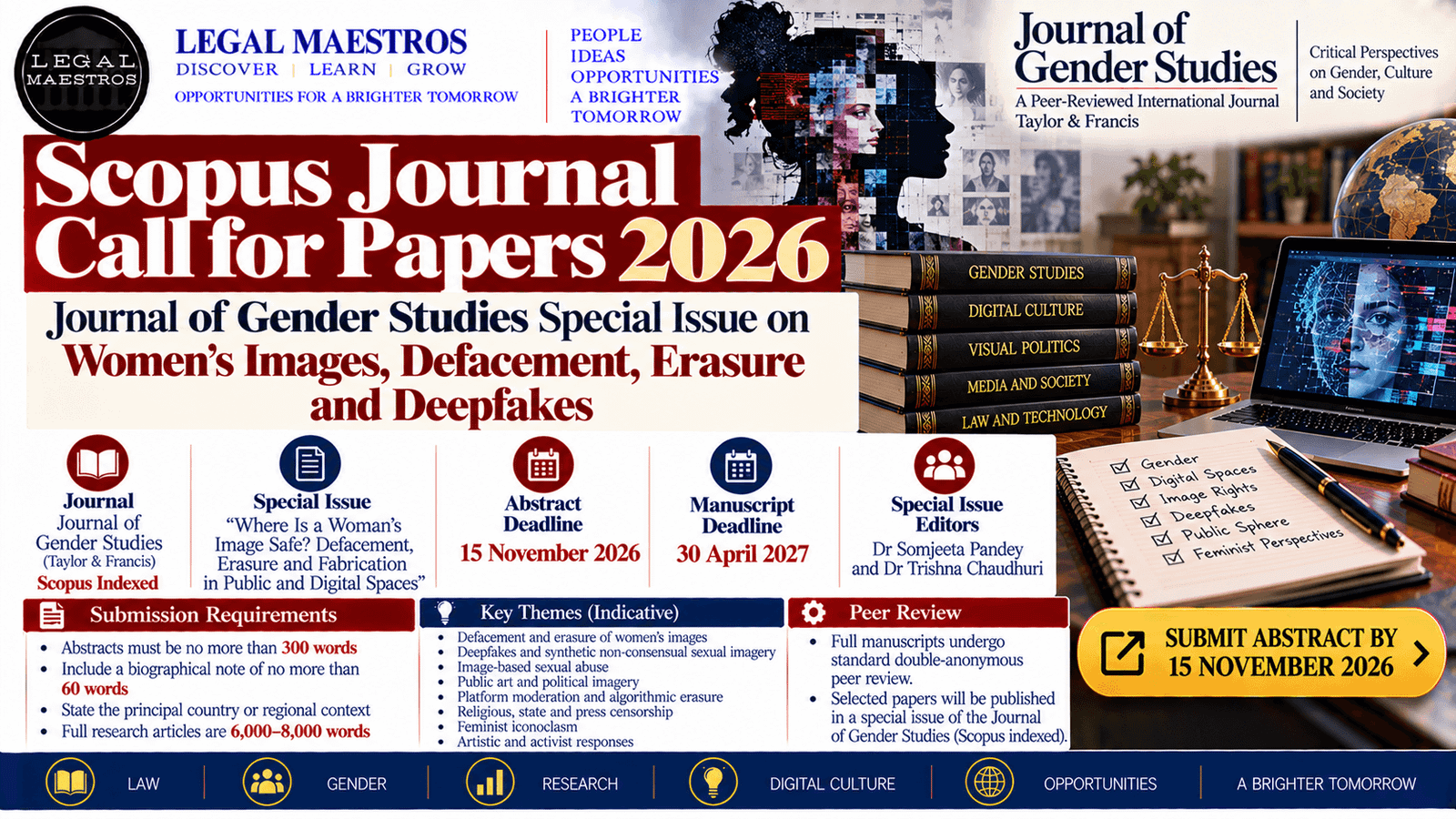
The Journal of Gender Studies has announced a special issue titled “Where Is a Woman’s Image Safe? Defacement, Erasure and Fabrication in Public and Digital Spaces.” The special issue will examine the ways images of women are altered, erased, sexualised, defaced or fabricated across public and digital spaces.
The journal is a Scopus-indexed publication, making the special issue relevant for researchers, academics, legal scholars and students working on gender studies, technology, media, law, visual culture and related areas.
The abstract submission deadline is November 15, 2026, while the deadline for full manuscripts is April 30, 2027.
Theme of the Special Issue
The special issue explores different forms of violations involving representations of women. These include physical defacement of murals and posters as well as digitally fabricated images, deepfakes and other forms of image manipulation.
The editors note that an image of a woman can become a site where sexualisation, humiliation, punishment, coercion or exclusion is performed. The issue therefore seeks to examine when an intervention against an image can itself constitute a form of symbolic or gendered harm.
The special issue encourages submissions based on case studies from different parts of the world, including South Asia, Africa, Latin America and the Caribbean, the Middle East and Central Asia, East and Southeast Asia, Europe and North America.
Research Areas for Submission
The call welcomes research on topics including image-based sexual abuse, sexual privacy, deepfakes, digitally altered imagery and the erasure of women from photographs.
Researchers may also examine the defacement of murals, street art, public art, film hoardings, advertising, political posters and commemorative imagery involving women.
Other areas include AI-generated sexual images, nudify applications, platform moderation, algorithmic erasure, religious and devotional images, feminist iconoclasm and the use of images as sites of symbolic violence.
The special issue also invites research examining how caste, class, colourism, religion and sexuality may influence which representations of women are targeted or erased. Artistic and activist responses, including repair, repainting and counter-images, are also among the suggested areas.
Abstract and Manuscript Submission
Researchers interested in contributing are required to submit an abstract of no more than 300 words, along with a biographical note of no more than 60 words. The abstract should clearly mention the principal country or regional context examined in the proposed research.
Abstracts must be sent by email to jgs.wiawis@gmail.com by November 15, 2026. Authors will be informed about the outcome of the abstract stage by December 15, 2026.
An invitation to submit a full manuscript does not guarantee publication. Full manuscripts will undergo the journal’s standard double-anonymous peer review, with final publication decisions resting with the Editors of the Journal of Gender Studies.
Full Paper Requirements and Important Dates
Research articles should generally be 6,000 to 8,000 words. The word count includes the abstract, tables, figure and table captions, footnotes and endnotes, while references are excluded.
Each article must include an unstructured abstract of up to 200 words and between three and six keywords. The full manuscript should be submitted through ScholarOne by selecting the special issue title “Where Is a Woman’s Image Safe? Defacement, Erasure and Fabrication in Public and Digital Spaces.”
The abstract deadline is November 15, 2026, and the full manuscript deadline is April 30, 2027. The special issue is edited by Dr Somjeeta Pandey, Gobardanga Hindu College, West Bengal, and Dr Trishna Chaudhuri, Manipal University Jaipur.
This can also be adapted into a shorter Lawctopus-style opportunity post or a version specifically highlighting the relevance for law researchers and legal scholars.