Applications expected to open in autumn 2026
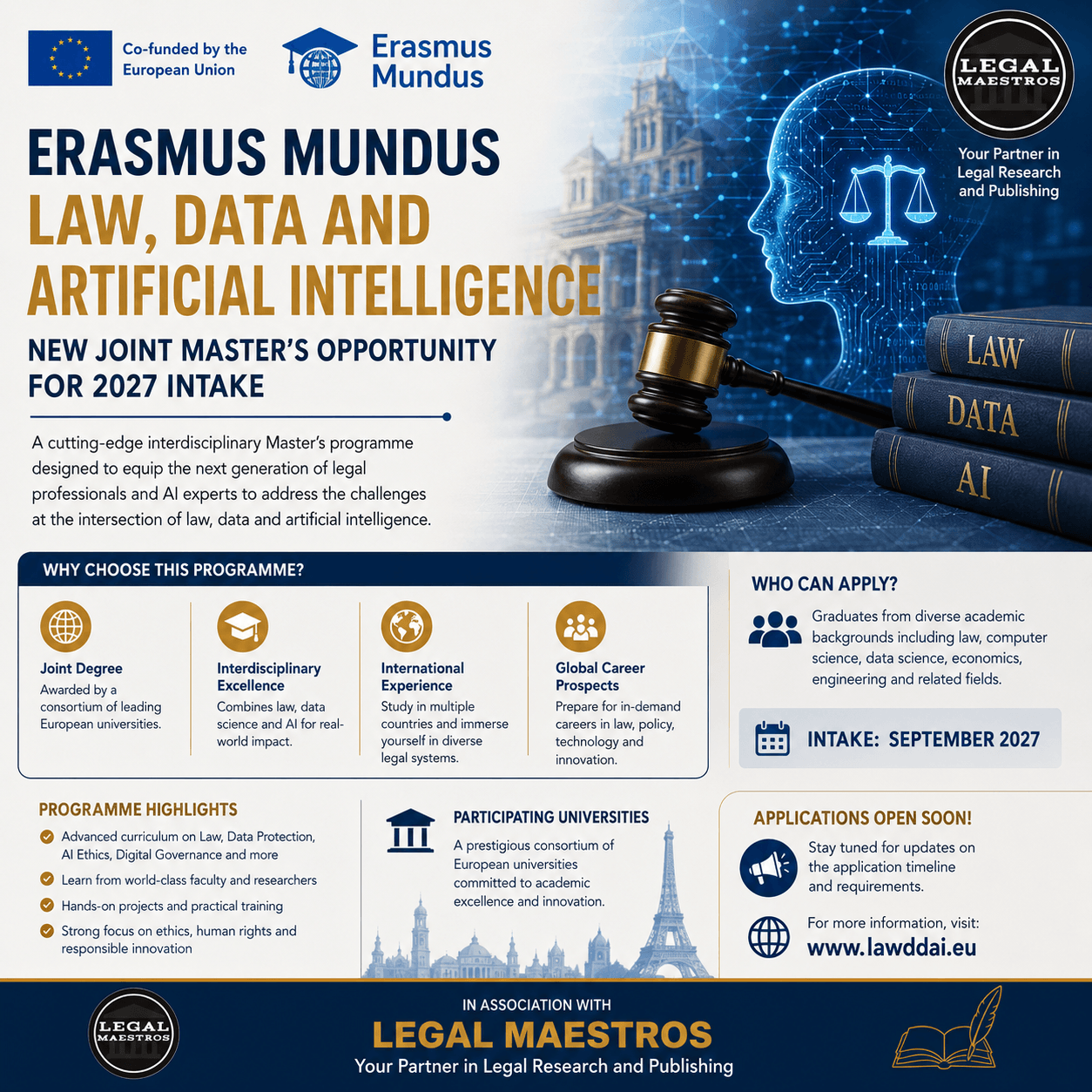
Students and young legal professionals interested in the intersection of law, data and artificial intelligence may soon have a new Erasmus Mundus opportunity to consider for the 2027 academic intake.
The European Commission has selected Law, Data and Artificial Intelligence among 37 new Erasmus Mundus Joint Masters approved under its latest funding call. The new programmes are expected to open applications in autumn 2026, with students beginning their studies in September 2027.
A Programme at the Intersection of Law and AI
The programme is known as the European Master in Law, Data and Artificial Intelligence (EMILDAI). It brings together legal studies, data governance and artificial intelligence in an international and interdisciplinary master’s programme.
The programme is designed to address the growing need for professionals who understand both the legal and technical dimensions of digital technologies. Its areas include data protection, governance, cybersecurity, AI law and ethics, among other subjects.
For law graduates, the programme offers a way to move beyond traditional legal studies and specialise in areas that are increasingly connected with technology regulation and digital governance.
Need Help With Your PhD or LLM Thesis?
Explore our thesis and dissertation writing support services for PhD and LLM students. Get subject-specific academic assistance for your research project.
Explore Our Services →Study Across Multiple Universities
EMILDAI is structured as an international joint master’s programme involving universities in different countries.
The current programme information lists Dublin City University in Ireland, Universidad de León in Spain, Avignon Université in France, Università di Pisa in Italy, Erasmus University Rotterdam in the Netherlands and Fundação Getulio Vargas in Brazil among its partner universities.
The European Commission describes Erasmus Mundus Joint Masters as programmes jointly designed and delivered by higher education institutions from different countries. They generally involve study, research, traineeships and preparation of a master’s thesis across an international academic environment.
What Will Students Study?
The programme combines law and computing and is aimed at developing an understanding of the legal, ethical and technological challenges created by digital transformation.
Students can develop expertise in areas such as AI regulation, data protection, digital governance, cybersecurity and technology law. The programme also has an international and multilingual dimension, with students gaining exposure to English and another European language depending on their study pathway.
The programme has also been formally established as a 120 ECTS master’s degree. The published study plan provides separate pathways in law and computing, with each pathway comprising 120 ECTS.
Erasmus Mundus Scholarships
One of the major attractions of the programme is its connection with the Erasmus Mundus Joint Master scheme of the European Union.
The European Commission has stated that the newly selected Erasmus Mundus Joint Masters will be available to students from around the world and that EU-funded full scholarships will also be available.
The exact scholarship availability, eligibility requirements and application process for the 2027 intake should be checked once the new application cycle is officially opened.
Earlier EMILDAI programme information has also listed scholarship support for students, but applicants should rely on the official 2027 call for the final scholarship terms.
Who Should Consider This Programme?
The programme may be particularly relevant for law graduates, technology law researchers and students interested in AI regulation, data protection, privacy, cybersecurity and digital governance.
It could also be useful for students who want to build careers in technology companies, law firms, regulatory bodies, public institutions, international organisations or policy roles involving emerging technologies.
The University of León notes that the programme is intended to prepare graduates for work involving data protection, governance, cybersecurity, AI law and ethics, with potential career opportunities in the legal sector, technology companies, research organisations and government institutions.
When Will Applications Open?
The European Commission has confirmed that the 37 newly selected Erasmus Mundus Joint Masters will open applications in autumn 2026, for programmes beginning in September 2027. Law, Data and Artificial Intelligence is specifically included in this new group.
Therefore, students interested in the 2027 intake should begin preparing their academic documents, CV, statement of purpose and other likely application materials well before the application window opens.
The exact application deadline and scholarship application procedure for the 2027 intake should be confirmed from the official programme announcement once applications open.
Opportunity for Law Students
The growing use of artificial intelligence and data-driven systems is creating demand for lawyers who understand technology as well as legal regulation.
The EMILDAI programme is positioned around this intersection. It combines legal education with computing and focuses on the legal, ethical and technical questions arising from digitalisation and AI.
For students planning a career in technology law, AI governance, privacy, data protection or digital regulation, the 2027 intake could therefore be an opportunity worth watching.
Programme: European Master in Law, Data and Artificial Intelligence (EMILDAI)
Level: Joint Master’s Degree
Field: Law, Data and Artificial Intelligence
Duration: Two years / 120 ECTS
Study Locations: Multiple partner universities in Europe and beyond
Intake: September 2027
Applications: Expected to open in autumn 2026
Scholarships: EU-funded Erasmus Mundus scholarships available, subject to the applicable selection and scholarship rules
Students interested in the programme should monitor the official EMILDAI and Erasmus Mundus pages for the 2027 application announcement and scholarship details.

![Legal Internship at Reserve Bank of India [Stipend of Rs. 20k; Summer; 2026]: Apply Dec 15, 2025!](https://legalmaestros.com/wp-content/uploads/2025/11/ChatGPT-Image-Nov-9-2025-06_32_27-PM.png)