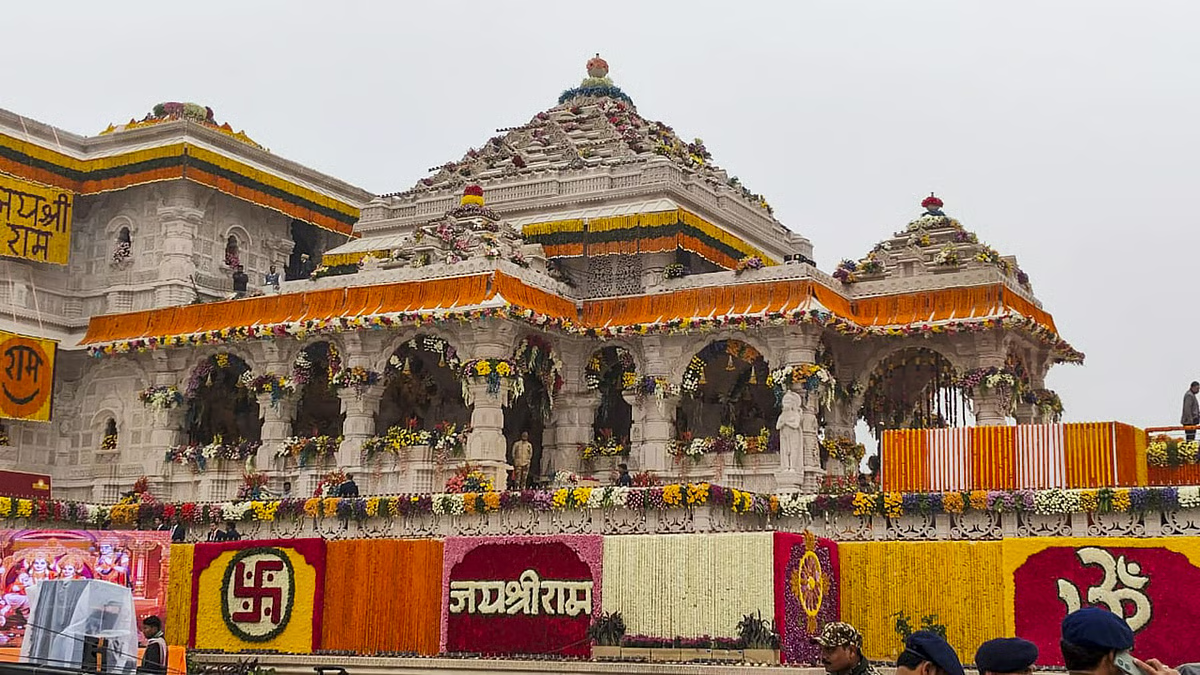
The Ram Janmabhoomi police station witnessed a chaotic evening on Thursday. Barely hours after the written complaint was lodged, the Uttar Pradesh police wasted no time. Eight men were taken into custody – a first in what many call the Ayodhya Ram Mandir donation “scam.”
This began the day the Special Investigation Team submitted its first report to the state government.
They found enough glaring cracks in the cash management system that the first information report was registered instantly. The report was signed by Krishna Mohan, a member of the Shri Ram Janmabhoomi Teerth Kshetra Trust. Every day, thousands of devotees from across the country drop in large sums of cash, gold, and silver in the temple boxes. The central allegation is that a substantial chunk of this physical cash did not make its way to the official bank accounts.
Who Exactly Got Caught?
The police arrested the eight employees responsible for the collection of donations within the temple premises. Ramashankar Yadav alias “Tinnu,” Anukalp Mishra, Avinash Shukla, Karunesh Pandey, Manish Yadav, Lavkush Mishra, Ramashankar Mishra, and Subhash Srivastava were apprehended. These men were positioned in the counting rooms where they are responsible for collecting cash from the donation boxes and physically sorting and counting the money.
One suspect is a former bank employee who had been hired to audit and maintain the counting.
They acted as the frontline protection of the temple’s income, only to allegedly orchestrate a grand scheme to pocket the earnings. Already months ago, former accounts supervisor Mahipal Singh flagged a series of irregularities in the accounts and the handling of funds. He was promptly removed from his post after raising the concerns.
What the Special Investigation Team Found
A sense of deep disquiet and apprehension pervaded the state government following the complaints. Consequently, a three-member Special Investigation Team was constituted on June 13 to investigate the matter extensively. The SIT officials and police officers spent five days thoroughly examining the entire logistical operation involved in the collection of donations in Ayodhya.
This involved multiple interviews with temple staff and detailed auditing of records detailing the money collected in various boxes.
According to sources, the team’s initial findings to the Chief Minister’s office in Lucknow were highly damaging. The investigation indicated that there were numerous deficiencies and a lack of stringent controls in the financial management system of the trust. The chain of custody of the cash was compromised at several points, and the SIT noted a deficiency in visual monitoring of the cash handling process with many cameras in the counting area being either improperly placed or completely unmonitored. In the face of these widespread shortcomings, especially in a system dealing with an annual income that reportedly touched 3.27 billion rupees in FY 2024-2025, the SIT recommended immediate dismissal of the counting team and a complete overhaul of the cash collection security procedures.
Breaking Down the Legal Charges
In an interesting turn of events, the First Information Report lodged against the suspects eschews older colonial-era codes in favor of the new Bharatiya Nyaya Sanhita. The charges pressed by the police are significant and include theft, cheating, criminal breach of trust, and criminal conspiracy. Criminal breach of trust carries the heftiest weight, as it denotes a betrayal of responsibility in guarding the property entrusted to an individual.
In this context, it implies that the accused, entrusted with the safekeeping of the devotees’ donations, systematically misappropriated the funds.
The charge of cheating suggests that the accused engaged in acts of deception to mask their actions, possibly through manipulated ledgers or hidden cash. The criminal conspiracy charge is the bedrock of the prosecution’s case, indicating a well-organized scheme where multiple individuals collaborated to exploit the security loopholes in the temple’s financial system over an extended period. Currently, the accused remain in police custody while investigations are underway to trace the movement of the stolen funds and to obtain arrest memos for further judicial proceedings.
The Political Backlash and Court Petitions
The confluence of religious sentiment and financial transactions is always bound to result in heightened emotions and, consequently, significant political fallout. Following the arrests, Samajwadi Party leader Akhilesh Yadav was quick to call for absolute transparency and questioning the narrative behind the FIR, suggesting it was a ploy to sacrifice lesser individuals while larger players remained unaffected. Chief Minister Yogi Adityanath vehemently responded by stating that no compromise would be made with public faith and that culprits would face stringent punishment. However, the integrity of the local investigation has come under fire, with several court cases emerging. A public interest litigation has been filed in the Lucknow Bench of the Allahabad High Court, demanding that the Central Bureau of Investigation take over the case, citing concerns about local police bias given the stature of the institution involved. In a related development, a plea has been moved in the Supreme Court, urgently seeking the immediate safeguarding of all digital records and CCTV footage to prevent their deletion or tampering. The court has directed the petitioner to revisit the matter later this week. Meanwhile, priests in Ayodhya have reacted with anger and have called for an expeditious trial, with the demand for lifetime bans for those found guilty. The local authorities have remained tight-lipped about their next steps, but hints suggest more arrests may be on the horizon.
SIT flags theft instances in Ayodhya
This broadcast breaks down the specific security lapses and suspected theft instances identified by the investigation team that led to the initial arrests.