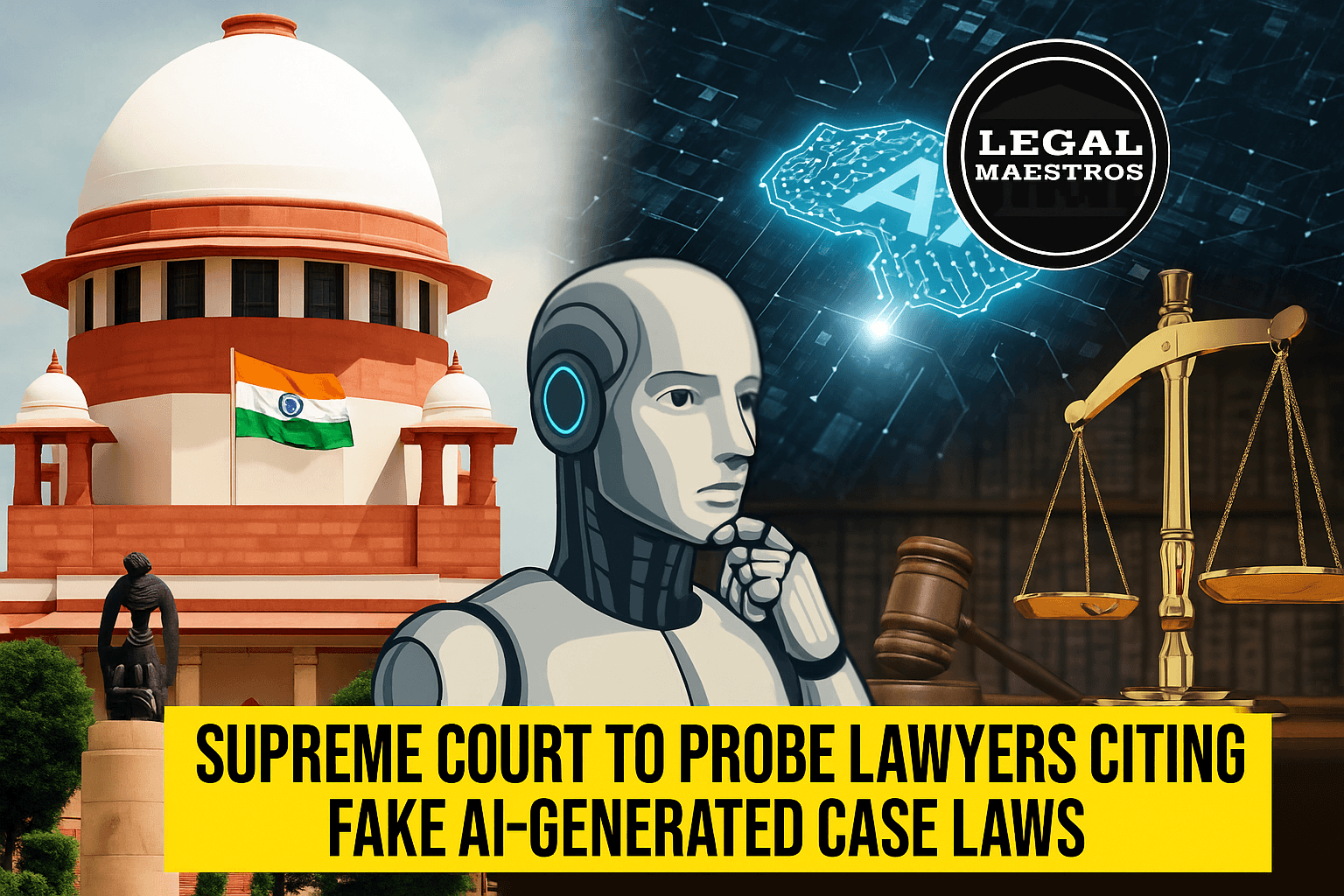
Supreme Court to Probe Lawyers Citing Fake AI-Generated Case Laws
False Citations Are under Investigation by the Supreme Court.
This has raised a serious investigation by the Supreme Court of India into an emerging worrisome trend in the legal system. Recently, a hearing showed that attorneys could have used Artificial Intelligence to create false law on cases. This event has raised eyebrows of the top court in the country, causing the judges to deal with it a stern response. The court headed by Justice Dipankar Datta and Justice Augustine George Masih showed dismay at the prospect of invalid judgments being presented in court as evidence. They have opted to look into the issue in order to ensure that the judicial process is not compromised.
This problem occurred in a hearing on insolvency dispute in which one of the parties provided a list of legal precedents. The opposing attorney mentioned the fact that such cases were not found in some official legal database. This disclosure indicated that the lawyers could have followed an AI tool such as ChatGPT to do their research without checking. The court did not take this lightly as the court observes that such actions have the potential of misleading the judges and giving them the wrong decisions. The judges emphasized that in case such citations are discovered to be counterfeit, those who commit the negligence are going to be dealt with harshly.
This event brings to light an increasing issue of the worldwide community overly relying on technology without comprehending its constraints. The purpose of Artificial Intelligence tools is to forecast text rather than to give the right legal facts. When the user requests an AI to provide him or her with the case laws regarding a given subject, it tends to come up with realistic sounding and entirely non-existent cases. This is referred to as hallucination in the technology sector yet in a court of law, it is equivalent to deceiving. The intervention of the Supreme Court is a serious caution to the whole legal fraternity in India.
For any queries or to publish an article or post or advertisement on our platform, do call at +91 6377460764 or email us at contact@legalmaestros.com.
The Particular Case of Omkara ARC vs. Gstaad Hotels.
The issue of controversy revolves around a high profile case between Omkara Assets Reconstruction Private Limited and Gstaad Hotels Private Limited. The case went to the Supreme Court following the hearing in the National Company Law Appellate Tribunal (NCLAT). In the hearing, Neeraj Kishan Kaul who represented Omkara ARC, made a shocking claim. He told the court that the other party had provided a rejoinder full of inaccuracies. He alleged that the document had more than one hundred citation of cases which were all fabricated.
Mr. Kaul presented the defence that the appellant, Deepak Raheja had depended on judgements that by no means existed. He has mentioned that even rulings of the criminal law, which were wrongly reported as precedents by the Insolvency and Bankruptcy Code, were used in some of the mentioned cases. Such a combination of wrong facts and non-existent names of cases sounded red alarms.
These accusations were heard with much alarm by the bench of Justices Datta and Masih. They noted that an act of submitting of false documents to the Supreme Court is a serious vice that compromises the duties of the justice system. According to the court they would not allow this issue to pass by and would take the appellant to task in case the allegations were true. The case has been set up to have another hearing on December 8 to ascertain the reality. The judges have indicated that they want a legitimate reason as to how such nonexistent cases got into a sworn legal filing.
Risks of AI Delusions within Law As a Practice.
The essence of this issue is in the functionality of Generative AI models in contrast to traditional law databases. Text mining systems such as ChatGPT or Google Gemini are trained on massive text volumes of the internet. They are taught speech patterns and able to use sentences that sound extremely authoritative and professional. Yet they are not acquainted with the law as a human lawyer is. They just assume the probable words that could follow another word to form a logical sounding response.
In case a lawyer asks the AI to locate cases that will support a certain legal argument, the AI attempts to help. In a case in which it cannot find a real one, it may hallucinate one by assembling names of real judges and realistic-sounding legal maxims. As an example, it may come up with a case name such as Sharma vs. State of Apex and assign it to an actual year and a court. This reference seems quite valid to a layman or a fast track attorney.
This poses a very harmful pitfall to the legal professionals who fail to undertake the process of verification. Previously, legal research took hours to go through hardcopy books or authenticated databases such as the SCC Online or Manupatra. These are human-filtered sources which contain only true judgment. AI tools provide a short cut, yet are missing the filter of the truth. By copy-pasting these results in court petitions, they are literally lying to the court yet they might not have done it with the intent of lying maliciously.
The Future of legal tech and Judicial Accountability.
The investigation by the Supreme Court will be a landmark in the application of technology in the Indian courts. Lawyers have an important role to play in the judicial system as they are regarded as officers of the court. Whenever a lawyer refers to a precedent, the judge makes the assumption that the case is in existence and that the interpretation is correct. In case the artificial intelligence fabricates fake news, then the whole basis of legal arguments is destroyed.
It is not the first instance of Indian courts having to deal with this problem, yet, it is the most considerable one. Similar incidents were also handled by the Delhi High Court and the Punjab and Haryana High Court in the recent past. The courts in such situations fined and gave stern warnings to the concerned lawyers. The presence of the Supreme Court now puts the issue on a national level. To a large extent, the court is likely to give some guidelines on how Artificial Intelligence can be used responsibly in research on the law.