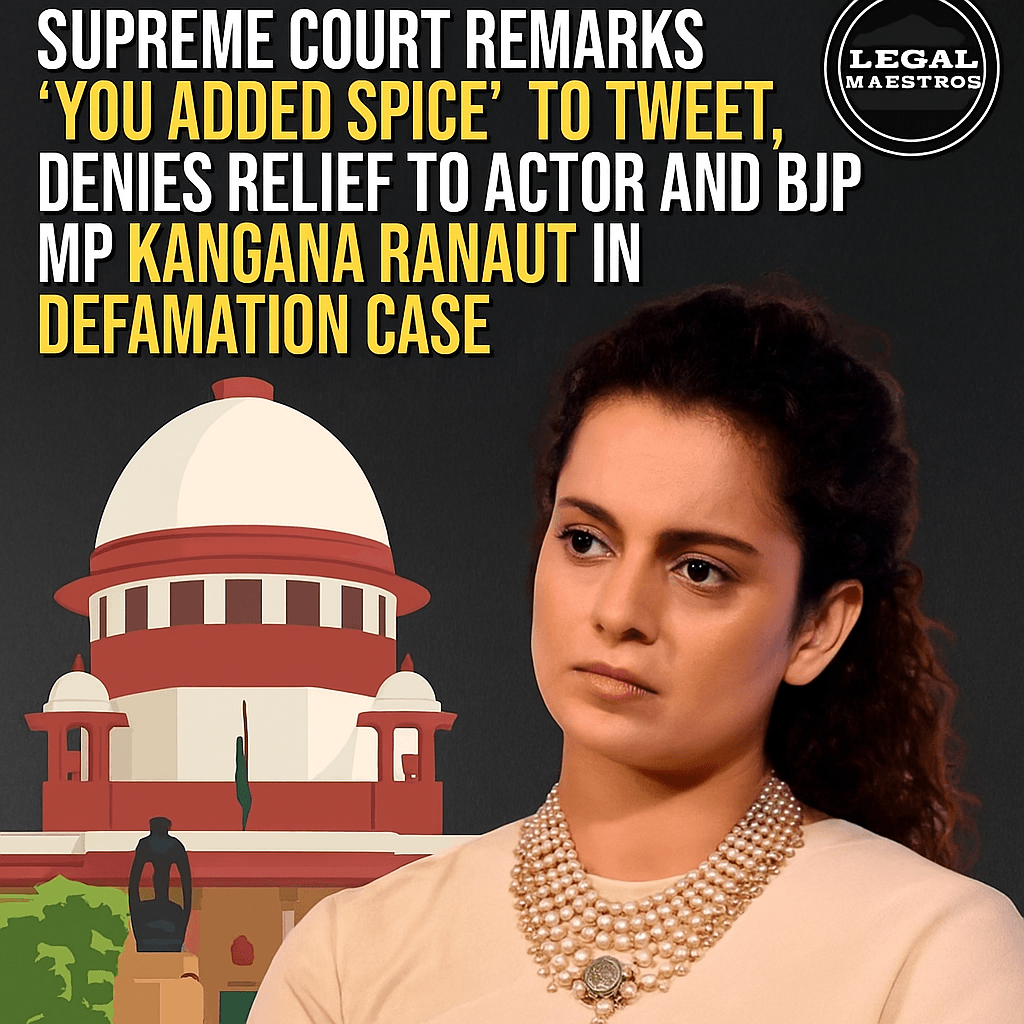
Supreme Court Remarks "You Added Spice" to Tweet, Denies Relief to Actor and BJP MP Kangana Ranaut in Defamation Case
Kangana Ranaut loses bid to have her case of defamation dismissed by Supreme Court.
The Supreme Court of India has rejected the plea of actor and BJP MP Kangana Ranaut in a criminal defamation case in a landmark verdict that highlights the responsibility of the social media user (a well-known personality, in this instance). The case is based on a tweet she shared in the 2020-21 protests organized by farmers where she supposedly used defamatory words about a female demonstrator. One of the bench of justices indicated that her post was not a mere retweet but added spice to the message and this was an important fact that made her counsel drop the plea. The reasoning behind this ruling is that the defamation lawsuit now continues to trial in a lower court in Bathinda, Punjab.
Mahinder Kaur, a 73-year-old woman who lives in a village located in Bathinda, was the first person to initiate a defamation complaint against Ranaut. Kaur claimed that the tweet by Ranaut wrongly accused her of being the Shaheen Bagh dadi, a woman that has become famous following the protests against the Citizenship Amendment Act. It was alleged in the complaint that the tweet was composed of false and defamatory statements that were meant to damage the reputation of Kaur. The complaint was lodged in a local court which upon examination of initial evidence was slated to issue a summons to Ranaut to appear.
Ranaut had earlier approached the Punjab and Haryana High Court to quell the criminal complaint and the summoning order claiming that the charges against her were unwarranted and that the proceedings were unsustainable in a judicial court. Nonetheless, the High Court denied her request and claimed that since she was a social media personality with a huge following, she had an additional duty to ensure that the information she said was truthful. According to the decision made by the High Court, the plaintiff had successfully proven a prima facie case of defamation and had not done it with the intention of suing.
For any queries or to publish an article or post or advertisement on our platform, do call at +91 6377460764 or email us at contact@legalmaestros.com.
The hearing by the Supreme Court became the final and the most recent part of this legal drama. In the case, the counsel of Ranaut attempted to plead that her tweet was just a retweet and that she would not be held responsible of the original content. But the court of law was not swayed by this reasoning. The comments which Ranaut had attached to her retweet particularly drew the attention of the judges, which, in their opinion, changed an act of sharing information into a personalized and potentially defamatory statement.
The term you added spice became one of the main elements of observation of the court, which indicated that the activity of a public actor on the content of social media is not an innocent act, even the retweeting. This comment indicates the increasing awareness of the judiciary about the peculiarities of social media and the specific issues it raises when it comes to the classical defamation regulations. The court proposed that Ranaut had any defensive, such as that she was making a clarification, which she needed to present in the lower court trial.

The fact that the Supreme Court did not want to interfere and ordered the case to continue at the trial court level is a clear indication. It highlights the factual issues and the motive in a particular post in the Internet should be addressed in a complete trial, where evidence could be given and cross-examined. The fact that the court refused to quash the complaint is a blowback to Ranaut and a triumph over the complainant, Mahinder Kaur, who has been struggling to restore her reputation.
The case has extended consequences to the way in which influential personalities and social media icons utilize the platforms they utilize. It is a good reminder that online comments, especially the ones that may damage the reputation of a person, could be come under the scrutiny of the law. The use of the added spice by the court sheds light on the fact that any commentary or personal contribution to a shared post might be enough to take legal action hence making people more responsible in regards to the content they are spreading to their huge follower counts. The ruling confirms that the freedom of speech is not absolute but it is accompanied with the obligation of not defaming others.
The case highlights the issues of application of traditional defamation laws (designed many years ago) in the rapidly moving and unregulated social media environment. The pace with which a tweet may turn viral and the damage it may inflict on the reputation of a person in real-time needs a solid legal framework. The current case might serve as the precedent in which the courts in India will deal in the same cases in the future, particularly those ones concerning the distinction between mere sharing and commenting on the content.
The case will now be reverted back to the Bathinda court where Ranaut will now be required to undergo the trial proceedings. Even the court order to request a personal appearance exemption in case of necessity takes into consideration her high-profile personality but squarely makes the law her responsibility. This protracted legal battle has turned into a spectacle in itself, with the words of the court building a serious amount of discourse on the duties of official individuals, and the liabilities which are attached to their online presence. The trial verdict will be closely monitored because it may influence the further discussion of the social media and legal responsibility in India.