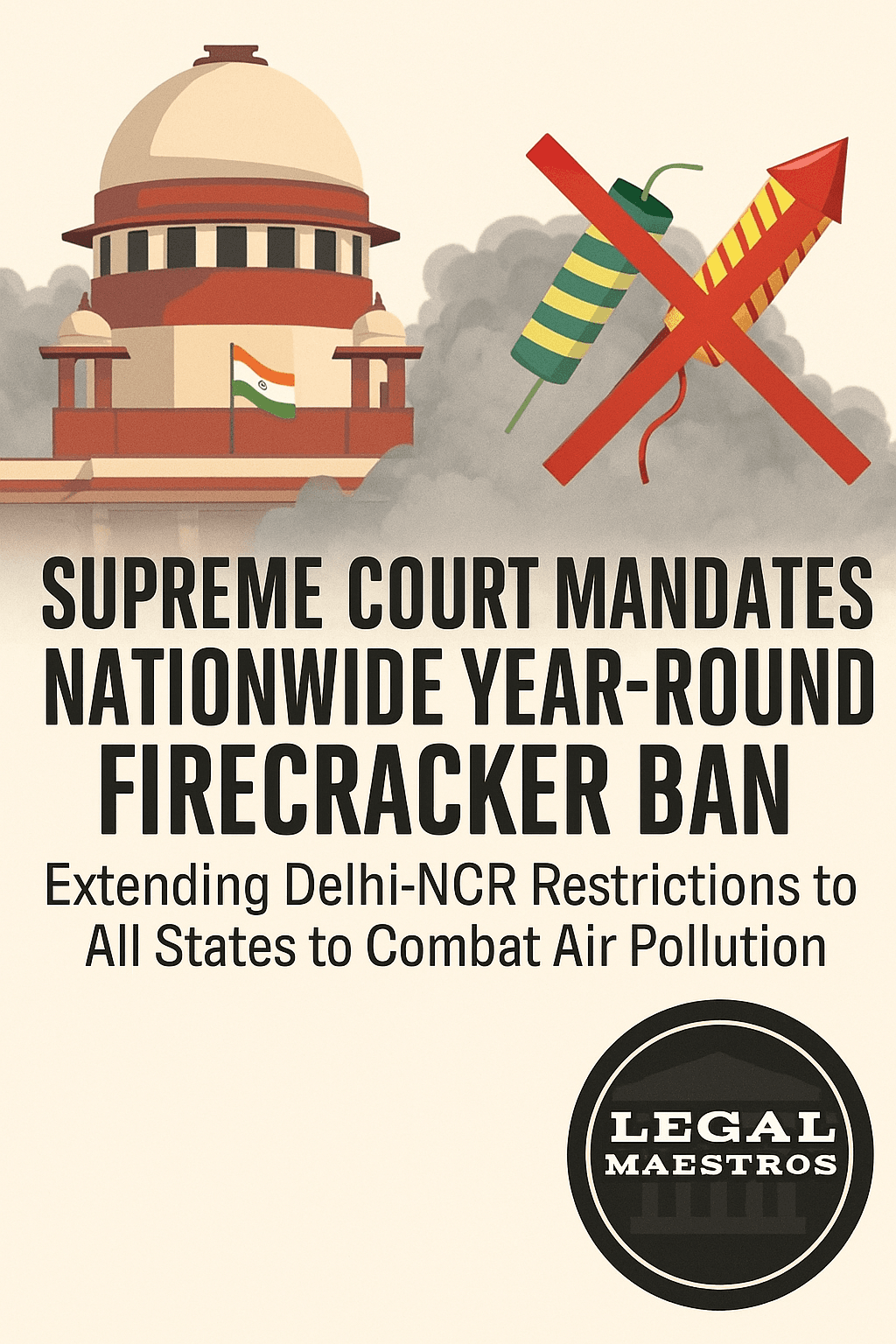
Supreme Court Mandates Nationwide Year-Round Firecracker Ban, Extending Delhi-NCR Restrictions to All States to Combat Air Pollution
The Supreme Court extends pick and ban the use of firecrakers in the country because of health and environmental reasons.
The Supreme Court of India has made a groundbreaking order and has expanded the ban on firecrackers that was only limited to the year round in the past years only to Delhi and the National Capital Region (NCR), to all states and union territories. This action is significant towards combating extreme air pollution in the country. The court ruling is a reply to the point according to which clean air is an inherent right of every citizen, not only the ones residing in the capital area. The decision of the highest court of law is an outcome of a protracted legal struggle and is pegged on massive evidence and findings on the health risks of fireworks.
The problem of air pollution in the city of Delhi-NCR has been bedeviling the Supreme Court over years and at times, it can be extremely dangerous, particularly in winter. One of the major sources of this pollution has been found to be the widespread use of firecrackers in festivals and celebrations. The court had already put a ban on their use in the capital which was to be converted into a ban on the sale, manufacture and use over 1 year. The same reasoning is now being extended to the whole country so that there is a nationalized strategy to the problem.
The justification of the factual prohibition throughout the country lies in the equality concept. The court observed that, it would be unjust to restrict the right to clean air to selected cities only. In a statement by his colleagues, the Chief Justice of India said that pollution is a problem of national importance and that there has to be a national solution to the problem. The court indicated that at times this situation has also been observed in other cities like Amritsar where the air quality is worse as compared to that of Delhi. This was a commentary on the desire to have a pan-India approach and not a patchwork style of approach.
For any queries or to publish an article or post or advertisement on our platform, do call at +91 6377460764 or email us at contact@legalmaestros.com.
The move has had mixed reactions by the people. The move has been greeted with cheers by environmentalists and health experts who deem it as a long overdue move towards safeguarding the health of the people. They claim that the ban would cause a notable reduction in the concentration of the amounts of the particulate matter and other harmful pollutants in the atmosphere. In its turn, it may decrease the number of respiratory diseases, heart related issues, and other health-related problems that are caused by the poor air quality. It is also regarded as a good step towards wildlife which is mostly disrupted by the high noise and smokes produced by the firecrackers.
But the ban too has been questioned especially by the people with the firecrackers business. The manufacturers and traders have expressed reservations over the effects on their lives saying that the move will leave millions of people unemployed. The reason is that they have stated that it is too stringent to ban it outright and that there should be a compromise such as promoting the use of green crackers. The court has been aware of these issues and it has requested that the concerned government agencies compile a report on the viability and quality of green crackers.

The order that the Supreme Court issued is not only a prohibition against firecrackers; but it is also an indicator of how the country takes the health of the people and the environment seriously. It leaves all the states with the responsibility of enforcing the ban to the letter and to identify means of assisting the communities whose means of livelihood rely on the industry. This ruling is an indication of the change in the legal and social dimension where the right to clean environment is being prioritized over the traditional practices that are harmful.
The court has also been very categorical against the argument that, firecrackers are a significant aspect of religious festivals. It has already affirmed that no religion encourages that people and environment should engage in activities that make them suffer. This is something that has been repeatedly brought up in court proceedings and it has assisted in creating the legal basis behind the ban. The court has always pointed out that traditions cannot be used as a reason to sacrifice health and safety of the population.
Pollution of air in India is a multifaceted problem that has many causes such as industrial emissions, vehicular pollution, construction dust and stubble burning. Although the contribution of firecrackers is seasonal, their contribution during festivals is tremendous leading to a sudden rise in the levels of pollution. The national ban is an effort to address this particular source and will be a gesture of a wider effort to comply with air quality. It is one of a bigger and ongoing endeavor to combat a national health crisis.
The ruling of the court also puts the government on its toes to formulate a national policy on air pollution. The directive emphasizes the importance of a concerted work of the central and state authorities to check the quality of air and implement rules related to the environment. It also requires investment into research and development of sustainable alternatives like green crackers and plans to assist firecracker workers to transfer to other types of work. The verdict is an appeal to the whole nation.
The next step will go beyond legal enforcement but will include the campaign of awareness among the population and cultural change. The ban needs to be supported by all the citizens to be effective. The verdict of the court is a great message that the overall good of the society should prevail over personal preferences or business interests that have a negative impact on the environment. The question now emerges on how the states will execute this extensive order and whether they are capable of striking a balance between the environmental protection and the economic issues.
This move by the Supreme Court is a landmark event in the Indian history of environment. It strengthens the role of judiciary as a defender of the basic rights such as the right to live a pollution free life. The decision is very persuasive and it could lead to more legal and policy action to correct other causes of pollution in the future. This is a clear sign that the struggle against pollution of air is a collective duty that goes beyond states and individual ideologies.