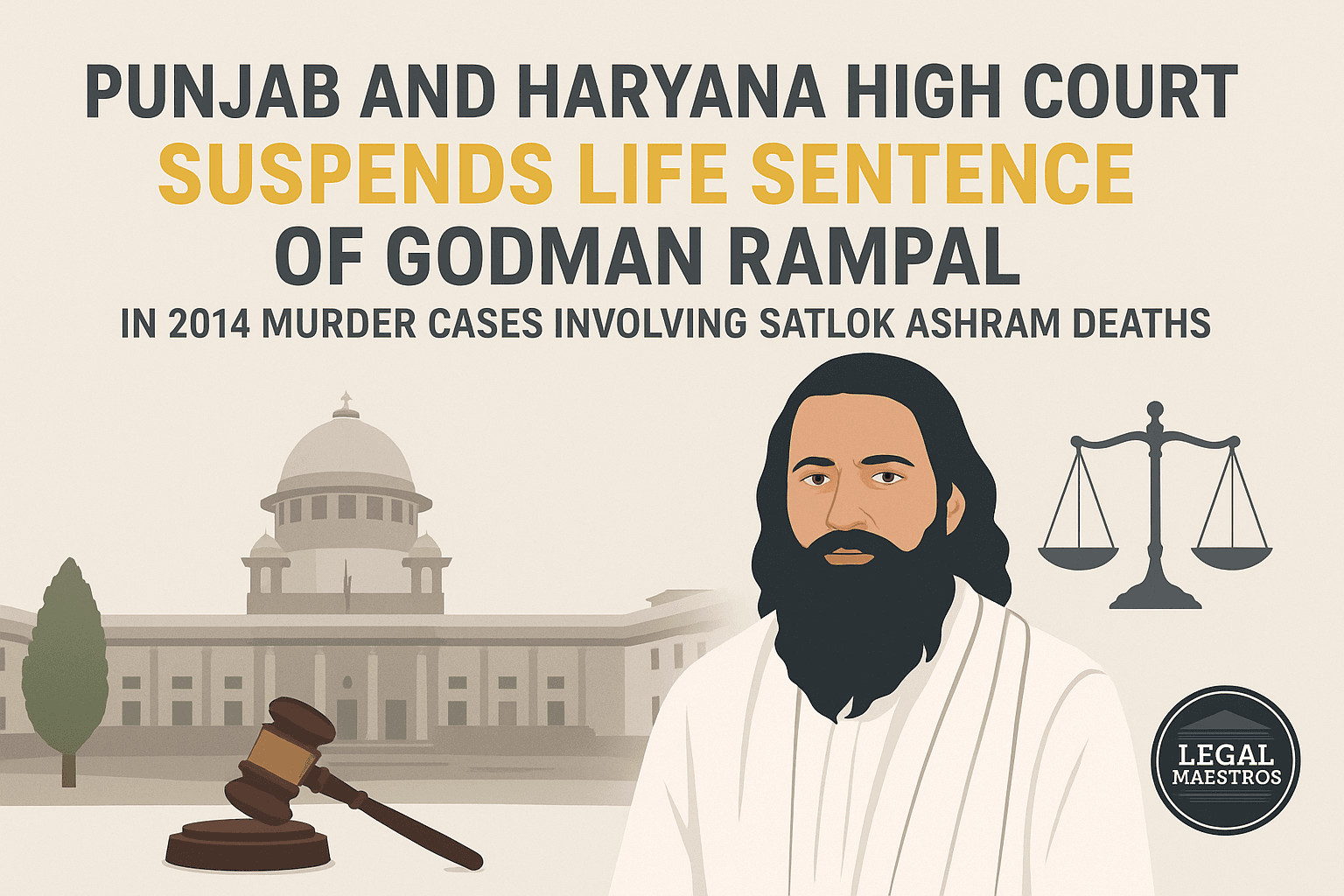
In a major move, which is now trembling the circle of lawyers and religionists, the Punjab and Haryana High Court has put the self-proclaimed godman Rampal on life imprisonment in the two murder cases concerning the 2014 Satlok Ashram murders.
Another case of surprising twist in the Rampal Case.
In a major move, which is now trembling the circle of lawyers and religionists, the Punjab and Haryana High Court has put the self-proclaimed godman Rampal on life imprisonment in the two murder cases concerning the 2014 Satlok Ashram murders. This ruling is a significant turning point in an extended and complicated legal fight that started with a theatrical police attack. This does not imply that Rampal has been cleared of the charges, but it is just that he is given the opportunity to get a bail and his appeal against the conviction will now be heard at the High Court.
The case has sparked the controversy of the legal procedure and how the justice system would treat such high profile cases. Suspending a life sentence after a case of many deaths and a tense confrontation with the police force, is not a very common phenomenon. It underlines the complexity of the Indian judicial system and the different channels that a convicted man can use to appeal against the decision of a lower court. A major area of concern in the progress of the case will be the legal basis of this suspension.
The 2014 Standoff and its Tragic Aftermath.
It started on November 19, 2014, when police surrounded Ashram of Satlok, Barwala in Haryana, to execute a non-bailable warrant against Rampal. The move by the police was triggered by failure by Rampal to appear in court multiple times in relation to a 2006 homicide case. This was followed by a two-week standoff that was tense with thousands of Rampal followers taking to the position of human shields so that the police would not be allowed to penetrate the premises. This escalated to a point where the followers reportedly fired bullets on the police and petrol bombs.
For any queries or to publish an article or post or advertisement on our platform, do call at +91 6377460764 or email us at contact@legalmaestros.com.
The situation was tragic and five women and one kid died in the ashram and this was the end of the standoff. They were also accused of being captured and being used as human shields by Rampal and his supporters. Rampal and more than 900 followers of his were later arrested by the police. The next part came in form of a direct complaint which was filed against Rampal along with his principal officers under different provisions of the Indian Penal Code such as murder, wrongful confinement, and sedition. The media publicized much of the occurrences that transpired during those days making the case a national issue.
Criminal Conviction and Appeal.
Rampal was found guilty of killing two people in an ashram in 2018 in a local court, after a trial that took several years, in two separate murder cases in regards to the ashram deaths. The court established a verdict of life imprisonment against him and his 13 followers. The evidence that led to this conviction was a mountain of evidence in the form of eyewitnesses, a forensic report and video footage of the standoff. The decision was regarded as a win to the rule of law and an unequivocal sign of the fact that no one, notwithstanding their stature, is above the law.

After being convicted, the legal team of Rampal appealed the case at the Punjab and Haryana High Court, whereby they were challenging the verdict of the lower court. The defense side claimed that the investigation was flawed and the prosecution evidence was not enough to convince beyond reasonable doubt that Rampal was guilty. The High Court ruling which stated that the sentence would be suspended shows that the court has found some strength in the defense arguments which means that there is the necessity to bring the judgment of the trial court to a thorough examination. It is a basic law procedure of the justice system where all the convictions are considered properly on a higher level.
The Suspension What It Means To The Future.
The suspension of the life sentence of Rampal is a procedural move that opens the opportunity of him coming out on the bail, although he will not be out of the judicial custody because of other charges. It is basically a suspension of his punishment as the High Court reviews the claims of his case afresh. The High Court did not reverse the conviction of the lower court, it has merely suspended the sentence pending a comprehensive hearing of the appeal. The final decision on the case will therefore rely on the final decision by the High Court based on the hearing conducted by both the prosecution and the defense.
The case also has an impact of extending to other cases against Rampal such as a sedition case and a wrongful confinement case which are pending to be heard. The victim legal team will most likely appeal to the Supreme Court ruling to suspend the sentence. The case is a reminder of how complicated and lengthy legal processes in India are particularly when high profile personalities are involved. The last episode of the Rampal saga is yet to be written, and the ruling of the High Court has made it certain that it would remain the focus of intense public and legal scrutiny.