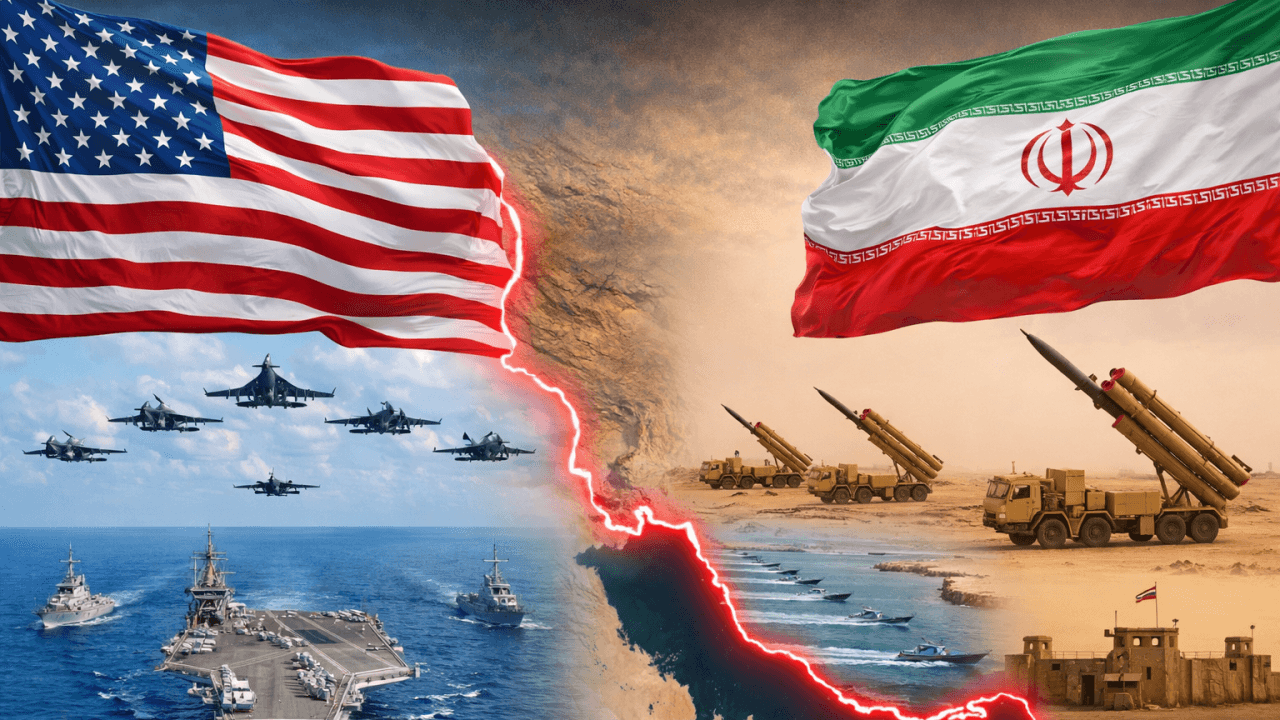
The recent MOU ( Memorandum of Understanding ) between USA and Iran, signed digitally by the Presidents of both countries, has important lessons for India.
USA is the most militarily and technologically advanced and powerful country in the world, whereas Iran is a relatively backward country. Yet the latter faced the unprovoked surprise attack on it by the former ( with its ally Israel ), beginning on 28th February, 2026, and fought it to a stalemate, resulting in the MOU.
Many people thought that the war would be over in a few days, with a quick Venezuela type victory for the Americans, and a regime change in Iran, and installation of a pro-US government there. After all, a stronger man is expected to easily overpower a weaker one in a contest, and impose his will.
But what actually happened was very different, and was something akin to what happened to the Americans in Vietnam. Though the Vietnamese could not defeat the Americans, neither could the latter defeat the former. In other words, it was a stalemate, as the American journalist Walter Cronkite described it in his famous telecast on 27.2.1968, and America was bogged in a quagmire
Seemingly and overtly, a stalemate is a drawn match. But where a powerful country is compelled to negotiate on equal terms, and enter into an agreement or MOU, with a weaker one, it is the latter’s victory, as in Korea, Vietnam, Algeria, and recently in Afghanistan.
So Iran, though by far militarily and economically weaker than America, has in reality won. How could such an unexpected, unforeseen and apparently miraculous phenomenon happen ?
When we examine the reasons, some important lessons for India emerge.
(1) The Iranian people were united. Though there were some dissidents against the Iranian regime earlier, after the war began with the unprovoked sneak attack by the Americans and Israelis on 28th February 2026, all Iranians united thereafter, particularly enraged by the killing of their Supreme Leader Ayatollah Ali Khameini, his relatives and senior officials, 168 schoolgirls, bombing of hospitals,etc.
The story of the Bundle of Sticks shows that a united people cannot be broken, like the Vietnamese, and now the Iranians.
https://www.thoughtco.com/aesops-fable-the-bundle-of-sticks-118589
We Indians are today divided on the basis of caste, religion, race, etc. We have huge problems of massive poverty and massive unemployment, appalling level of child malnutrition ( every second child in India is malnourished, according to Global Hunger Index ), skyrocketing prices of essential commodities, almost lack of proper healthcare and good education for our masses, etc.
We will never be able to solve these problems unless we unite, and launch a mighty united and protracted people’s struggle ( jan sangharsh ), rising above caste, religion and race, led by genuinely patriotic modern minded leaders, in which tremendous sacrifices will have to be made, culminating in a historical people’s revolution ( jan kranti ) which will set up a new political and social order under which there will be rapid industrialization of the country, and steady rise in the standard of living of the people.
(2) The Iranian people have shown that for a nation to defeat a more powerful enemy, its people must be prepared for great sacrifices, even sacrifice of their lives.
The Iranians are mostly Shia Muslims, who are taught since childhood of the tragedy of Karbala, and martyrdom of Imam Husain, who was willing to die rather than to bow his head and accept the suzerainty of the tyrant Yazid. So Iranian culture teaches that one must never surrender to tyranny, even if it costs one his life.
If Indians want to face their great socio-economic and political challenges, and overcome them, they too must imbibe the indomitable spirit of the brave Iranians, about whom I wrote this article :
https://indicanews.com/iran-facing-fearful-odds
(3) The third lesson for India is that we must use scientific and intelligent methods in our struggle, instead of just emotions, as the Iranians did. The Iranians built several cities deep underground ( like the Cu Chi tunnels in Vietnam ) from where they launched their missiles and drones ( since these could be destroyed by US and Israeli missiles if launched from the surface ), and they inflicted severe economic pain on their enemy by closing the Strait of Hormuz. They also allied themselves to the Chinese and Russians ( as the Vietnamese did ), to get military and technological help from these developed countries.
Although Iran is a much smaller country than India, with a population of only 93 million ( while India’s population is 1430 million ), we have to become humble disciples of the brave Iranians, and learn the 3 things abovementioned from them.
Attachments area