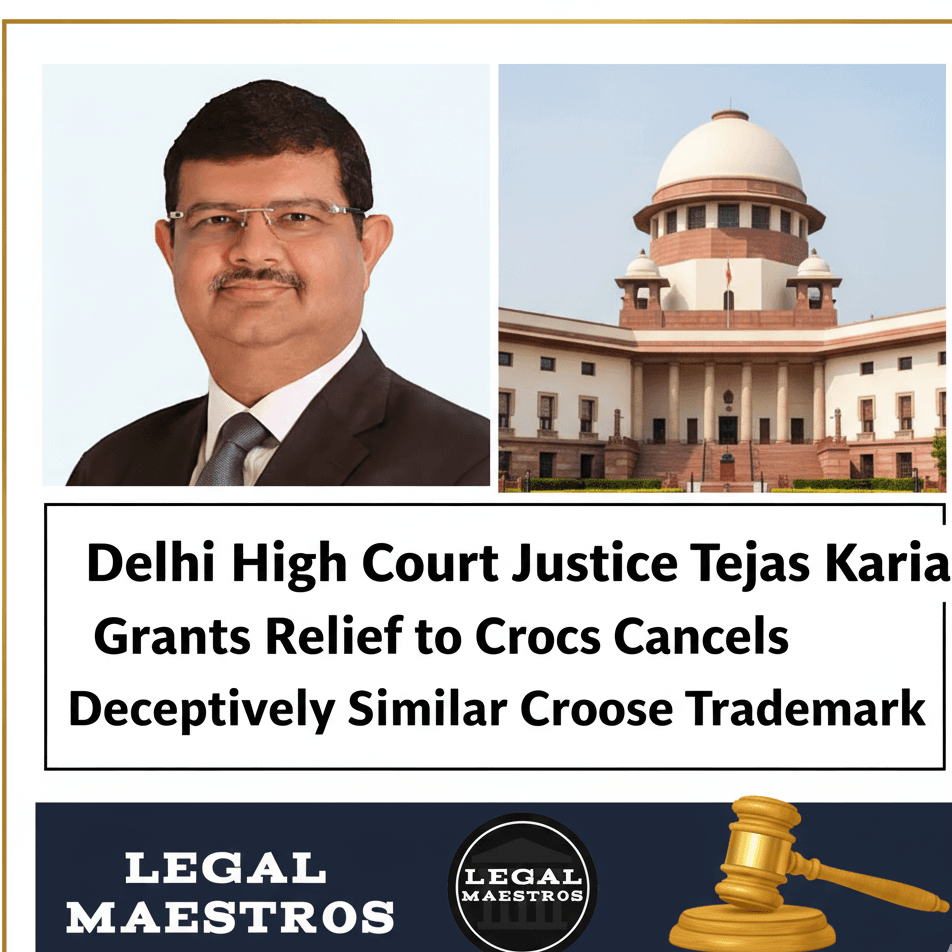
Delhi High Court Justice Tejas Karia Grants Relief to Crocs Cancels Deceptively Similar Croose Trademark
A Legal Victory for a Global Footwear Giant
The Delhi High Court has granted relief to the famous footwear company, Crocs Inc. in a landmark decision on the issue of intellectual property rights, wherein Justice Tejas Karia granted cancellation of a trademark named Croose on the basis that it was deceptively close to the famous brand Crocs. This ruling is a huge step forward in the fight against brand extinction in the Indian market by Crocs, which is also facing imitation of its brand.
Crocs had filed the legal suit against it when it realized a local company had registered the trademark Croose to be used on shoe and other footwear products. Crocs responded that the name was chosen on the purpose of appearing and sounding like its own, to defraud the customers. Such a similar name, the company argued, would unfairly cash in on the goodwill and reputation that Crocs has developed over several years all around the world.
The intervention of the court highlights the strict position of the judiciary in guarding against infringement of the established brands. The High Court has avoided the registration of the Croose brand under a name that would confuse greatly by canceling it. The decision acts as a good discouragement to other would-be wrongdoers who would now want to take a ride on the shoulder of famous trademarks.
For any queries or to publish an article or post or advertisement on our platform, do call at +91 6377460764 or email us at contact@legalmaestros.com.
This case introduces the issues of protection of intellectual property in various nations by international brands. In the case of Crocs, it is not only one name that is similar but the preservation of the uniqueness and integrity of a brand familiar to millions of customers all over the world. It strengthens the law protecting the operations of companies that put their investment into their brand identity.
The Core of the Conflict: Deceptive Similarity
The principle of deceptive similarity was the major concern in this legal conflict. This is a legal examination that shows whether a new trademark is too similar to an existing trademark, and thus may give the impression of confusion to an average consumer. The court does not consider the similarity of the names only, but the similarity of the names with regards to the sound, appearance or the thought to form a false association in the mind of the customer.

Crocs produced a very strong case that the trademark name, Croose, was phonetically virtually identical to Croaks. One would easily confuse the two with a customer who hears it being pronounced out loud. This phonetic similarity was one of the foundations of their case. They claimed that the minor discrepancy in spelling does not play a big role in the differentiation of the two names, particularly in a crowded market, where decisions to purchase are usually made in a short period of time.
Moreover, the fact that both trademarks were registered to operate in the identical category of goods footwear, enhanced the case further, the chance of confusion was multiplying exponentially under such circumstances. A consumer seeking comfortable clogs may buy a Croose product and think that it is the brand of the original Crocs brand or it is an affiliate of that brand.
The court reviews such cases according to the eyes of an average intelligent individual with an imperfect memory. This implies that it is not about whether someone who is scrupulous can tell the difference but a common shopper. Crocs was able to demonstrate that Croose did not pass this test, and that set the stage or consumer deception and unfair competition.
The Court’s Decisive Ruling
In his meticulously detailed judgment, Justice Tejas Karia went much in favor of Crocs. The logic of the ruling was based on the long-established principles of trademark law, which puts the prevention of confusion on the market and protection of the hard-earned reputation of a brand first. The judge ruled that the two marks, “Crocs” and “Croose” were both phonetically and visually similar to the extent which was not acceptable in a competitive market.
The court has pointed out how Crocs is a household name in India and anywhere in the world, and that position gives it a greater level of protection. Crocs products have a massive reputation created through the large scale use, marketing, and sale of their products, which the law should not be allowed to weaken. The judge observed that the fact that a rival had adopted a name of similar sound could not amount to a mere coincidence and it implied that it was aimed at capitalizing on the fame that Crocs enjoyed.
Justice Karia in his order emphasized that it would be against the interest of the people to enable the trademark of the Croose stay on the register. Not only would it hurt Crocs financially, but it would also defraud the consumers who may be purchasing a product of a possible different quality under the illussory notion that they are purchasing a product of a trusted brand.
The decision essentially removes the Croose trademark of the official register and thus the usage of the trademark on shoe manufacturing is unlawful. This clearly indicates that courts will never shy away to abolish trademarks that are evidently meant to copy an already registered trademark, and that will perpetuate the integrity of the entire trademark registration process.
Protecting a Brand’s Identity and Goodwill
The brand of a company is one of the most valuable assets. It is the total of the experiences and perceptions of a consumer in relation to a product, which is acquired over the years through its investment in quality, marketing, and customer service. The legal representation of this goodwill is a trademark.
The threat to dilute or harm this goodwill is that a competing brand applies a deceptively similar name. The customer who purchases a defective Croose will correlate his or her unpleasant experience with Crocs in a way that damages a decades-old reputation. That is why trademark law is so imperative, it has made sure that reputation of a company is not owned by another.
The cancellation of the “Croose” trademark by the Delhi High Court has just strengthened an essential principle of business: you cannot put up your business on the shoulders of the success of another person. The decision promotes healthy competition, where the brands should win on the merit and quality of their own brands, but not by causing confusion with the market leaders.