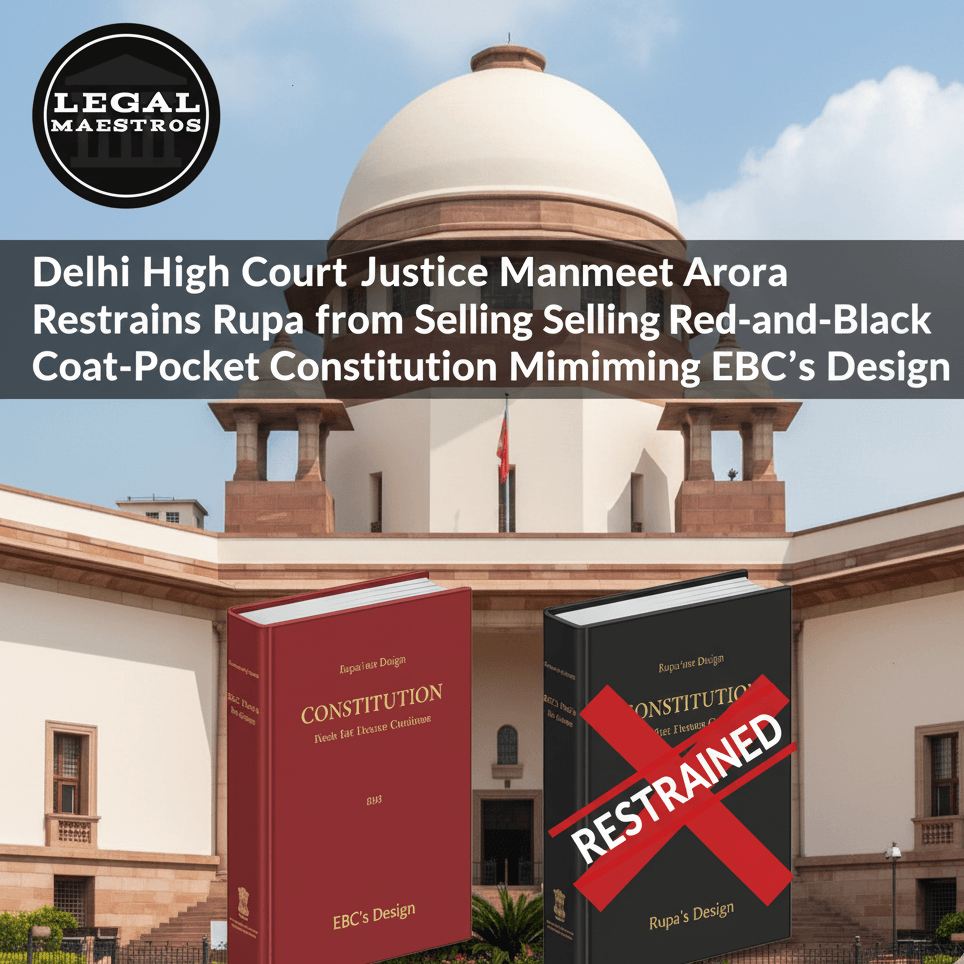
Delhi High Court Justice Manmeet Arora Restrains Rupa from Selling Red-and-Black Coat-Pocket Constitution Mimicking EBC’s Design
A Legal Battle Over a Pocket-Sized Book
The Delhi High Court has intervened in a special copyright battle and directed the Rupa Publications to cease selling its coat pocket edition of the Constitution of India. Justice Manmeet Pritam Singh Arora granted the interim injunction because she discovered that the version by Rupa appeared to be really a copy of a popular edition published by the Eastern Book Company (EBC), a major legal publishing house. This is not a case concerning the text of the Constitution, which is publicly accessible but the unique look of the book.
In the fray of the controversy lies the popular coat-pocket Constitution of EBC, with a special red-and-black cover and gold lettering. EBC claimed to have been publishing this edition over many years and that the design used is instantly recognizable among the legal fraternity and among the general population. They argued that a new version released by Rupa Publications recently replicates this design to such a high level that it may confuse customers easily.
The suit brought by EBC claims that Rupa committed a crime of passing off, the legal definition of a company attempting to pass off its products as the ones of a more established brand. EBC argued that through imitation in its signature design, Rupa was unjustly taking advantage of the goodwill and reputation that EBC has established over a decades-long period. This is the argument that the first order of the court indicates to be quite substantive.
For any queries or to publish an article or post or advertisement on our platform, do call at +91 6377460764 or email us at contact@legalmaestros.com.
This court battle sheds light on one of the most interesting elements of intellectual property law. It demonstrates that protection may go further than what is contained in a book, as far as what is illustrated in a book, and it is much more obvious when such an appearance is a trademark in consumers minds. The case is now subject to a complete hearing, although until then, Rupa version as a lookalike cannot be sold.
The Heart of the Dispute: A Distinctive Design
The main point that Eastern Book Company made was that the appearance and feel of their pocket Constitution are a brand identifier. This is what is called in legal terms as trade dress or get-up. The image and general look of a product is what makes it stand out of the other products in the market. In the case of EBC this is a particular blend of a black background, a panel in red, the design of the gold lettering and the location of the Ashoka Lion emblem.

To demonstrate that this design is not a chance combination of colors, EBC has presented evidence of a branding exercise that has been sustained over the years. According to them, lawyers, law students, judges, and even politicians have become concerned that this specific aesthetic has become equated with the quality and accuracy of an EBC publication. When one looks at that red-and-black cover, s/he does not merely look at the Constitution, but at the EBC edition of the Constitution.
This association, EBC alleged, is a valuable asset, which has been established through constant use and marketing. This was a well earned reputation that Rupa was attempting to leech off of, by producing an almost identical cover. EBC reported that an unsuspecting customer, perhaps in a hurry, might just grab the Rupa edition in a bookstore, thinking that they were buying the reliable EBC version and this would result in a loss of money as well as the reputation of EBC, in case the other product is of low quality.
The publisher stressed that one is also free to print and sell the Constitution of India, but not to pack it in a package that deliberately resembles the well-known design of a competitor. The case is basically over the safeguarding of the distinctiveness of their product look and forestalling confusion in the market which is a pillar in the fair competition.
The Court’s Decisive Order
Justice Manmeet Pritam Singh Arora supported the submissions of EBC in his first order. The court determined that there was a prima facie case, or in other words, on the face of it. This is because at this initial stage, EBC claims seemed robust enough to be acted upon. As noted by the judge, the visual similarity between the two books was too obvious and important.
At the heart of the reasoning of the court was that there was a high chance of confusion by the masses. Justice Arora observed that the two covers were so similar that neither of the two could be confused by an ordinary consumer. The most significant test in action of passing off is this possibility of confusion. The task of the court is to safeguard the consumer against fraud and to safeguard business against unfair exploitation of goodwill by its competitors.
The judge made what is referred to as interim injunction. It is not a judgement on the case but a temporary injunction to keep the situation where it is and not to cause further damage to EBC until the court reviews the case in greater detail. Until the entire case is heard in court and a final ruling made, Rupa Publications is now prohibited to publish, sell or even advertise its pocket Constitution with the disputed red-and-black cover. 🧑⚖️
This is a quick and decisive move by the Delhi High Court to highlight the importance of the judiciary in protecting the intellectual property. The order sends a very strong message that trade dress and unusual packaging are subject to legal protection, despite the fact that the main text of a book can be accessed by anyone.
Rupa’s Defense and the Broader Implications
Rupa Publications has been kept quiet in the meantime, but they did have their say in defense. Their primary argument must have been that the elements employed on the cover such as colors such as red and black, and the Ashoka emblem, were generic and common. They would have contended that there is no individual party which could claim a monopoly of the color combination, particularly in a book so important to the nation as the Constitution.
Rupa could have also mentioned in their edition differences like the name of the publisher being prominent to say that they were not attempting to fool anyone. But the court first considered that these small variations were not substantial enough that they could prevail over the largely similar overall effect produced by the two covers. The decision gives priority to the overall appearance rather than a list of individual components.