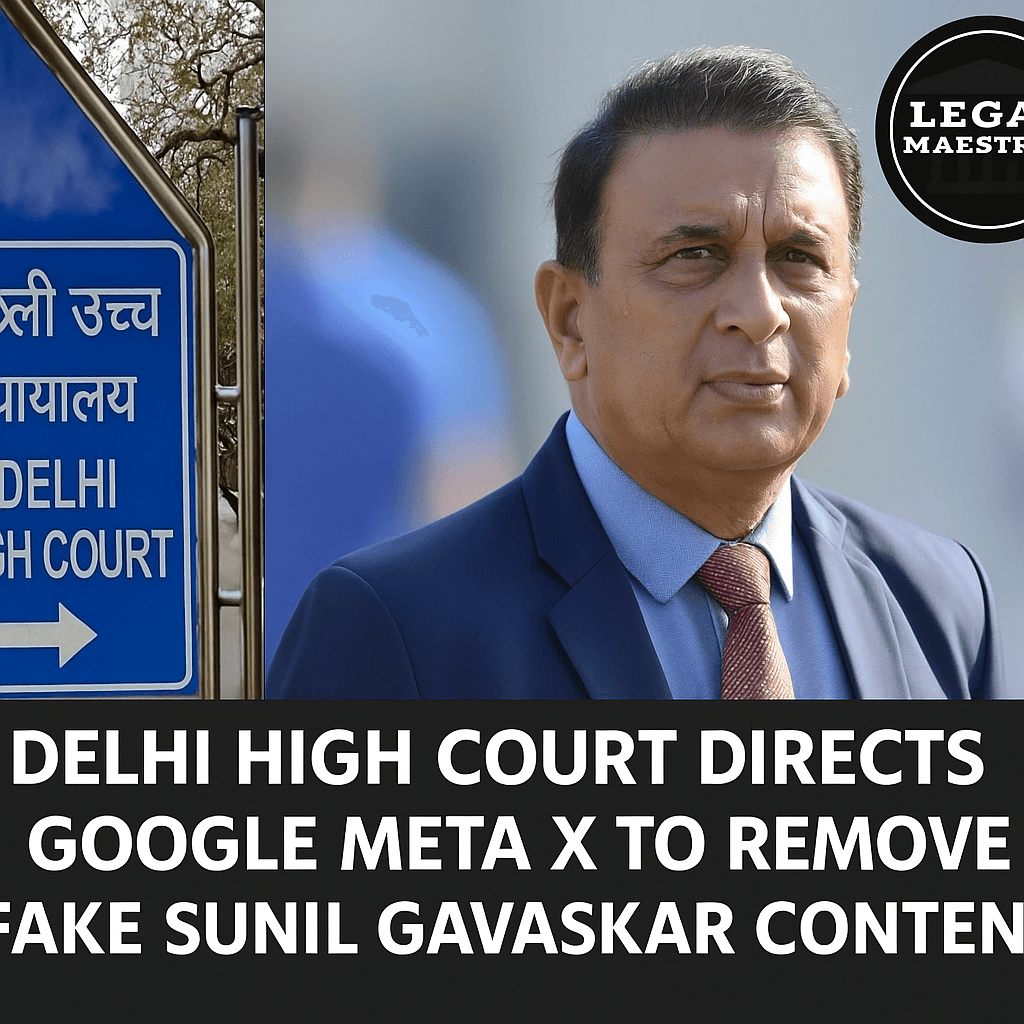
Delhi High Court Directs Google Meta X to Remove Fake Sunil Gavaskar Content
Superstar Cricketman Saved by High Court.
The High Court of Delhi has made a big step to save the image of a great cricketing legend Sunil Gavaskar. Friday, the court gave an order to giant technology companies such as Google, Meta, and X. The order compels such sites to take down counterfeit materials that use the name and image of the cricketer unlawfully. This is in response to a lawsuit initiated by Gavaskar who is seeking protection against the misuse of his persona. The court has already realized the severity of the matter and demanded the digital platforms to comply with it immediately.
The case was presided over by Justice Manmeet Pritam Singh Arora, who set up certain deadlines to be followed. The court ordered Sunil Gavaskar to locate and submit the objectionable material in the form of the links or web addresses. He has got a time of 48 hours under which he is required to provide these details to the social media intermediaries. After these links have been given to the platforms, they are required to handle the lawsuit as a formal complaint. They are then required to act accordingly by having to remove or disable the access to the content within a week.
The ruling of the court brings out the increased worry concerning the abuse of the celebrity identities during the age of the Internet era. The judiciary requests the platforms to move expeditiously, and it can be viewed as an effective message concerning the accountability of tech firms. The order streamlines and makes the content removal a smooth process. It does not entail protracted court cases over each and every fake content. Rather it builds up a system in which the platforms have to address certain complaints in a timely manner.
For any queries or to publish an article or post or advertisement on our platform, do call at +91 6377460764 or email us at contact@legalmaestros.com.
The Character of the Fake Content and Frauds.
The legal team of Sunil Gavaskar had provided some disgusting examples of the exploitation of his identity. They mentioned that he was being sold without his consent in his photos and voice. This also involved counterfeited products which purported to be signed by the cricketing legend. The fans were being cheated to purchase them, thinking that they were authentic memorabilia. The case claimed that it did not only result in a monetary loss to the masses but also destroyed the brand value of Gavaskar.
The misinformation was also mentioned in the complaint on top of commercial exploitation. It was also being done with some instances of fake quotes and critical remarks involving Gavaskar. Such fake advertising was aimed at other cricketing stars such as Indian coach Gautam Gambhir and Virat Kohli. Such counterfeit information may cause unwarranted controversy and division in the cricketing fraternity. It deceives the masses and damages the working relationships of the legend.
Another significant issue with the plea was the application of Artificial Intelligence to produce deepfakes. The petition has pointed out that AI-created videos were being used to make Gavaskar appear to be promoting questionable financial deals. Such deepfakes are getting progressively advanced, and it is difficult to tell the truth and the fiction to the common user. The intervention of the court is regarded as the only defense against this technological threat.
Comprehending Personality Rights in India.
The legal principle of this case is the so-called personality rights or publicity rights. The right permits individuals in the public to regulate the commercial use of their name, image, voice and likeness. In India, this has not been specifically addressed in a statute, but the right to privacy and property has been supported by courts. Celebrities have spent their lifetime to establish their name, and the law safeguards them against other people who take advantage of their popularity.
The Delhi High Court is not the first court to make such ruling. There have been other Bollywood actors and social personalities who have sought the same protection in the recent years. The stars such as Amitabh Bachchan, Anil Kapoor and Jackie Shroff have earlier been granted court injunctions against misuse of their image. These have provided precedent as to the fact that the identity of a person possesses economic worth. Third parties cannot take advantage of it without permission and due compensation.
The case of Sunil Gavaskar supports this legal trend and firmly transfers it to the world of sport. It explains that the right to defend personality does not only apply to film stars, and is applicable to all prominent personalities. The legal framework is also enhanced by the fact that the court turned to the Information Technology Rules of 2021. It links the theory of individual rights and the legally required responsibilities of digital intermediaries. This will establish a stronger mechanism of addressing online identity theft and impersonation.
Social Media Intermediaries Responsibilities.
The social media mediators, such as Google, Meta, and X have a huge burden of responsibility in relation to the order of the court. These platforms are not mere content hosts as per the Information Technology Rules. It is their responsibility to make sure that their platforms are not utilized in infringing the rights of people. The user is legally obliged to report when content does infringe on their rights, and the platform must then investigate and take action in this case. The court has made these companies remember about their grievance redressal systems.
Justice Arora pointed out that the initial step of any party aggrieved should be to directly go to the platform. The court pointed out that the IT Rules established a framework on how to deal with such complaints. The court is imposing these existing rules by ascertaining the platforms to make decisions on the complaints raised by Gavaskar within a period of one week. It is an indicator that the internal activities of these technological powerhouses have to be effective and receptive. They are not able to overlook any valid grievance of users, more of so when it touches on the possibility of fraud.
The case also deals with the problem of John Doe defendants, commonly known in Indian legal system as Ashok Kumars. They are unknown persons, who post counterfeit materials, anonymously. It is hard to trace the individual uploaders that exist anonymously, so it falls on the providers of the content to take responsibility. The court in targeting the intermediaries is making sure that the content is removed at the base. This is probably the most viable method of preventing the viral misinformation.