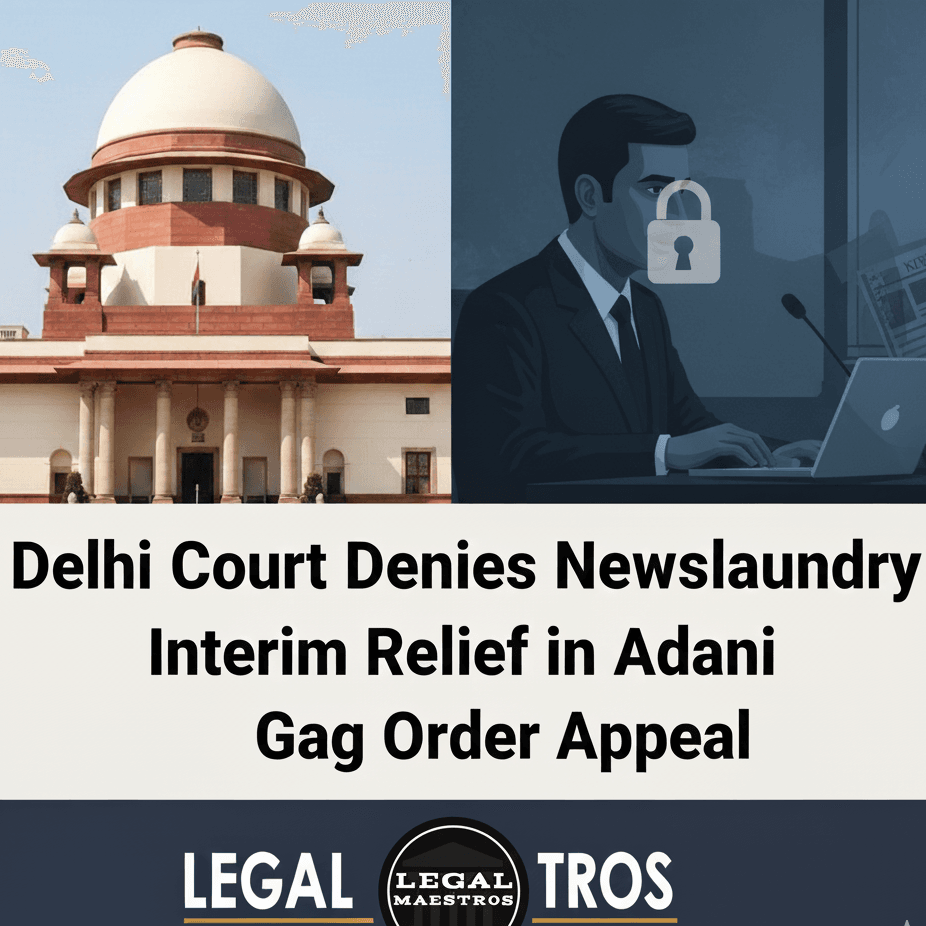
Delhi Court Denies Newslaundry Interim Relief in Adani Gag Order Appeal
A Setback for Press Freedom
In a major twist in the already existing legal battle between the Adani Group and the independent news website Newslaundry, the Delhi court has refused to grant the media house interim relief. Such a ruling indicates that a previously established gag order that does not allow Newslaundry to release some content about the conglomerate will not be lifted immediately. The decision is being considered a significant set back to the news organization in its struggle of press freedom.
Newslaundry had challenged a prior decision of a lower court that had allowed Adani Group to have the injunction. In a bid to achieve this appeal, the news portal was demanding an urgent suspension of the gag order as the main case could be heard. Nonetheless, this request was denied by the court, where they said that the injunction would remain in force until a conclusive decision on the appeal is made.
The case has gained a lot of attention since it is a clash between one of the biggest and most influential corporate houses in India and a small, reader-financed news publication with a reputation of critical reporting. The case is a core of one of the key debates: the freedom of the law to defend the reputation of the corporation or the freedom of the media to report and be able to check the power of the media.
For any queries or to publish an article or post or advertisement on our platform, do call at +91 6377460764 or email us at contact@legalmaestros.com.
The refusal of the interim relief extends the limitations of the Newslaundry in reporting about the Adani Group. In the case of a media house, which aims at thorough analysis and media criticism, this restriction to cover a particular and large object poses a serious professional and ethical dilemma. This new order is an important, although not positive, milestone in the legal struggle of the news portal but it is not the end.
The Origins of the Legal Battle
Newslaundry had started releasing a set of articles and videos criticizing the Adani Group and its chairman, Gautam Adani, subsequently initiating the legal conflict. The publication was allegedly a critique of the business practices and the debt of the conglomerate as well as the coverage given to the conglomerate by the media. After the Adani Group published these, they filed a defamation lawsuit, which requested damages and an immediate end to the spread of the articles.

The Adani Group alleged in its litigation that the reporting by Newslaundry, was ill-motivated, untrue and had inflicted untarnishable damage to the reputation of the group. The conglomerate claimed the articles did not constitute good-faith journalism but were an intentional effort to cast it in a bad light. On the basis of these arguments, the company managed to obtain a gag order or initial injunction at a trial court.
This first court injunction was broad. It instructed Newslaundry to remove the mentioned articles and videos in its website and social media platforms. In addition, it inhibited the news organization to release any such similar defamatory information against Adani Group in the future. To the media advocates, this form of pre-publication censorship is an extreme danger to free speech.
Newslaundry has persistently justified its journalism, saying that it is factual, accessible to the public and falls under the common good. The group contends that it is the key responsibility of the press to report and criticize strong business enterprises in a free democracy. It was based on this that they have chosen to appeal the gag order of the trial court to a higher court.
The Fight for Interim Relief
When appealing the gag order, the main legal approach of Newslaundry was to request interim relief. Their lawyers claimed that the injunction was pre-censorship and violated of the First Amendment to the Constitution. They argued that permitting the order to be in place, even on an interim basis, would not permit them to do lawful reporting on a topic of such great public significance.
Their argument was based on the freedom of the press, which was guaranteed in the Constitution. They declared that any limitation on this right had to be reasonable, and can not be applied to censor criticism. Newslaundry believed the gag order was an overreaction and that the allegations made by the Adani Group to be defamed deserved to be considered in a full trial, rather than a preliminary injunction which prevented reporting at all.
The interim relief application was about a desperate appeal to the court to stay the gag order pending the issues of the appeal before the court. The legal staff of the news portal must have pointed out that with each passing day the injunction is on, it is inflicting irreparable damage not only to Newslaundry, but to the right of the people to know also. They placed the gag order as an instrument of intimidating and silencing dissenting voices.
This is a legal gimmick in such instances because appeals may be a lengthy process to settle. In requesting interim relief the appellant attempts to lessen the damage that the order of the lower court would cause immediately. This is especially vital in the case of a news organization, because news is often timely to determine the relevance and influence of news.
The Court’s Rationale and What It Means
The court was forced to carry out a very fine balancing exercise in its ruling to reject interim relief. It balanced the right to freedom of speech of Newslaundry against the right of Adani Group to guard against the possibility of reputation damage through the process of the legal action. The refusal to allow the relief by the court implies that at this initial phase it considered the obligation of safeguarding the reputation of the conglomerate more persuasive.
The reasoning of the judge probably revolved around the fact that in case the articles were discovered to be defamatory in the future, the reputation destruction of the Adani Group would be permanent. Thus, the more sensible course of action was to preserve the status quo, i.e. the gag order, until the appeal had been heard in full. This does not imply that the articles have been determined defamatory by the court but rather that the court has determined that it will not raise the temporary restrictions as yet.
In the case of Newslaundry this implies a more tedious and prolonged legal struggle. The disputed articles need to be kept down, and they are yet not allowed to post similar materials on the Adani Group. They now turn completely to the main appeal, and here they will have to make a detailed argument that will persuade the court that this gag order should be overturned indefinitely.